










Digiphoto Entertainment Imaging cuts Q2 EBIT loss sharply
Key highlights
- DEI narrowed its Q2 FY27 EBIT loss to Rs 1.2 crore from Rs 15 crore in Q1 FY27.
- Q2 FY27 revenue rose to Rs 147 crore from Rs 130 crore in Q1 FY27 but remained 22% below Rs 195 crore a year earlier.
- WeC post-visit sales covered 45% of DEI sites and generated more than 1,200 Q2 FY27 transactions.
- Management said no more than 8% to 10% of DEI's roughly 230 sites may be EBITDA-negative.
powered by IRIS
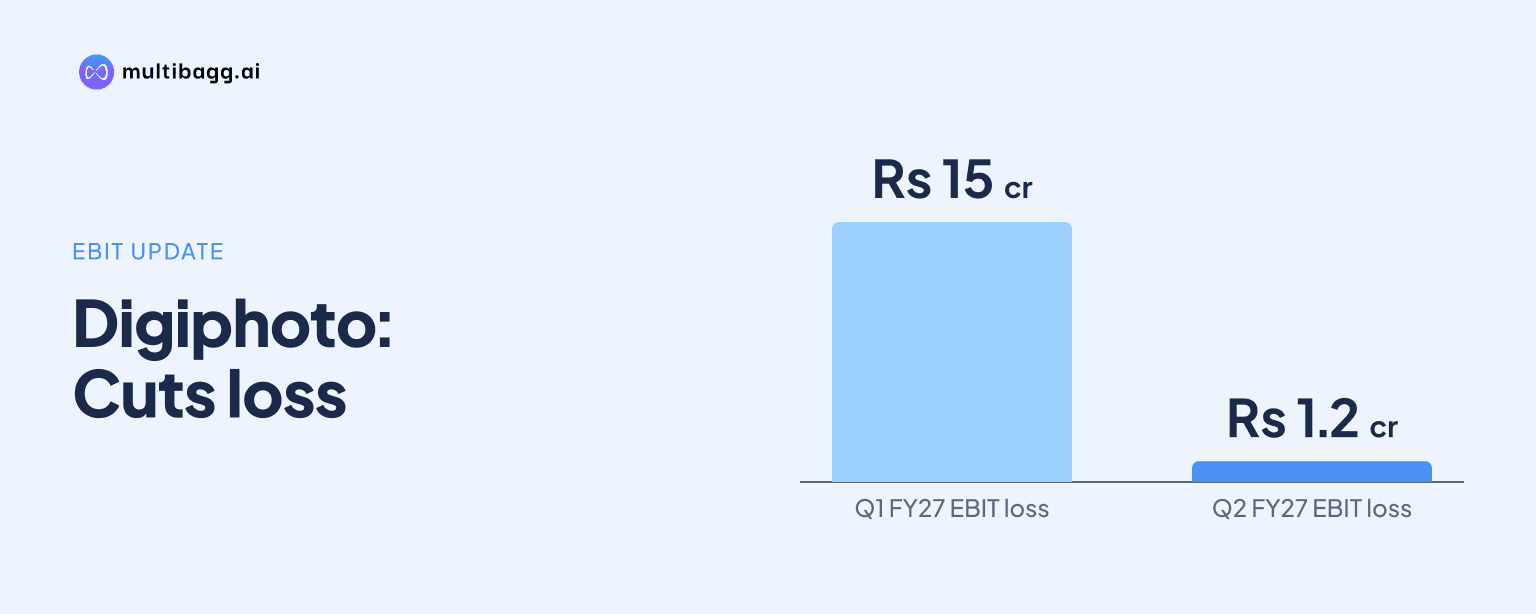
Digiphoto Entertainment Imaging cut its EBIT loss to Rs 1.2 crore in Q2 FY27 from Rs 15 crore in Q1 FY27, despite revenue remaining 22% below the prior-year quarter at Rs 147 crore. DEI attributed the sequential improvement to Middle East workforce reductions, site rationalisation, contract renegotiations and consolidation of its IT systems around WeC.
Know Thomas Cook (India) inside out
Results, valuation, peers and who's buying, in one view.
How did DEI's Q2 FY27 revenue and EBIT change?
DEI raised Q2 FY27 revenue to Rs 147 crore from Rs 130 crore in Q1 FY27, while its EBIT loss narrowed by Rs 13.8 crore to Rs 1.2 crore. Management described the quarter as a recovery period, but revenue was still Rs 48 crore below the Rs 195 crore reported in Q2 FY26, indicating that the earnings improvement came before a full top-line recovery.
The comparison shows that revenue improved sequentially but remained below the previous year's level, while EBIT moved much closer to break-even than in Q1 FY27. DEI had reported an EBIT profit of Rs 2.3 crore in Q2 FY26, so Q2 FY27 did not restore the profitability achieved a year earlier.
Management said it redirected attention towards Far East markets and sought to maximise revenue at existing sites through events and new content. In the United Arab Emirates, revenue had recovered to about 40% to 50% of the prior-year level despite geopolitical conditions, providing some higher site productivity but also showing the remaining revenue gap.
Why did DEI narrow its Q2 FY27 EBIT loss?
DEI narrowed its Q2 FY27 EBIT loss mainly through workforce optimisation, including direct staff reductions in the Middle East and a flatter operating structure in other markets. Management said the full-quarter benefit of these changes, along with technology-led streamlining of support functions, contributed to the move from a Rs 15 crore Q1 FY27 EBIT loss to a Rs 1.2 crore loss.
The company also renegotiated revenue-share terms with partners and reviewed material and service contracts more aggressively. With Q2 FY27 revenue at Rs 147 crore rather than the Rs 195 crore recorded in Q2 FY26, management identified lower staffing costs and improved partner and procurement economics as the mechanisms supporting margins during the recovery.
DEI also made WeC its primary IT system and removed overlapping technology costs during Q2 FY27. Management said the workforce, contract and IT actions were sustainable, but it did not quantify the savings from staff reductions, revenue-share changes, service contracts or IT consolidation separately.
How is WeC changing DEI's sales conversion?
DEI activated WeC post-visit sales at 45% of its sites in Q2 FY27, covering about 35% of portfolio revenue. The tool generated more than 1,200 transactions during the quarter, and management said conversion at certain sites was about 2% to 5% higher than in their previous years of operation.
Post-visit sales seek purchases after a customer leaves a site rather than relying only on purchases during the visit. Management said WeC could support higher conversion, revenue and margins as business volumes recover, while noting that the portfolio was not yet operating at full levels.
DEI is also testing a WhatsApp customer journey intended to raise conversion before a visit. The company did not disclose a conversion rate, revenue contribution or rollout timetable for that test, but its use alongside WeC adds a digital sales mechanism to the cost actions that narrowed the Q2 FY27 EBIT loss.
Got a follow-up? Ask IRIS
How many DEI sites may be EBITDA-negative?
DEI said no more than 8% to 10% of its roughly 230 sites may be hovering around EBITDA-negative status. EBITDA, or earnings before interest, tax, depreciation and amortisation, is not measured by management on a day-to-day basis for every site, so it did not provide an exact current count.
An analyst said DEI had closed around 30 to 32 non-profitable sites during Q2 FY27 and asked about further closures. Management did not confirm that number, describing the removal of EBITDA-negative sites as a cyclical process and saying it may retain a loss-making site if it is linked to another site with better economics.
Management said its intent is to keep every site gross-margin positive, even where a location does not cover its share of overall costs. That distinction means a site can generate a positive gross margin but remain EBITDA-negative after operating or central cost allocations, which is why DEI gave no fixed closure target for FY27.
What could drive DEI's next-quarter recovery?
DEI expects a steadier Middle East recovery if there is no further trading disruption, and management identified Q3 FY27 as its largest quarter of the year. The United Arab Emirates was at about 40% to 50% of prior-year revenue in Q2 FY27, leaving a material recovery opportunity but making the outlook dependent on trading conditions.
During Q2 FY27, DEI signed five new partnerships across Malaysia, Maldives, Singapore and India, renewed more than 20 key partnerships, and launched three partnerships in Indonesia, China and Maldives. These additions support management's plan to increase revenue at existing and new sites while the Middle East market recovers.
DEI also signed the Warner Bros. Harry Potter exhibit in Shanghai, which management expects to contribute sizably to revenue recovery in coming quarters. Management further anticipated partnerships with Hong Kong Disney and Petronas Malaysia to begin soon, although their contribution depends on commencement and on the absence of unforeseen trading disruptions.
Conclusion
DEI's Q2 FY27 performance shows substantial sequential EBIT repair, with the loss falling from Rs 15 crore in Q1 FY27 to Rs 1.2 crore. The improvement was achieved while revenue reached Rs 147 crore, still Rs 48 crore below Q2 FY26, making workforce changes, site discipline, contract terms, IT consolidation and digital selling the disclosed drivers rather than a full demand rebound.
The next result to watch is Q3 FY27, which management called DEI's largest quarter of the year. Progress will depend on Middle East revenue recovering from the United Arab Emirates' 40% to 50% of prior-year revenue, the Shanghai exhibit beginning to contribute, planned partnerships commencing, and WeC building beyond its Q2 FY27 coverage of 45% of sites and 35% of portfolio revenue.