










Thomas Cook keeps liquidity while weighing adjacent deals
Key highlights
- Thomas Cook reported around Rs 2,800 crore in cash and short-term investments, including prepaid-forex-card float.
- Management described net debt of about Rs 316 crore and did not disclose a free-cash figure.
- Financial services grew 21%, with education up 33%, retail up 12% and corporate up 10%.
- Sterling held Rs 380 crore of cash, and its demerger was targeted for NCLT approval by the end of March or early April.
powered by IRIS
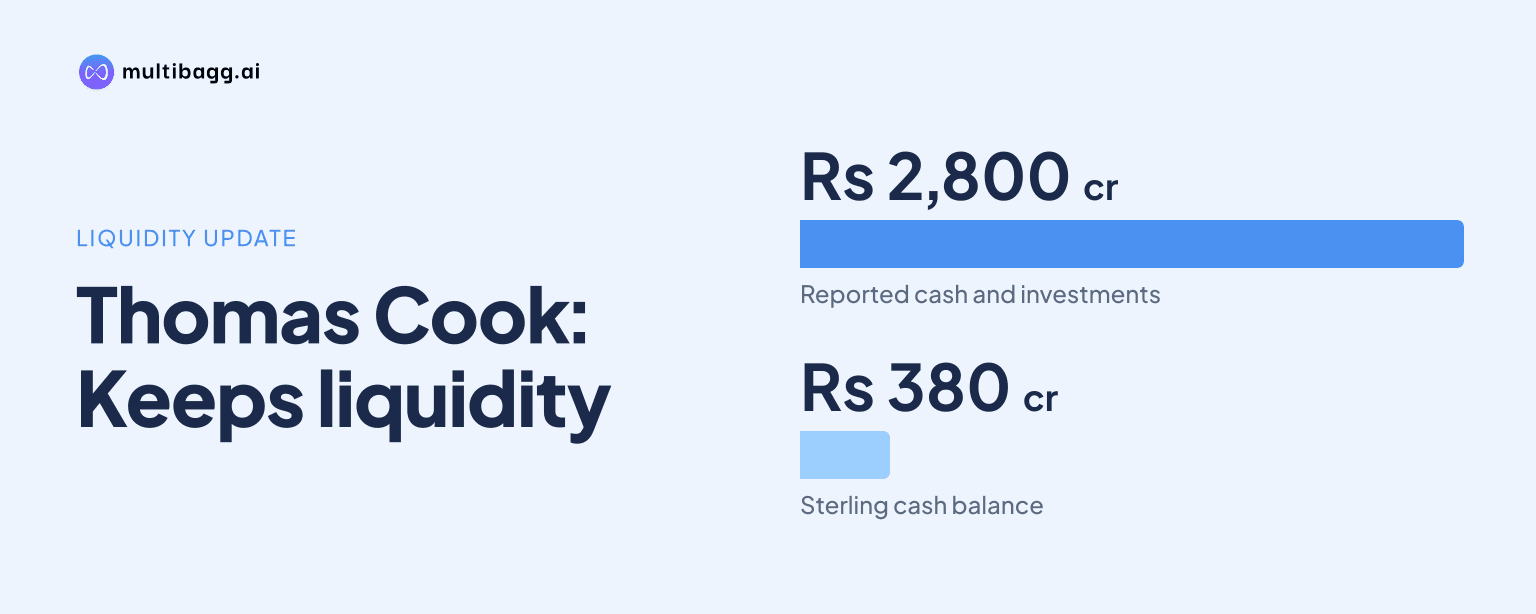
Thomas Cook (India) Limited said cash and short-term investments of around Rs 2,800 crore will support automation, business growth and suitably priced adjacent acquisitions, but part of the balance is prepaid-forex-card float and management intends to retain liquidity for disruptions. It may consider returning cash if suitable deals do not emerge over the next couple of years.
Know Thomas Cook (India) inside out
Results, valuation, peers and who's buying, in one view.
How much of Thomas Cook’s Rs 2,800 crore cash is free for deployment?
Thomas Cook said not all of its around Rs 2,800 crore in cash and short-term investments is freely available because a substantial, undisclosed portion represents float on prepaid forex cards. Management said the balance should be assessed on a net basis rather than treated as a single pool for acquisitions, technology spending or shareholder distributions.
Management described net debt of about Rs 316 crore “on a gross basis” during the discussion of available cash. It did not quantify the forex-card float, free cash after obligations or a minimum liquidity balance. As a result, the call does not establish a precise amount that Thomas Cook can deploy without affecting operating requirements.
The forex-card balance is connected to Thomas Cook’s financial services operations, which generated a blended forex gross margin of 1.6% to 1.8%, according to management. The associated float includes foreign-currency and rupee deposits, with a blended average return of about 7.5% to 8%, making it operationally different from cash described as completely free.
What will Thomas Cook spend its available cash on?
Thomas Cook said its immediate capital uses include growth investment, automation, artificial intelligence and modernization of back-end SAP applications. Management said it has already spent a meaningful amount on AI, but stressed that it is making those investments judiciously rather than committing funds without a defined purpose.
The company did not disclose a rupee budget, implementation schedule, expected savings or revenue target for its AI and SAP projects. That leaves the scale of technology expenditure unspecified, although management presented automation as one of the uses for cash alongside acquisitions and retained liquidity.
Financial services provides operating context for investment priorities. The segment grew 21% in the reported quarter, led by 12% growth in retail, 33% growth in education and 10% growth in corporate business. Education therefore expanded faster than the other two cited components, despite management noting softness in student demand reflected in Liberalised Remittance Scheme, or LRS, data.
Management expects financial services to deliver double-digit growth for some time, rather than forecasting a repeat of high-20% growth. It reiterated an expected earnings before interest and tax, or EBIT, margin range of 40% to 45%, saying the segment has consistently delivered a 45% EBIT margin. Thomas Cook did not assign any part of the Rs 2,800 crore balance specifically to financial services or automation.
What acquisitions would Thomas Cook consider?
Thomas Cook said it will consider acquisitions only in areas connected to its existing line of business and only when the purchase price supports expected returns. Management said it does not intend to buy a business that is completely different from its current operations.
No acquisition target, sector subcategory, deal value or completion timetable was disclosed. Management’s test is strategic fit and price relative to returns, not a requirement to deploy the reported cash balance quickly. Its comments indicate a willingness to evaluate transactions, rather than a commitment to announce or complete one.
The company gave a conditional horizon of the next couple of years for suitable opportunities to emerge. If opportunities do not meet its criteria during that period, management said there are several ways to return cash to shareholders. It did not identify whether such a return could take the form of a dividend, buyback or another mechanism.
Thomas Cook’s stance also separates acquisition funding from its broader liquidity policy. Since the Rs 2,800 crore figure includes prepaid-card float and management has not disclosed free cash, the call does not support an estimate of the potential size of an acquisition. Any transaction would need to fit within management’s stated need for operating and contingency liquidity.
Got a follow-up? Ask IRIS
Why is Thomas Cook retaining liquidity despite its cash balance?
Thomas Cook said the COVID period demonstrated the importance of holding cash through uncertainty, and management believes volatile conditions occur frequently. It therefore plans to retain an unspecified amount of liquidity while spending on AI, application modernization and possible adjacent acquisitions.
Management did not disclose a target cash balance, liquidity ratio or debt-reduction plan. Its stated approach is to preserve a reserve for disruption while considering spending that supports business growth. The Rs 316 crore net-debt description and the prepaid-card float are the two specific reasons management gave for not viewing the Rs 2,800 crore headline balance as wholly surplus.
The travel business offers an additional reason for caution around near-term conditions. India leisure forward bookings for the October-November-December period were running about 30% higher in value than the comparable period a year earlier, with India outbound and business-to-business holiday operations included. That India business accounts for roughly 51% of travel-segment revenue in the relevant quarter, while international destination management services account for the remaining 49%.
Management said the international business shortfall improved from 37% in the first quarter to 24% in the second quarter, a 13-percentage-point quarter-on-quarter recovery. It expected the October-November-December trajectory to improve further, but did not provide a specific revenue or margin target. Retained liquidity therefore sits alongside a recovery that management still described through booking and shortfall trends.
How does the Sterling demerger relate to shareholder returns?
Thomas Cook said the planned demerger of Sterling, which holds Rs 380 crore of cash, is one way of rewarding shareholders. Management did not present the demerger as a conventional cash-distribution programme, but cited it when explaining alternatives if acquisition opportunities do not materialise.
As of November 2, the process was at the National Company Law Tribunal, or NCLT, stage. Management said it had received approvals from the National Stock Exchange, the BSE and the Securities and Exchange Board of India, or SEBI, and had already filed papers with the NCLT.
Management expected an NCLT directive to convene a shareholder meeting within days of the call, with that meeting potentially held by late December or early January. It said the process remained on track for NCLT approval by the end of March or early April. Those dates were management expectations, not completed milestones.
Sterling management separately said it aims to maintain earnings before interest, tax, depreciation and amortisation, or EBITDA, margins of 32% to 37% as it scales resorts and occupancy on a capital-light basis. That operational target concerns the demerged hospitality business, while Thomas Cook’s parent-level comments focused on automation, adjacent acquisitions and liquidity.
Conclusion
Thomas Cook’s capital-allocation message is that the Rs 2,800 crore reported balance cannot be treated as entirely surplus because it includes prepaid-forex-card float and is considered alongside Rs 316 crore of net debt as described by management. Available capital is intended for disciplined technology investment, business growth and acquisitions that fit existing operations and meet management’s return test.
The next disclosed milestones are the Sterling shareholder meeting expected by late December or early January and the targeted NCLT approval by the end of March or early April. Over the next couple of years, investors can watch whether Thomas Cook identifies an adjacent acquisition at an acceptable price, quantifies its automation spending, or pursues a shareholder-return method if suitable opportunities do not emerge.