










Sterling says GST cost held Q2 EBITDA growth to 4%-5%
Key highlights
- Sterling reported Q2 FY27 EBITDA of about Rs 28.9 crore, up approximately 4%-5% year on year.
- Management said a Rs 4 crore GST input-tax-credit cost affected Q2 FY27 but not the prior-year Q2.
- Sterling calculated Q2 FY27 EBITDA of about Rs 32.9 crore excluding the GST cost, implying 19%-20% growth.
- Q2 FY27 room nights sold rose approximately 23%, while total RevPAR increased 12%.
powered by IRIS
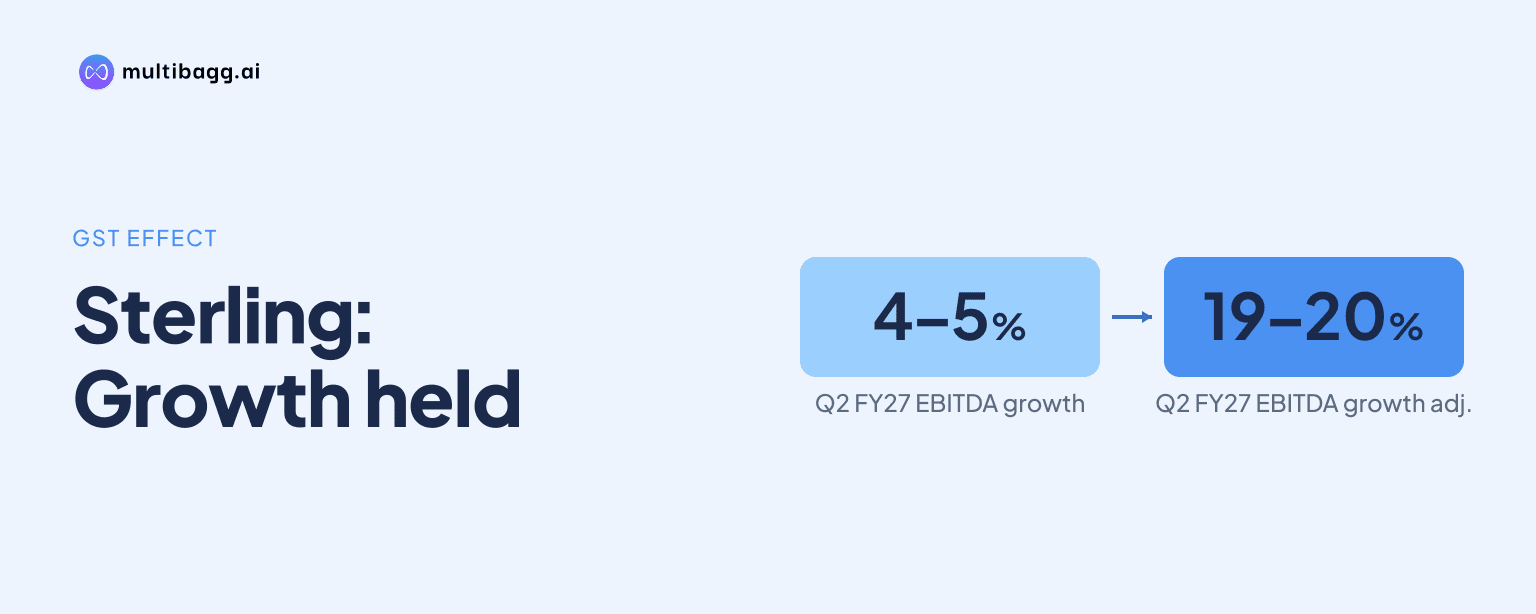
Sterling reported Q2 FY27 earnings before interest, tax, depreciation and amortisation, or EBITDA, of about Rs 28.9 crore, up 4%-5% year on year, after incurring a Rs 4 crore goods and services tax, or GST, input-tax-credit cost. Management said EBITDA would have been about Rs 32.9 crore, implying 19%-20% growth for analytical comparison.
Know Thomas Cook (India) inside out
Results, valuation, peers and who's buying, in one view.
What held back Sterling's reported Q2 EBITDA growth?
A Rs 4 crore GST input-tax-credit-related cost held Sterling's reported Q2 FY27 EBITDA growth to about 4%-5%, even as revenue rose approximately 17% to Rs 127.2 crore. Reported EBITDA increased from approximately Rs 27.7 crore in the corresponding quarter last year to about Rs 28.9 crore in Q2 FY27.
Management said this GST cost was not present in the prior-year Q2 comparison. It also said the same cost treatment had fully affected Q3 of the previous financial year, creating a timing mismatch between the two Q2 periods rather than, in management's view, signalling a change in the underlying direction of operating performance.
The cost occurred in July to September, which management described as Sterling's traditionally weakest seasonal quarter because monsoon conditions affect demand across several leisure and wildlife destinations. Despite that backdrop, Sterling recorded its highest Q2 revenue of about Rs 127.2 crore and reported profit before tax, or PBT, of approximately Rs 14 crore.
How did Sterling calculate adjusted Q2 EBITDA growth?
Sterling calculated adjusted Q2 EBITDA by adding the Rs 4 crore GST cost back to reported EBITDA of about Rs 28.9 crore, resulting in approximately Rs 32.9 crore. Against EBITDA of about Rs 27.7 crore in the corresponding quarter last year, management said this produces growth of around 19%-20%.
The Rs 32.9 crore figure is not Sterling's reported EBITDA for Q2 FY27. It is management's analytical comparison intended to remove a cost that affected the current quarter but did not affect the prior-year Q2, while reported EBITDA remains approximately Rs 28.9 crore.
The distinction changes the apparent earnings movement. Reported EBITDA was about Rs 1.2 crore higher than the prior-year figure, whereas EBITDA excluding the incremental GST cost was about Rs 5.2 crore above the corresponding-quarter result. Management described the latter measure as a more meaningful view of earnings conversion, subject to the stated GST-cost adjustment.
Management expects year-on-year comparisons to become more consistent from Q3 FY27 because the GST cost treatment had fully affected Q3 of the prior financial year. That expectation concerns comparability, while the reported Q2 FY27 result continues to include the Rs 4 crore cost.
Got a follow-up? Ask IRIS
What operating metrics supported Sterling's Q2 revenue growth?
Sterling's Q2 FY27 revenue growth was supported by approximately 23% growth in room nights sold, a roughly 300-basis-point improvement in occupancy and about 12% growth in average room rates for its owned-and-leased portfolio. These factors resulted in 12% growth in total revenue per available room, or RevPAR.
Sterling opened seven resorts during Q2 FY27, its highest number of openings in a single quarter, taking its portfolio to 83 properties and above 4,000 keys as of September 30, 2026. The additions comprised six management contracts and one revenue-share property, consistent with management's asset-light and capital-light expansion approach.
The operating data indicate that higher volumes and pricing accompanied the larger network. Room-night growth of approximately 23% exceeded revenue growth of about 17%, while occupancy improved by 300 basis points and owned-and-leased average room rates rose around 12%; management cited this combination in explaining its view that existing-property productivity also improved.
Sterling reported net cash reserves of approximately Rs 380.5 crore at the end of Q2 FY27 and said it remained debt-free. Management also reported 27 consecutive profitable quarters and said the cash position would support investment in its network, technology, products and people while maintaining capital-allocation discipline.
How did Sterling's first-half performance compare with Q2?
Sterling's first half, or H1 FY27, showed reported EBITDA growth of approximately 15% to Rs 91 crore, compared with reported Q2 FY27 EBITDA growth of about 4%-5% to Rs 28.9 crore. H1 FY27 revenue rose approximately 19% to Rs 297.1 crore, while PBT increased 22% to about Rs 62.3 crore.
Operating indicators were higher over the six-month period than in Q2 in several respects. H1 FY27 room nights sold rose approximately 24%, compared with about 23% in Q2; occupancy improved 500 basis points, compared with 300 basis points; and total RevPAR grew a little over 15%, compared with 12% in Q2.
Average room rates rose about 12% in Q2 FY27 and approximately 11% in H1 FY27, showing that the half-year improvement in RevPAR included both higher occupancy and higher pricing. Management said the H1 figures provided a longer-period view of the earnings capability of the Sterling platform, including revenue of Rs 297.1 crore and EBITDA of Rs 91 crore.
Management expects the seven Q2 openings to contribute progressively as properties mature, market presence develops and commercial performance ramps up. It also said the October-to-December festive and holiday season, followed by January-to-March leisure, meetings, incentives, conferences and exhibitions, or MICE, and wedding demand, are traditionally stronger periods for the business.
Conclusion
Sterling's reported Q2 FY27 EBITDA outcome was Rs 28.9 crore, with year-on-year growth of about 4%-5%, while revenue grew roughly 17% to Rs 127.2 crore. Management attributes the difference largely to a Rs 4 crore GST input-tax-credit cost that did not occur in the prior-year Q2 and calculates that EBITDA excluding this cost would have reached approximately Rs 32.9 crore, up around 19%-20%.
The next result to watch is Q3 FY27, when management expects the GST-cost comparison with the prior year to become more consistent. Management will also be seeking to convert the 83-property network, more than 4,000 keys as of September 30, 2026, and seven Q2 resort openings into higher resort productivity, management-fee contribution and operating profitability during the traditionally stronger second half.