










Thomas Cook expects Desert Adventures recovery after 67% sales fall
Key highlights
- Desert Adventures sales declined 67% in Q2 FY27, compared with an 89% deficit in Q1 FY27.
- Thomas Cook management expects a 50% recovery at Desert Adventures in the current quarter.
- Travel segment revenue declined 7% year on year to Rs 1,568.3 crore in Q2 FY27, while EBIT margin rose sequentially to 2.9%.
- Leisure travel forward bookings were 30% above the prior year, according to management.
powered by IRIS
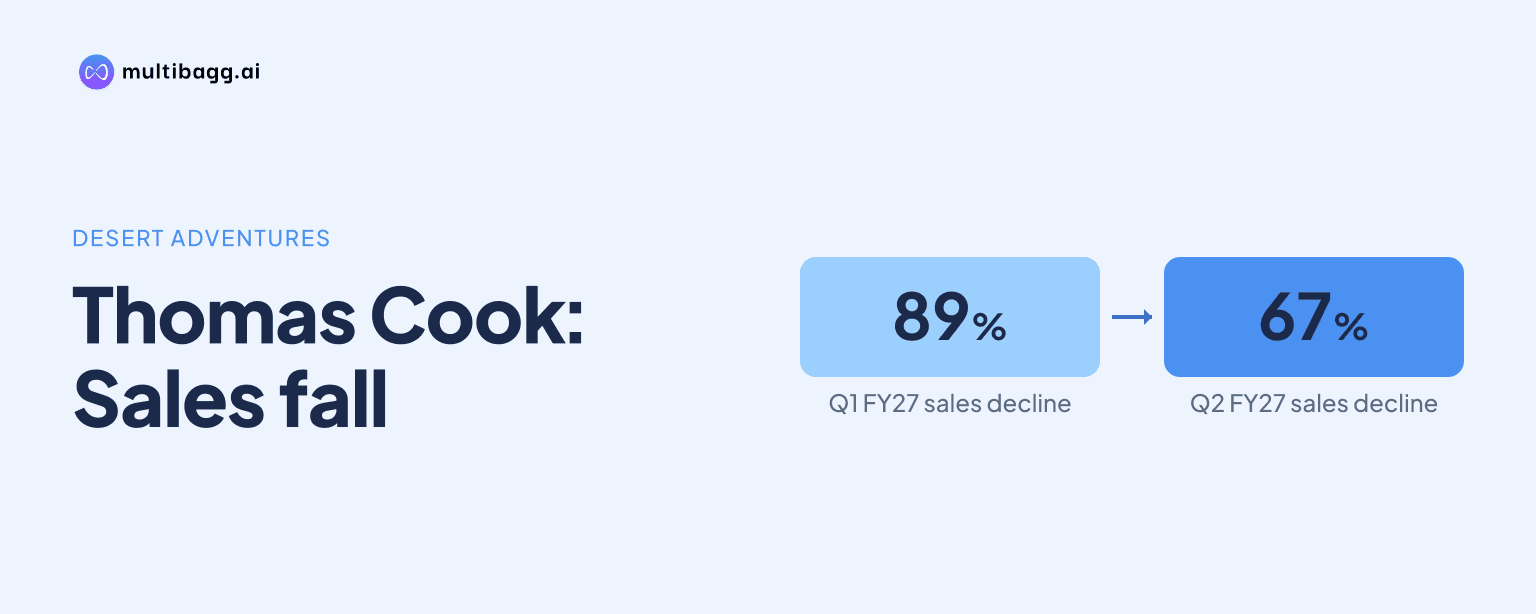
Thomas Cook (India) Limited said Desert Adventures sales declined 67% year on year in Q2 FY27 as geopolitical uncertainty in the Middle East reduced travel demand, but management expects a 50% recovery in the current quarter. The sales deficit had narrowed from 89% in Q1 FY27, and management cited early demand improvement during September.
Know Thomas Cook (India) inside out
Results, valuation, peers and who's buying, in one view.
What happened to Thomas Cook’s Desert Adventures sales in Q2 FY27?
Desert Adventures sales fell 67% year on year in Q2 FY27, leaving the Middle East as Thomas Cook’s most affected overseas market. Management attributed the decline to continuing geopolitical uncertainty, which weighed on both travel demand and customer confidence in the region.
The decline was smaller than the 89% deficit reported in Q1 FY27, a sequential improvement of 22 percentage points. Management said September brought early demand recovery from key source markets, but it did not identify those markets or disclose a separate September sales figure.
Management’s stated expectation of a 50% recovery in the current quarter is an outlook, not reported performance. The transcript does not define whether the recovery refers to sales, travel volumes or the remaining gap against an earlier period, so it does not establish a specific 50% year-on-year sales-growth forecast.
How did the Middle East conflict affect Thomas Cook’s travel business?
The Middle East disruption affected Thomas Cook directly through Desert Adventures and indirectly through parts of its long-haul outbound portfolio. Management said geopolitical uncertainty disrupted flight connectivity on certain routes and raised airfares, affecting customer travel plans and booking conversions.
Consolidated total income was Rs 2,003 crore in Q2 FY27, down 5% year on year, while management cited an operational-income shortfall of more than Rs 103.6 crore, largely from Desert Adventures and Digiphoto Entertainment Imaging. Travel segment revenue declined 7% year on year to Rs 1,568.3 crore in the quarter.
For H1 FY27, travel income from operations was Rs 3,278.9 crore, down 11% from a year earlier. That comparison shows that the Q2 moderation in the sales deficit had not yet reversed the impact of geopolitical volatility earlier in the financial year.
What supports Thomas Cook’s current-quarter recovery expectation?
Management based its 50% recovery expectation on the narrowing of Desert Adventures’ deficit to 67% in Q2 FY27 from 89% in Q1, September demand improvement and forward bookings. It also said the business continued cost optimisation and operational-readiness measures while the market remained disrupted.
Forward bookings across Thomas Cook’s leisure travel business were running 30% above the prior year, according to management. The company also reported a rebound in long-haul travel to Europe and Australia, while Japan continued to perform after the cherry-blossom season into autumn despite elevated airfares and other input costs.
Management made the broader demand outlook conditional on no further external shocks. It said some current-quarter booking momentum could flow into the final quarter of FY27, but described the second-half outlook as cautious optimism rather than a return of international operations to pre-conflict levels.
Got a follow-up? Ask IRIS
Which Thomas Cook businesses offset some Middle East weakness?
Domestic travel, India destination management services and African private safaris partly offset weakness in the Middle East and United States. Thomas Cook’s domestic travel business grew 8% in Q2 FY27, led by Ladakh, Kerala, Sri Lanka, Bhutan and the Bhakti & Darshan portfolio, particularly Char Dham.
The domestic result was affected by cancellations of certain Kailash Mansarovar Yatra departures after disruptions to the China visa process. Management put those cancellations at Rs 18.5 crore and said high China visa rejection rates also reduced booking conversions and travel volumes.
India destination management services grew 16% during what management described as a seasonally softer quarter, supported by inflows from the UK, Germany, France, Portugal and Japan. Private safaris grew 31% in South Africa and 14% in East Africa, while Asian Trails grew 9%, supported by China, Singapore and Thailand.
AlliedTPro, Thomas Cook’s US destination-management business, reported a 22% sales decline because of weak international visitor arrivals. The decline improved from a 40% gap in the preceding quarter, although softer inflows from source markets moderated growth elsewhere in its Asia Pacific operations.
How did Thomas Cook’s travel profitability change despite lower revenue?
Thomas Cook’s travel segment reported earnings before interest and tax, or EBIT, of Rs 45.5 crore in Q2 FY27, with an EBIT margin of 2.9%. The margin improved sequentially from 2.4%, which management attributed to cost agility that allowed expenses to be aligned with changing business volumes.
Within India travel, Thomas Cook ended Q2 FY27 6% below the prior year and reported an EBIT margin of 3.8%. Management said the India business’s EBIT deficit narrowed from 31% to 22%, while its long-haul outbound volume deficit was reduced by about 50% sequentially.
At group level, profit before tax before exceptional items was Rs 84.8 crore, broadly in line with the prior year, while the profit-before-tax margin rose to 4.2% from 4.0%. The transcript does not disclose a separate profit or loss figure for Desert Adventures.
Conclusion
Thomas Cook’s Q2 FY27 figures show that the geopolitical disruption remained severe for Desert Adventures, where sales were still 67% below the prior-year level, but the decline was less acute than the 89% deficit in Q1. Domestic travel growth of 8%, India destination management services growth of 16%, African safari growth and a sequential travel EBIT-margin increase to 2.9% provided partial support.
The next disclosed measure to watch is whether Desert Adventures delivers the 50% recovery management expects in the current quarter. Management also pointed to leisure forward bookings running 30% ahead of the prior year, but said the outlook depends on avoiding a further geopolitical disruption that could weaken travel confidence.