










Thomas Cook Education Forex Rises 33% as Remittances Fall
Key highlights
- Thomas Cook education forex business grew 33% year on year in Q2 FY27.
- RBI data cited by Thomas Cook showed education outbound remittances fell 34% from April to August 2026.
- Thomas Cook Financial Services gross turnover rose 7% to Rs 3,900 crore in Q2 FY27.
- Thomas Cook digital adoption increased to 22.4% from 21.5% a year earlier.
powered by IRIS
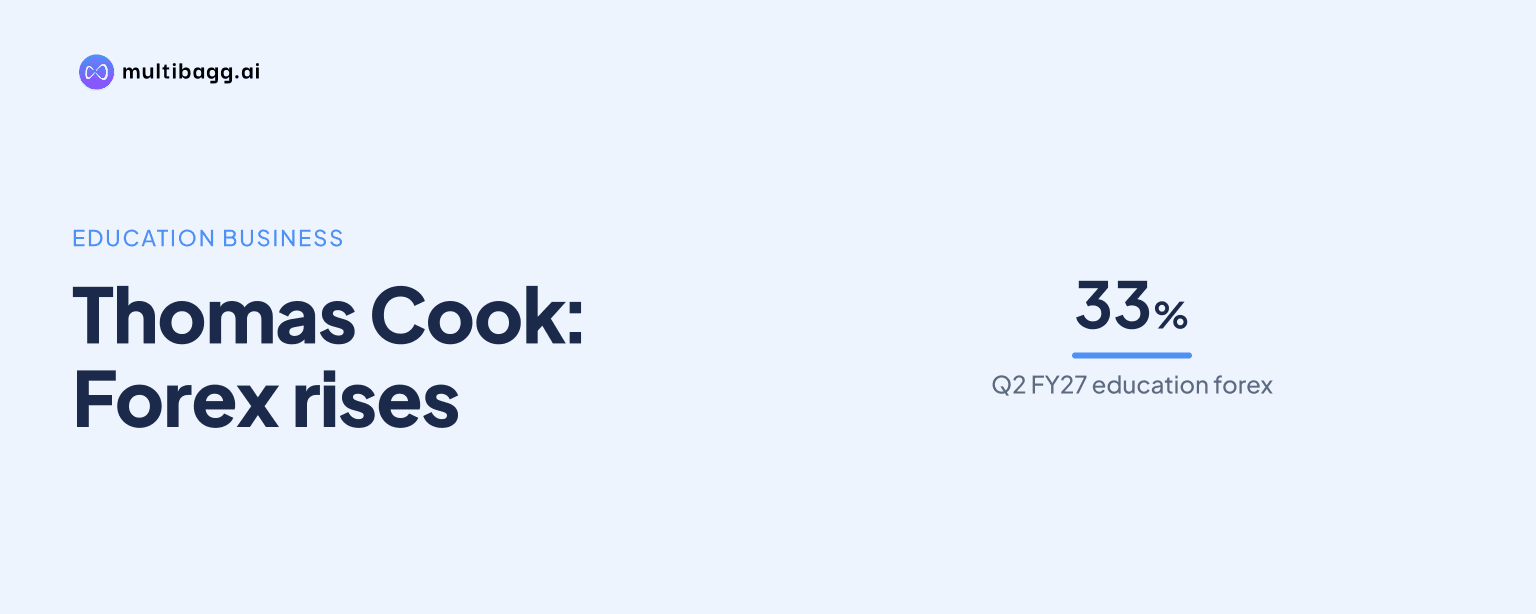
Thomas Cook (India) Limited’s education forex business grew 33% year on year in Q2 FY27 even as Reserve Bank of India, or RBI, data cited by management showed outbound education remittances declined 34% from April to August 2026. Thomas Cook attributed the divergence to distribution partnerships and its Study Buddy forex card for students.
Know Thomas Cook (India) inside out
Results, valuation, peers and who's buying, in one view.
How did Thomas Cook’s education forex business perform?
Thomas Cook’s education forex business increased 33% year on year in Q2 FY27 and helped lift its retail portfolio by 12%. Management compared this with RBI data for April to August 2026, when outbound remittances in the education category declined 34%, while travel-related foreign-exchange remittances declined 1%.
The two data points cover different periods: Thomas Cook reported a July-to-September 2026 quarter, while the RBI data cover five months through August 2026. The transcript did not disclose education forex turnover, transaction volumes or a numerical market-share figure, so the company’s precise share gain cannot be calculated.
Education was the main stated driver of retail growth in Q2 FY27. Within Thomas Cook’s financial-services portfolios, corporate business increased 10% and travel declined 6%, showing that the retail result was not matched by the travel category during the same quarter.
What did Thomas Cook say drove education forex growth?
Thomas Cook said its 33% education forex growth reflected its distribution reach, relationships with non-banking financial companies, or NBFCs, overseas education counsellors and the Study Buddy forex card. Management described Study Buddy as a student-focused product for customers going abroad, but gave no card-sales volume, partner count or revenue contribution.
The company’s stated model is to reach students through counselling and financing relationships during the overseas-education planning process. This channel approach was relevant against the 34% decline in RBI-reported education remittances from April to August 2026, although the call did not establish how much of Thomas Cook’s growth came from new customers rather than higher activity from existing customers.
Digital channels also formed part of the forex distribution strategy in Q2 FY27. Overall digital adoption increased to 22.4% from 21.5% in the corresponding prior-year period, a gain of 0.9 percentage points, with management citing customer engagement through its app and WhatsApp channel.
Got a follow-up? Ask IRIS
How did Thomas Cook Financial Services perform in Q2 and H1 FY27?
Thomas Cook Financial Services reported 21% revenue growth in Q2 FY27, while gross turnover rose 7% to Rs 3,900 crore and earnings before interest and tax, or EBIT, increased 10% to Rs 45.2 crore. The segment’s Q2 EBIT margin was 44.1%, and management said retail business drove the turnover increase.
For H1 FY27, gross turnover grew 4% to Rs 7,200 crore, including a 10% increase in retail turnover to Rs 5,500 crore. Revenue from operations rose 14% to Rs 191.8 crore, EBIT increased 9% to Rs 85.6 crore and the EBIT margin was 44.7%.
The first-half turnover growth of 4% was lower than Q2’s 7%, while H1 revenue growth of 14% was below the quarter’s 21%. The transcript did not explain the difference between turnover and revenue growth rates, but it identified retail as the Q2 turnover driver and education as the principal source of retail portfolio growth.
How is Thomas Cook extending forex distribution?
Thomas Cook expanded both digital and physical forex access during Q2 FY27. Forex cards sold through quick-commerce platform Blinkit grew 96% compared with Q3 FY26, though management said the comparison was not entirely like for like and presented it only as an indication of channel growth.
The company operationalised retail counters at Angamaly, Cochin and Hubli, while closing its Thiruvananthapuram branch as part of retail-network optimisation in the quarter. Management linked the footprint approach to travel demand from Tier 2 and Tier 3 markets, but did not disclose the number of dedicated forex outlets or their turnover.
Corporate forex turnover rose 10% in Q2 FY27, which management attributed to a higher wallet share from existing relationships and new client acquisitions. This compared with 12% retail portfolio growth and a 6% fall in travel forex, underscoring the differing trends across the segment’s customer groups.
Thomas Cook’s wider branch network reached 310 at the end of September 2026, up 7% from 289 a year earlier through the franchise route. That network figure applies to the group’s distribution network rather than Financial Services alone, but management presented physical reach and digital capabilities as supporting its forex strategy.
Conclusion
Thomas Cook’s 33% education forex growth in Q2 FY27 diverged sharply from the 34% decline in RBI-reported education remittances for April to August 2026. The result supported a 12% increase in the retail portfolio and contributed to Financial Services revenue growth of 21%, while travel forex declined 6% and corporate forex increased 10%.
The next disclosure to watch is whether education continues to lead retail growth after Q2 FY27, particularly as management continues to use NBFC and overseas education-counsellor relationships, Study Buddy, Blinkit and retail-footprint optimisation. Management gave no education forex target, market-share target or forecast for education remittances.