










NIS FY26 loss reflects Rs 27.82 crore labour provision charge
Key highlights
- NIS booked a Rs 27.82 crore one-time, non-cash labour-code transition provision in FY26.
- NIS reported FY26 PAT of negative Rs 1.85 crore, while adjusted PAT was Rs 19.12 crore.
- NIS total income increased to Rs 436.70 crore in FY26 from Rs 405.33 crore in FY25.
- NIS EBITDA margin improved to 7.68% in FY26 from 7.37% in FY25.
powered by IRIS
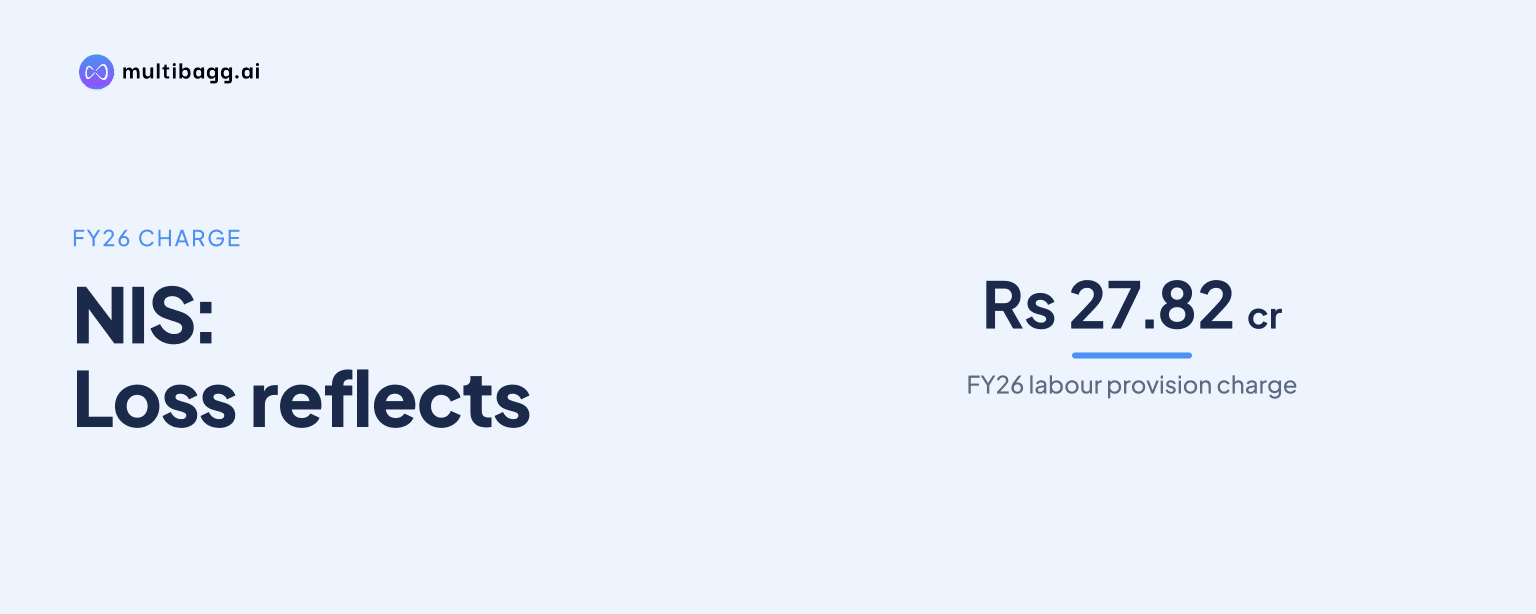
NIS reported a loss after tax of Rs 1.85 crore in FY26 after recognising a Rs 27.82 crore one-time, non-cash provision associated with the labour-code transition; adjusted profit after tax, excluding the exceptional item, was Rs 19.12 crore. The presentation describes the provision as accounting-led rather than an operating cash outflow.
Know NIS Management inside out
Results, valuation, peers and who's buying, in one view.
Why did NIS report a loss in FY26?
NIS reported negative profit after tax, or PAT, of Rs 1.85 crore in FY26 because it recorded a Rs 27.82 crore exceptional item. NIS says the charge reflected an upfront provision for transition-related statutory obligations following revised wage definitions under the new labour-code framework, and describes it as one-time, non-cash and accounting-led.
The revised wage definition increased employee-benefit obligations, according to NIS. The company says it assessed the incremental liability through an actuarial valuation under Accounting Standard 15, or AS 15, and recognised it upfront. Long-term provisions consequently rose to Rs 23.29 crore in FY26 from Rs 0.10 crore in FY25, while short-term provisions increased to Rs 12.04 crore from Rs 6.86 crore.
The presentation distinguishes the reported result from adjusted PAT, which excludes the exceptional item. Adjusted PAT was Rs 19.12 crore in FY26, compared with Rs 18.69 crore in FY25, while reported PAT moved from a profit of Rs 18.67 crore to a loss of Rs 1.85 crore. NIS also reported a tax credit of Rs 4.35 crore in FY26, compared with tax expense of Rs 0.12 crore in FY25.
Did NIS remain profitable before the exceptional provision?
Yes. NIS reported adjusted PAT of Rs 19.12 crore and earnings before interest, tax, depreciation and amortisation, or EBITDA, of Rs 33.53 crore in FY26. Adjusted PAT increased by Rs 0.43 crore from Rs 18.69 crore in FY25, although the adjusted PAT margin declined to 4.38% from 4.61%.
Total income rose to Rs 436.70 crore in FY26 from Rs 405.33 crore in FY25, while revenue increased to Rs 433.40 crore from Rs 402.17 crore. Other income was Rs 3.30 crore, compared with Rs 3.15 crore a year earlier. NIS attributes revenue growth to scale-up and long-term contracts, while stating that wage inflation and a business-mix transition moderated margins.
EBITDA increased to Rs 33.53 crore in FY26 from Rs 29.89 crore in FY25, but remained below Rs 33.62 crore in FY24. EBITDA margin improved to 7.68% from 7.37% in FY25, yet remained below the FY24 margin of 8.85%. Profit before tax similarly rose to Rs 21.62 crore from Rs 18.80 crore, while finance costs increased to Rs 9.39 crore from Rs 8.78 crore.
Got a follow-up? Ask IRIS
How could the labour codes affect NIS's market position?
NIS says the four labour codes consolidate 29 labour laws and increase requirements for digital compliance, payroll transparency, statutory benefits and formal workforce documentation. For manpower-intensive security and facility-management businesses, NIS says the framework raises compliance intensity across wage, benefit and workforce-record processes.
Management presents formalisation as a potential opportunity rather than a quantified financial forecast. NIS says smaller and informal operators may face pressure from higher statutory discipline and systems requirements, while large clients are likely to prefer audit-ready, technology-enabled and compliant service partners. It also says a more formal workforce can improve employee retention, service consistency and on-ground productivity over time.
The presentation places this opportunity alongside an Indian facility-management services market valued at USD 139.5 billion in 2022 and projected to reach USD 258.2 billion by 2030. The cited outlook implies about 8% compound annual growth from 2023 to 2030. NIS identifies integrated facility management, or IFM, as the largest and fastest-adopted segment, while security services remain the most widely used facility-management service.
NIS plans to scale IFM across government and corporate customers and deepen its presence in Maharashtra, Gujarat, the National Capital Region and Tier-2 cities. Its strategy also includes expansion of CCTV rental and technology-led security solutions, use of subsidiaries for skill development and technology integration, and a greater share of IFM and CCTV rentals, which management calls margin-accretive services.
What changed in NIS's cash flow and balance sheet in FY26?
NIS generated cash flow from operating activities of Rs 10.33 crore in FY26, down from Rs 14.89 crore in FY25 and Rs 12.02 crore in FY24. Cash flow from investing activities was negative Rs 4.38 crore, compared with negative Rs 5.85 crore in FY25, while financing cash flow turned positive at Rs 36.31 crore after negative Rs 15.68 crore in the prior year.
Cash and bank balances rose to Rs 67.13 crore in FY26 from Rs 24.87 crore in FY25. Trade receivables also increased, reaching Rs 145.83 crore from Rs 125.88 crore, while the receivable turnover ratio declined to 2.97 times from 3.20 times. Current assets rose to Rs 281.57 crore and current liabilities to Rs 108.84 crore, from Rs 218.68 crore and Rs 95.23 crore respectively.
Borrowing composition shifted during FY26. Long-term borrowings fell to Rs 1.12 crore from Rs 7.78 crore in FY25, while short-term borrowings increased to Rs 81.95 crore from Rs 76.00 crore. NIS reported debt to equity of 0.42 times, compared with 0.55 times, and a current ratio of 2.59 times, compared with 2.30 times.
The provision contributed to total non-current liabilities rising to Rs 24.41 crore in FY26 from Rs 7.88 crore, despite lower long-term borrowings. Total equity increased to Rs 196.00 crore from Rs 152.00 crore, and total assets rose to Rs 329.25 crore from Rs 255.11 crore. These balance-sheet changes show the provision affected liabilities as well as the reported earnings result.
Conclusion
NIS's FY26 reported loss principally reflected the Rs 27.82 crore provision tied to revised wage definitions and actuarially assessed employee-benefit obligations. The adjusted PAT of Rs 19.12 crore, total income of Rs 436.70 crore and EBITDA of Rs 33.53 crore separate the operating measures reported by NIS from the exceptional accounting charge.
The next disclosures to watch are NIS's planned expansion in IFM, CCTV rentals and technology-led security services, together with management's target of gradual EBITDA-margin improvement over the medium term. Its FY26 receivables of Rs 145.83 crore, operating cash flow of Rs 10.33 crore and finance costs of Rs 9.39 crore are additional reported measures that may show how the transition and growth plan develop.