










NIS targets higher margins as manpower services supply 85%
Key highlights
- NIS disclosed Rs 370.50 crore, or 85.49%, of FY25-FY26 service revenue from security and housekeeping.
- Security services contributed Rs 199.49 crore, or 46.03%, of NIS’s FY25-FY26 service mix.
- IFM contributed Rs 56.91 crore, or 13.13%, of NIS’s FY25-FY26 disclosed service mix.
- NIS says CCTV rentals generate approximately 20–25% EBITDA margins.
powered by IRIS
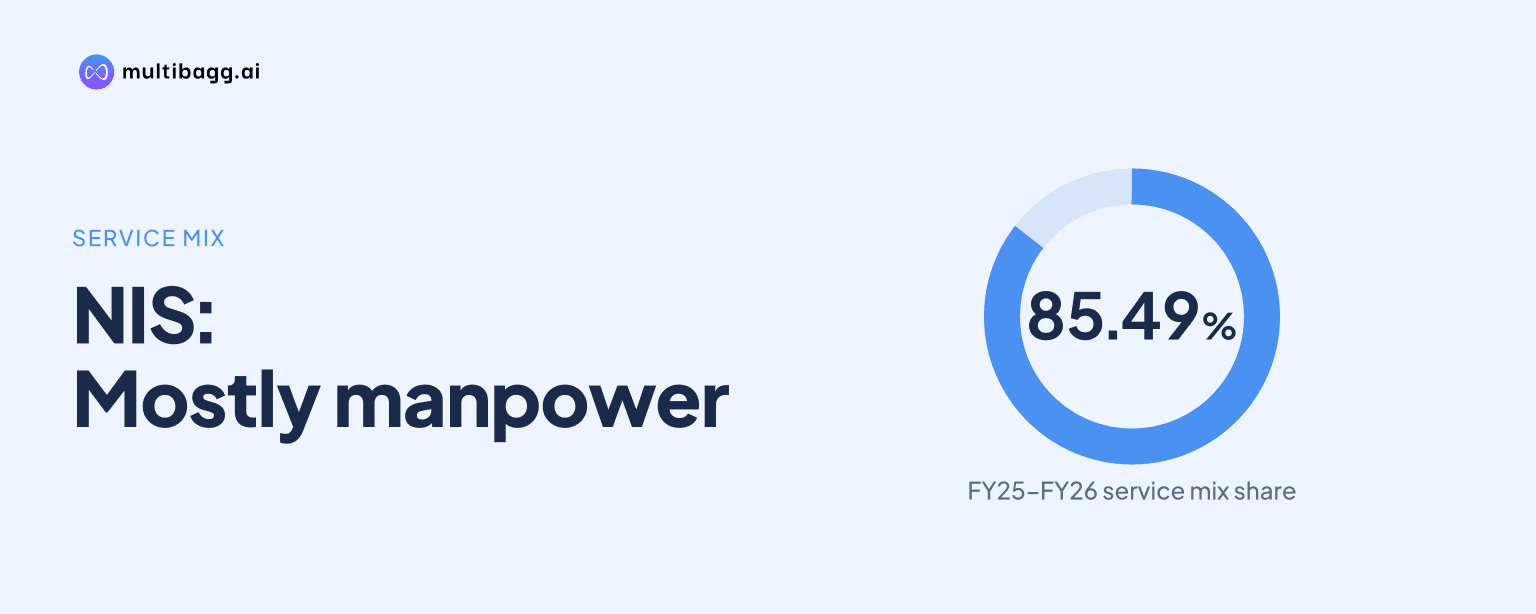
NIS Management Limited says security and housekeeping generated Rs 370.50 crore, or 85.49%, of its FY25-FY26 disclosed service mix, while CCTV rentals delivered approximately 20–25% EBITDA margins. NIS is positioning Integrated Facility Management and rentals as margin-expansion levers alongside its manpower-led operating base.
Know NIS Management inside out
Results, valuation, peers and who's buying, in one view.
How concentrated is NIS revenue in manpower-led services?
NIS’s disclosed FY25-FY26 service mix was concentrated in security services and housekeeping and payroll, which together contributed Rs 370.50 crore and 85.49% of the Rs 433.40 crore total. Security was the largest line at Rs 199.49 crore, or 46.03%, while housekeeping and payroll supplied Rs 171.01 crore, or 39.46%.
NIS describes its model as annuity-led and manpower-driven, with government and private-client contracts generally lasting three to five years and monthly billing across more than 1,500 operational sites. Its security operation deploys more than 19,100 personnel across these sites and serves sectors including retail, banking and financial services, airports, healthcare, industry, residential properties and government clients.
Why is NIS expanding Integrated Facility Management?
NIS identifies Integrated Facility Management, or IFM, as a growth and margin driver because it combines multiple facility functions under a single contract. IFM generated Rs 56.91 crore, or 13.13% of the FY25-FY26 disclosed service mix, making it smaller than security and housekeeping but substantially larger than the Rs 5.99 crore other-services category.
The IFM offer includes electrical and mechanical maintenance, plumbing, carpentry, annual maintenance contract management, office administration, landscaping and utility management. NIS says bundled services, mechanisation and automation support the segment’s margin rationale, while longer contracts can increase wallet share per client and support retention.
Housekeeping is linked directly to this expansion plan because NIS says housekeeping services can be integrated with IFM contracts for bundled delivery. The Rs 171.01 crore housekeeping and payroll business therefore provides an existing service line that can be incorporated into broader facility-management mandates. NIS reports a strong presence in government and infrastructure projects and an increasing focus on private-sector corporate facilities, but does not disclose an IFM margin or a growth target.
What margin does NIS report for CCTV rentals?
NIS reports that CCTV rentals deliver approximately 20–25% earnings before interest, tax, depreciation and amortisation, or EBITDA, margins. It says this range is significantly higher than margins in manpower-led services, although the presentation does not provide separate EBITDA margins for security, housekeeping or IFM.
NIS’s electronic-security portfolio includes closed-circuit television surveillance, access control and command-and-control systems. It operates through supply, installation, testing and commissioning, or SITC, as well as rental models. NIS describes rentals as asset-backed, multi-year recurring revenue and says its commercial focus includes government contracts, rental-led deployments and artificial-intelligence-enabled surveillance.
The presentation gives examples of relevant contract activity but does not disclose standalone electronic-security revenue. In 2024, NIS reported a Rs 35 crore CCTV project with the Government of West Bengal, alongside a Rs 30 crore Pune Airport facility-management contract. It also says it secured a CCTV project from the Maharashtra Government in 2026, but does not disclose its value, revenue-recognition schedule or contribution to the FY25-FY26 service mix.
Got a follow-up? Ask IRIS
How does NIS support recurring revenue and cross-selling?
NIS supports recurring revenue through contracts of three to five years, monthly billing and a network of more than 1,500 sites. The company says technology supports service delivery through enterprise resource planning, or ERP, mobile attendance and QR-code monitoring, deployed at more than 700 electronic-attendance sites and 600 remotely monitored sites.
NIS serves more than 600 clients across 14 states, with 14 branch offices and average client relationships of 4.5 to five years. Security services are described as a platform for cross-selling and deeper client relationships, while housekeeping can be bundled into IFM contracts and electronic security can add surveillance systems to the wider service offer.
Company-level revenue rose from Rs 378 crore in FY24 to Rs 402 crore in FY25 and Rs 433 crore in FY26, an increase of Rs 55 crore over two years. Customer concentration also changed: the top 10 customers represented 30% of revenue in FY24, rising to 36% in FY25 and remaining at 36% in FY26, while other customers’ share declined from 70% to 64%.
What does the mix mean for NIS’s operating priorities?
NIS’s disclosed mix means that manpower services remain central to revenue scale, while IFM and CCTV rentals are the activities specifically linked to margin expansion. Security and housekeeping supplied Rs 370.50 crore of the FY25-FY26 mix, whereas IFM supplied Rs 56.91 crore and CCTV rental margins were disclosed without a standalone revenue contribution.
Execution relies on workforce deployment, standardised processes and digital systems. NIS cites a 129:1 core-to-associate ratio, trained manpower and standard operating procedures as elements of its operating model. Its group includes Keertika Academy Private Limited, a National Skill Development Corporation-partnered vocational training platform with 11 centres that has trained about 1.25 lakh candidates under government skill schemes.
NIS also links technology to compliance and billing accuracy through ERP, remote site supervision, digital attendance and QR-code monitoring. For the electronic-security business, the disclosed mechanisms are access control, command-and-control systems and artificial-intelligence-enabled surveillance. The presentation does not provide capital expenditure, rental-asset utilisation, fleet size, working-capital data or segment profitability beyond the CCTV rental EBITDA margin range.
Conclusion
NIS’s disclosed FY25-FY26 mix shows that its revenue remains predominantly tied to security and housekeeping, which supplied 85.49% of service revenue. The company’s margin-expansion rationale rests on IFM’s ability to bundle facility functions under larger contracts and on CCTV rentals’ disclosed 20–25% EBITDA margins and multi-year recurring revenue model.
What to watch next is whether NIS reports a larger IFM and electronic-security contribution from its stated pipeline of government and infrastructure work. The presentation identifies the Rs 30 crore Pune Airport facility-management contract, the Rs 35 crore West Bengal CCTV project and a 2026 Maharashtra Government CCTV project, but leaves revenue timing, segment targets and standalone electronic-security revenue unresolved.