










Nisus targets ₹2,500 crore AIF across four platforms
Key highlights
- Ni-YAM has a ₹2,500 crore target, SEBI approval and a first close planned by Q3 FY27.
- Nisus targets ₹2,000 crore across multiple SM REITs, with registration and set-up in process in H2 FY27.
- NIFCOT1 targets US$50 crore, with a US$5 crore first tranche of 100,000 tokens planned after DFSA approval.
- The UAE private-credit platform targets US$50 crore while fund structuring and regulatory set-up continue in H2 FY27.
powered by IRIS
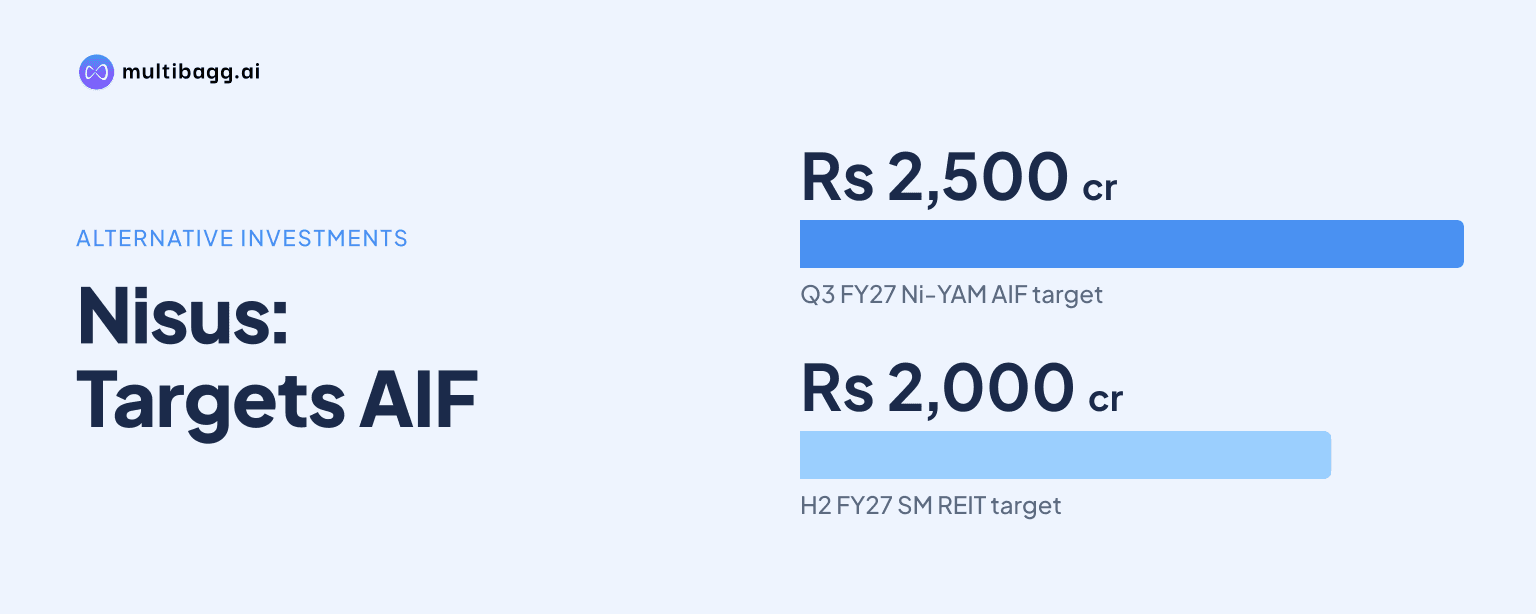
Nisus Finance is targeting a ₹2,500 crore Nisus Yield & Asset Multiplier Alternative Investment Fund in FY27, its largest stated rupee platform, while also pursuing ₹2,000 crore of Small and Medium REITs and US$50 crore targets each in tokenised real estate and UAE private credit. The four initiatives remain at different approval, fundraising and structuring stages.
Know Nisus Finance Services Co inside out
Results, valuation, peers and who's buying, in one view.
What are Nisus's four platform targets and current stages?
Nisus has disclosed ₹4,500 crore of targets across its two India-focused platforms and US$100 crore across its two UAE-oriented platforms, but these figures are targets rather than reported fundraising or deployed capital. Ni-YAM had received Securities and Exchange Board of India approval and started fundraising in H1 FY27, whereas the other three platforms remained in registration, approval or structuring processes.
The targets differ in both currency and intended product. Ni-YAM combines secured credit, land and development exposure in India, while the SM REIT initiative is intended to span multiple trusts. NIFCOT1 is structured around tokenised economic interests in a Dubai International Financial Centre, or DIFC, regulated real-estate fund, and the UAE credit plan targets structured credit in regional private markets.
The presentation does not state that the ₹4,500 crore and US$100 crore targets are commitments from investors. It instead identifies milestones that would precede or support launches, including Ni-YAM's first close, SM REIT registration, Dubai Financial Services Authority, or DFSA, approval for the first NIFCOT1 tranche, and regulatory set-up for private credit.
How is Nisus structuring the ₹2,500 crore Ni-YAM AIF?
Nisus is structuring Ni-YAM as a five-year Alternative Investment Fund, or AIF, with a ₹2,500 crore target, a ₹1 crore minimum investment and a hybrid strategy spanning secured credit, land and development stages. The presentation says the fund received SEBI approval in H1 FY27, was rated AIF-1, or Excellent, by CARE, and had begun fundraising.
The disclosed fund terms include a 2.0% annual management fee, a 12% hurdle rate and a 20% performance fee above that hurdle. Nisus presents a 24% to 28% gross internal rate of return, or IRR, as a fund term, alongside a target multiple on invested capital of three to four times. Detailed terms are referenced to the private placement memorandum.
Ni-YAM is intended to combine stable income and capital appreciation, according to the presentation. Nisus describes secured credit as senior, last-mile and capital-protected, while the fund's broader strategy includes land and development-stage investments. Its stated H2 FY27 outlook is a first close by Q3 FY27 and institutional anchor investors, with deployment from Q3 FY27 onwards.
The market case cited for the fund includes ₹1.5 lakh crore to ₹2 lakh crore of underfunded real-estate opportunities and more than 3,900 acres of land transacted in 2025. Nisus also cites a 25% compound annual growth rate in residential-cum-plotted land acquisition from 2022 to 2025, and says peripheral and satellite markets account for 20% to 30% of sales.
Got a follow-up? Ask IRIS
What has Nisus disclosed about its SM REIT platform?
Nisus is targeting ₹2,000 crore across multiple Small and Medium Real Estate Investment Trusts, or SM REITs, with registration and REIT set-up described as in process in H2 FY27. The investment-manager entity has already been established, but the presentation does not name individual schemes, properties or a fundraising date.
The proposed structure is described as SEBI regulated, with a ₹50 crore minimum threshold and scheme-based segregation. Nisus says the model provides more than 95% cash-flow distribution through a full pass-through structure. These are structural characteristics of the planned platform, not a disclosed return estimate for a specific SM REIT scheme.
Nisus cites a projected ₹47,500 crore SM REIT market by 2030 and labels this as a projected tenfold increase. That industry estimate is separate from the company's ₹2,000 crore target, which applies across multiple proposed SM REITs. As of the reporting date, the presentation says there were about 10 REIT managers, including two SM REIT managers.
The SM REIT timetable is less specific than Ni-YAM's stated first-close objective. Ni-YAM had approval and fundraising under way in H1 FY27, while the SM REIT disclosure focuses on registration and set-up during H2 FY27. The presentation does not report completed capital raising, a registered trust or acquired assets for the SM REIT platform.
How do NIFCOT1 and UAE private credit differ?
Nisus's NIFCOT1 tokenisation platform targets US$50 crore and proposes a US$5 crore first tranche of 100,000 digital tokens through the Toyow marketplace, while the UAE private-credit platform also targets US$50 crore but remains at the fund-structuring stage. NIFCOT1 has more disclosed operating mechanics, whereas the credit platform has fewer published terms and no specified launch quarter.
Under the proposed NIFCOT1 structure, a British Virgin Islands, or BVI, special-purpose vehicle subscribes to an underlying DIFC-regulated fund and issues economic-interest tokens through Toyow. Nisus says token holders would receive economic exposure through the BVI vehicle, including periodic rental yield and capital upside from the underlying assets. The presentation lists a 2.0% annual management fee and a 12% to 15% gross IRR for token holders.
Nisus reported three H1 FY27 steps for NIFCOT1: incorporation of Nisus BVI Limited, an application for DFSA approval and a marketplace partner. The US$5 crore first tranche is planned after DFSA approval, and the presentation identifies Toyow as a partnership with Xchain Technologies FZCO. It also says the product may use multiple digital currencies.
For UAE private credit, Nisus describes a structured-credit strategy for regional private markets and calls the launch timeline “in pipeline.” Unlike NIFCOT1, the presentation does not disclose a fee schedule, target IRR, fund tenure, minimum investment or named regulator. Its stated H2 FY27 work is fund structuring and regulatory set-up, making it earlier in the disclosed development sequence than Ni-YAM and less defined than NIFCOT1.
Conclusion
Nisus has outlined four fund-management platforms with materially different levels of readiness. Ni-YAM is the most advanced based on disclosed SEBI approval, fundraising activity and a ₹2,500 crore target. The SM REIT plan has an investment-manager entity in place, while NIFCOT1 depends on DFSA approval and UAE private credit remains subject to further structuring and regulatory work.
The next disclosed markers are Ni-YAM's first close by Q3 FY27 and deployment from Q3 FY27 onwards, SM REIT registration and set-up in H2 FY27, and NIFCOT1's US$5 crore first tranche after DFSA approval. For UAE private credit, management has disclosed no dated launch milestone beyond the ongoing H2 FY27 structuring and regulatory process.