










Nitin Spinners targets 30% fabric revenue after expansion
Key highlights
- Nitin Spinners plans to increase fabric’s revenue contribution to about 30% by FY28 from 21.4% in H1 FY27.
- Finished woven-fabric capacity is expected to rise by 35 million metres annually, reaching 71 million metres in FY28e from 36 million metres in FY26.
- The company expects its higher fabric mix to add 100 to 150 basis points to margins, while reporting an EBITDA margin of 17.80% in H1 FY27.
- Renewable-power initiatives totaling 95.4 megawatts are expected to cover 50% to 55% of annual power consumption and save about Rs 50 crore annually.
powered by IRIS
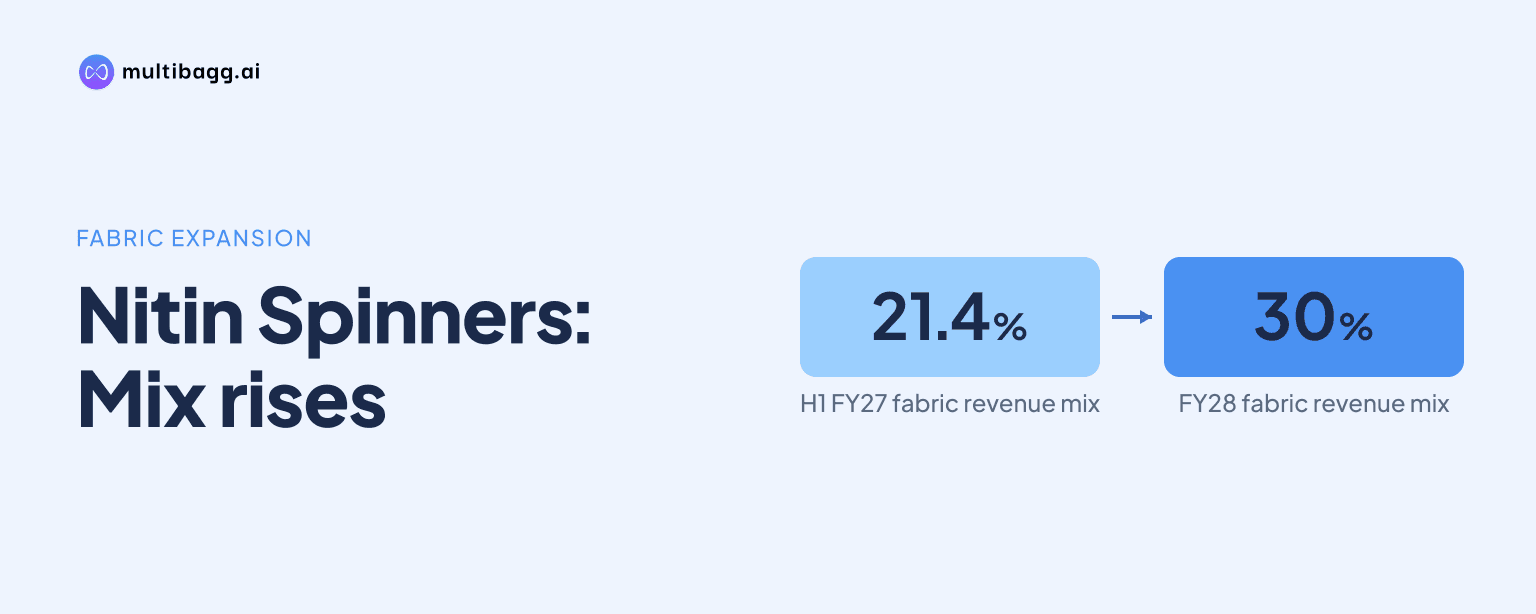
Nitin Spinners Limited aims to raise fabric to about 30% of revenue by FY28, from 21.4% in H1 FY27, by increasing annual finished woven-fabric capacity to 71 million metres from 36 million metres in FY26. Management says about 60% of its new 22,400 metric-tonnes-per-annum spinning capacity will feed in-house fabric production.
Know Nitin Spinners inside out
Results, valuation, peers and who's buying, in one view.
How much woven-fabric capacity is Nitin Spinners adding?
Nitin Spinners is adding 35 million metres of annual finished woven-fabric capacity, taking total capacity to 71 million metres in FY28e from 36 million metres in FY26. The FY27e figure of 35 million metres in the capex chart represents the planned addition, while the FY28e figure shows the resulting total capacity.
The spinning and weaving projects were in an advanced stage of commissioning, with partial trial production already started, according to the presentation. Nitin Spinners expects full commissioning by the end of December 2026 and lists premium products, a wider portfolio, new markets, integration, lower operating costs and margin expansion among the project rationales.
The yarn expansion adds 22,400 metric tonnes per annum, lifting annual yarn capacity from 110 thousand tonnes in FY26 to 132 thousand tonnes in FY28e. Nitin Spinners identifies dyed yarn and fabric made from dyed yarn as value-added products linked to the programme.
How will Nitin Spinners use the added yarn capacity?
Nitin Spinners plans to direct about 60% of the new 22,400 metric-tonnes-per-annum spinning capacity into its own fabric operations. The company says the increased woven-fabric capacity will raise captive yarn consumption, creating a fibre-to-fabric chain across spinning, knitting, weaving and processing.
The intended use of yarn supports a change in revenue mix. Fabric accounted for 21.4% of H1 FY27 revenue, compared with 73.2% for yarn and 5.4% for other products, while management targets a fabric contribution of about 30% by FY28. That is a planned rise of about 8.6 percentage points from the reported H1 FY27 fabric share, although the presentation does not disclose a FY28 revenue amount.
Nitin Spinners reported current production capacity of 1.10 lakh tonnes of yarn, 36 million metres of finished woven fabric and 11,000 tonnes of knitted fabric. Its disclosed manufacturing base includes 231 airjet weaving machines, 4,34,832 spindles, 5,864 rotors, 264 airjet spinning positions and 77 circular knitting machines.
What margin and policy levers does Nitin Spinners identify?
Management says a higher fabric mix can add 100 to 150 basis points to margins, where one basis point is one-hundredth of a percentage point. This is a stated structural lever rather than a reported FY28 margin forecast; Nitin Spinners reported an earnings before interest, tax, depreciation and amortisation margin of 17.80% in H1 FY27.
Nitin Spinners reported H1 FY27 revenue of Rs 1,860.2 crore and profit after tax of Rs 163.9 crore, equal to an 8.81% margin. The company links the proposed margin effect to a more value-added product portfolio, including compact and fine counts up to Ne 100, Supima, Giza, organic, slub, core-spun and new blends.
The new project is eligible for interest subsidy, capital subsidy and electricity-duty benefits under the Rajasthan Investment Promotion Scheme, or RIPS, 2024. Nitin Spinners also names RIPS 2024 incentives on new capital expenditure as a structural lever, but does not disclose the monetary value or expected timing of the benefits.
Got a follow-up? Ask IRIS
How is Nitin Spinners using renewable power to cut costs?
Management says renewable initiatives can save about Rs 50 crore annually and cover about 50% to 55% of total annual power consumption. The programme listed in the presentation totals 95.4 megawatts, comprising 68.4 megawatts of solar power and 27 megawatts of hybrid power, with annual generation of 25.8 crore units.
Nitin Spinners has 18.8 megawatts of solar capacity and an 18-megawatt hybrid power-purchase agreement operating fully. Its 4.6-megawatt solar installation at the Bhilwara unit is also fully operational and produces 0.9 crore units of power; together, these operating assets account for the 41.4 megawatts of current renewable capacity stated elsewhere in the presentation.
The additions scheduled for Q3FY27 include 4.2 megawatts of on-site solar at Chittorgarh, a 33-megawatt captive solar plant under open access, a 7.8-megawatt captive solar plant at Chittorgarh and a 9-megawatt hybrid power-purchase agreement for Chittorgarh. The solar projects announced in Q3FY26 had capex of about Rs 230 crore, while the hybrid agreement announced in Q4FY26 had capex of about Rs 9.5 crore.
What markets support Nitin Spinners' fabric strategy?
Nitin Spinners reported that exports contributed 67% of H1 FY27 revenue, while its revenue presentation gives the geographic split as 66.7% exports and 33.3% domestic sales. The company has a presence in more than 55 countries and cites this reach as part of its plan to enter new markets with fabric and premium products.
Management says trade agreements with the United Kingdom and European Union are expected to widen market access. The presentation does not provide an implementation date, tariff detail or revenue estimate related to these agreements, so their financial effect remains undisclosed.
Nitin Spinners reports a revenue compound annual growth rate of about 15% and says its capital expenditure is funded through internal accruals and term debt. On the balance sheet, non-current borrowings were Rs 1,183.3 crore in September 2026, compared with Rs 545.2 crore in March 2026, while capital work-in-progress rose to Rs 915.2 crore from Rs 102.4 crore.
Conclusion
Nitin Spinners is combining 35 million metres of new woven-fabric capacity with 22,400 metric tonnes per annum of added spinning capacity to move more yarn through its own downstream operations. The strategy targets a larger fabric contribution to revenue, while management identifies fabric mix, RIPS 2024 eligibility and renewable power as the main mechanisms for changing the operating model.
The next disclosed milestones are full commissioning of the spinning and weaving projects by the end of December 2026 and renewable installations scheduled for Q3FY27. The unresolved measures are the value and timing of RIPS 2024 benefits, the timing of the stated Rs 50 crore annual renewable saving, and the eventual reported effect of the fabric mix on margins and revenue share.