










Niyogin Fintech shareholders approve composite restructuring scheme
Key highlights
- Niyogin Fintech shareholders approved the composite restructuring scheme on October 30, 2026.
- The NCLT Chennai Bench allowed the scheme's first-motion application on September 11, 2026.
- Remote e-voting for the stakeholder meetings ran from October 26 to October 29, 2026.
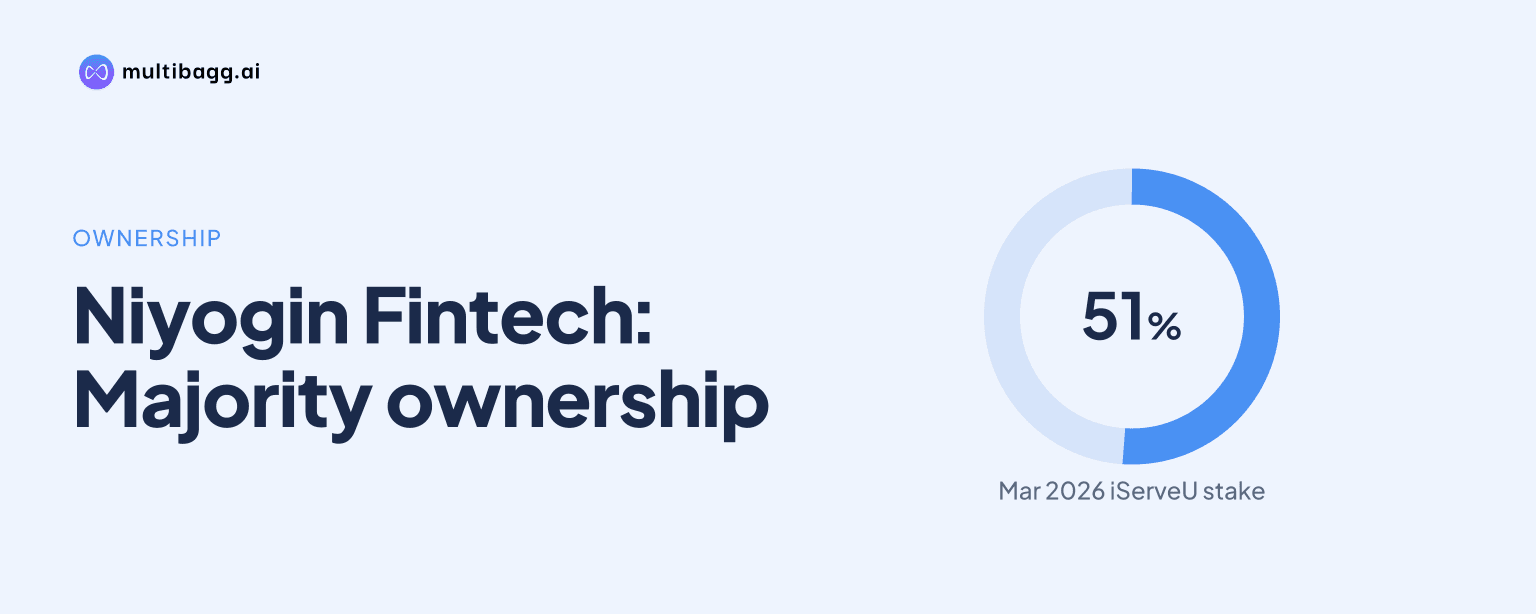
- Niyogin Fintech held a 51% stake in iServeU as of March 2026.
powered by IRIS
Niyogin Fintech Limited shareholders approved the composite restructuring scheme on October 30, 2026, moving the company closer to separating its NBFC business into Niyogin Finserv Limited and combining its remaining business with iServeU Technology Private Limited. The approval matters because the plan is intended to create two focused, separately listed businesses.
Know Niyogin Fintech inside out
Results, valuation, peers and who's buying, in one view.
What did Niyogin Fintech shareholders approve?
Niyogin Fintech approved a Composite Scheme of Arrangement and Amalgamation involving Niyogin Finserv Limited and iServeU Technology Private Limited. The vote took place at a court-convened meeting held pursuant to directions of the National Company Law Tribunal, Chennai Bench.
Under the arrangement, Niyogin Fintech is identified as the demerged and amalgamating company. Niyogin Finserv is the resulting company for the demerged NBFC business, while iServeU is the amalgamated company. The stated structure separates lending and distribution operations from technology and investment holdings.
The company had convened meetings of equity shareholders, secured creditors and unsecured creditors for October 30. The available information also states that secured creditors approved the scheme. However, no detailed voting percentages or quantified financial impact of the arrangement have been provided in the material available.
The approval was sought under Sections 230 to 232 of the Companies Act, 2013. The company said the voting process was subject to regulatory approval thresholds designed to address both statutory majority requirements and the interests of public shareholders.
How did the scheme reach the stakeholder-voting stage?
The scheme reached the voting stage after the NCLT Chennai Bench allowed the first-motion application through an order dated September 11, 2026. The order was uploaded on September 22, following which Niyogin Fintech issued stakeholder-meeting notices on September 29.
Remote e-voting was available from October 26 to October 29, with National Securities Depository Limited facilitating the voting and video-conferencing process. The meetings were scheduled to be held through video conferencing, allowing the relevant stakeholder groups to consider the proposal before the court-directed meeting date.
Before the NCLT process, BSE had issued a no-adverse-observation letter for the scheme. Niyogin Fintech had also received in-principle approval from the Reserve Bank of India for the arrangement involving the company, Niyogin Finserv and iServeU.
The tribunal directed meetings of Niyogin Fintech equity shareholders and creditors, as well as creditor meetings of iServeU. Meetings for certain other stakeholder classes were dispensed with, according to the company disclosures on the first-motion order.
Got a follow-up? Ask IRIS
Why is Niyogin Fintech separating its businesses?
Niyogin Fintech has described the restructuring as a way to create two separately listed companies with direct management accountability and distinct operating strategies. Niyogin Finserv is intended to operate as a tech-enabled NBFC, while iServeU is positioned as a payments-infrastructure business.
Niyogin Fintech is a listed fintech company and registered NBFC that provides a digital platform for financial services used by MSMEs. Its offerings include credit, investments, financial inclusion services and software-as-a-service capabilities. The company builds technology rails that enable banks, fintechs and merchant platforms to offer financial products without developing the underlying infrastructure independently.
As of March 2026, Niyogin Fintech held a 51% stake in iServeU, a 60% stake in Moneyfront and a 100% stake in Niyogin AI. iServeU operates in payments, Moneyfront provides wealth technology, and Niyogin AI focuses on document automation. The scheme is intended to separate the NBFC operations from the technology and investment-related businesses.
The restructuring follows other portfolio actions by the company. At its 38th annual general meeting on September 23, 2026, shareholders approved the sale of its stake in material subsidiary Investdirect Capital Services Private Limited. The special resolution received 100% of valid votes cast in favour.
What does the approval mean for investors and operations?
The shareholder and secured-creditor approvals mark progress in the legal and stakeholder process, but they do not by themselves complete the transaction. Further steps remain under the arrangement process, including the required tribunal and regulatory procedures.
For investors, the main change under the proposed scheme is the planned separation of the group's NBFC operations and payments-infrastructure operations. The company has said the structure is intended to allow each business to pursue its own strategy and provide clearer accountability for management.
The available disclosures do not state an exchange ratio, a final record date, an effective date, or a quantified effect on Niyogin Fintech's capital structure or valuation. Investors therefore do not yet have disclosed figures to assess the final allocation of shares or the financial contribution of each resulting business.
Niyogin Fintech's shares closed at Rs 52.13 on September 29, 2026, up 2.88% on the next-day-close measure cited in the provided information. No share-price movement linked specifically to the October 30 approvals has been disclosed.
Conclusion
Niyogin Fintech's shareholder approval advances a restructuring that would place the NBFC business in Niyogin Finserv and combine the remaining business with iServeU. The court-convened vote follows the NCLT's first-motion approval, BSE's no-adverse-observation letter and the RBI's in-principle approval.
The next items to watch are the publication of detailed voting results and the scrutinizer's report on the company website and BSE platform, followed by further NCLT and regulatory actions required to implement the scheme. The company has previously indicated that completion is expected over 15 to 18 months.