










Niyogin misses Q2 targets but maintains FY27 growth outlook
Key highlights
- iServeU Q2 FY27 net revenue was Rs 18.1 crore, below guidance of Rs 21-24 crore.
- NBFC AUM was Rs 270 crore in Q2 FY27, versus guidance of Rs 325-340 crore.
- iServeU adjusted EBITDA margin was 6.8% in Q2 FY27, below the 20-25% guided range.
- Niyogin retained FY27 NBFC AUM guidance of Rs 400-425 crore.
powered by IRIS
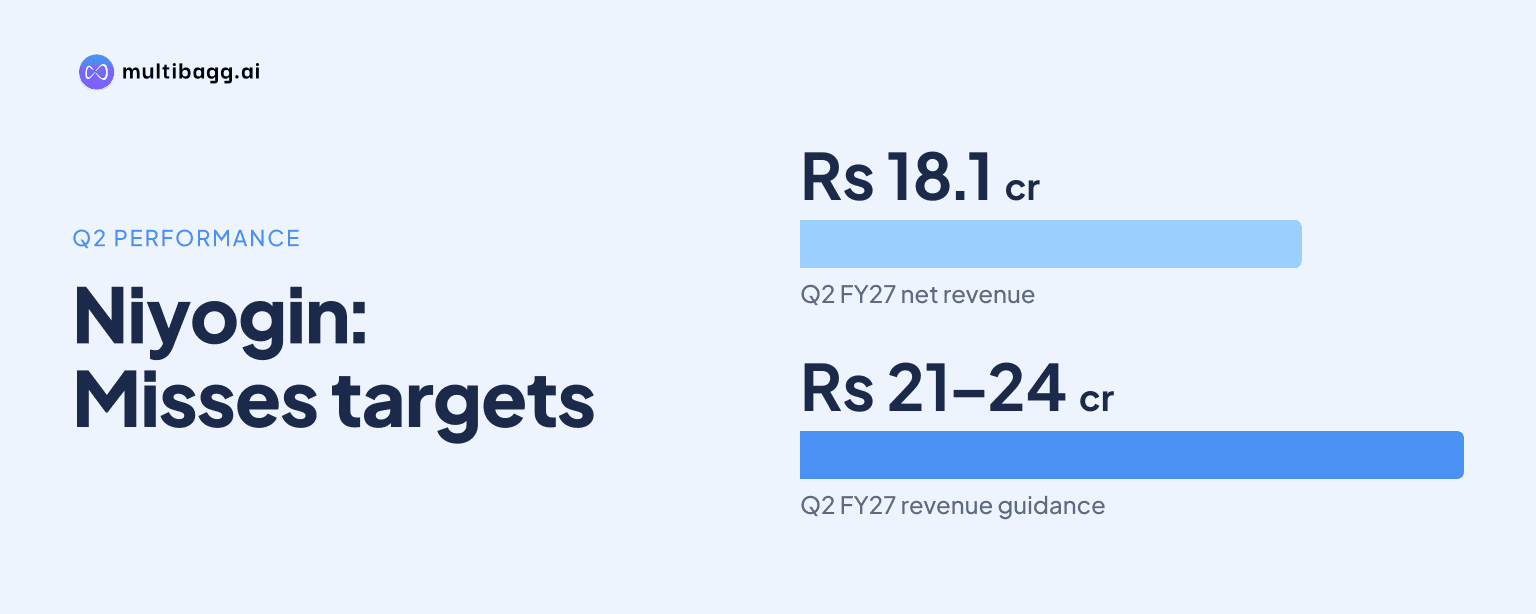
Niyogin missed all four disclosed Q2 FY27 operating guidance measures, with iServeU net revenue at Rs 18.1 crore against Rs 21-24 crore and NBFC assets under management at Rs 270 crore against Rs 325-340 crore, while management retained its FY27 revenue and portfolio estimates.
Know Niyogin Fintech inside out
Results, valuation, peers and who's buying, in one view.
How far did Niyogin miss its Q2 FY27 guidance?
Niyogin fell below each of the four parameters in its Q2 FY27 guidance comparison. iServeU net revenue was Rs 18.1 crore, below the Rs 21-24 crore range, while adjusted earnings before interest, tax, depreciation and amortisation, or EBITDA, margin was 6.8% against guidance of 20-25%. The presentation said iServeU improved sequentially, but its revenue and operating profitability remained below the earlier estimate.
The NBFC business also did not meet its quarterly ranges. Assets under management, or AUM, including off-book exposure, were Rs 270 crore versus guided AUM of Rs 325-340 crore. Profit before tax, or PBT, excluding employee stock option plan, or ESOP, expense was a Rs 1.4 crore loss, compared with guidance for Rs 0.8-1.1 crore of profit. Niyogin attributed this outcome to lower net interest income and operating profitability.
Niyogin’s gap to the bottom end of guidance was Rs 2.9 crore for iServeU revenue and Rs 55 crore for NBFC AUM. The PBT result represented a move from an expected profit to a loss. These comparisons measure delivery against Niyogin’s own ranges rather than against an external forecast.
How did iServeU perform despite missing guidance?
Niyogin’s iServeU business improved sequentially in Q2 FY27 despite remaining below its revenue and margin targets. Net revenue rose about 15% to Rs 18.1 crore from Rs 15.8 crore in Q1 FY27. Reported EBITDA increased to about Rs 2.5 crore from Rs 0.7 crore, while adjusted EBITDA moved to about Rs 1.2 crore from an adjusted EBITDA loss of about Rs 0.5 crore.
iServeU’s reported PBT loss narrowed to about Rs 3.4 crore in Q2 FY27 from about Rs 5.6 crore in Q1 FY27, a reduction of about Rs 2.2 crore. Niyogin said depreciation and provisioning continued to affect the bottom line. Its order book stood at Rs 546 crore, although the presentation describes this as contracted opportunity, with revenue recognition dependent on implementation schedules and customer utilisation.
Technology and payment metrics also increased during the quarter. Technology service provider and software-as-a-service, or TSP/SaaS, revenue was Rs 9.3 crore in Q2 FY27, compared with Rs 9.1 crore in Q1 FY27. Recurring SaaS revenue rose to Rs 6.0 crore from Rs 5.0 crore and accounted for 65% of Q2 TSP/SaaS revenue. Unified Payments Interface gross transaction value increased to Rs 1,134 crore from Rs 703 crore following the onboarding of multiple payment aggregators.
Why did the NBFC business fall short in Q2 FY27?
Niyogin’s NBFC business reported lower income as its lending portfolio contracted. AUM including off-book exposure declined 19% sequentially to Rs 270 crore in Q2 FY27 from Rs 332 crore in Q1 FY27. Net revenue fell to about Rs 5.2 crore from Rs 7.3 crore, while net interest income declined to Rs 8.3 crore from Rs 10.2 crore.
The lower portfolio and income coincided with a reported PBT loss of about Rs 1.6 crore, compared with PBT of Rs 0.8 crore in Q1 FY27. Excluding ESOP expense, the Q2 loss was about Rs 1.4 crore, compared with profit of about Rs 1.0 crore in the preceding quarter. Pre-provisioning operating profit was Rs 1.7 crore, while credit cost was Rs 3.1 crore.
Niyogin said expansion of the portfolio is linked to the availability and cost of liquidity, as well as underwriting and portfolio-level risk considerations. Its stated NBFC priorities include optimising funding, improving loan-book earnings, deploying capital efficiently and originating loans through partners as funding capacity permits. The presentation therefore makes portfolio growth conditional on funding arrangements and lending economics.
Got a follow-up? Ask IRIS
What FY27 outlook is Niyogin maintaining after Q2?
Niyogin retained FY27 estimates that imply growth in iServeU revenue and NBFC AUM, while projecting NBFC PBT below the FY26 actual. For iServeU, management estimates Q3 FY27 net revenue of Rs 20-25 crore and FY27 net revenue of Rs 80-100 crore, compared with Rs 74.7 crore in FY26. The presentation describes the full-year revenue range as 1.1-1.3 times FY26 actual.
For the NBFC, Niyogin estimates Q3 FY27 AUM of Rs 325-340 crore and FY27 AUM of Rs 400-425 crore, compared with Rs 352 crore in FY26. The FY27 AUM range is stated as 1.1-1.2 times FY26 actual. However, FY27 PBT excluding ESOP is estimated at Rs 3-5 crore, below the Rs 6.6 crore reported for FY26.
Niyogin has kept its iServeU adjusted EBITDA margin estimate at 20-25% for both Q3 FY27 and FY27. That range compares with 22.4% in FY26 and 6.8% in Q2 FY27. Management said delivery depends on customer implementation, revenue realisation, funding availability and prevailing business conditions, rather than presenting the estimates as assured outcomes.
What actions does Niyogin say will support its FY27 plan?
Niyogin says iServeU’s immediate focus is converting contracted opportunities into active revenue-generating engagements. The plan includes expanding recurring technology income, improving utilisation of existing infrastructure and progressing partnerships with banks, payment institutions and other partners. iServeU deployed 61.3 thousand soundbox units in Q2 FY27 and had cumulative installations of about 600 thousand units.
Soundbox deployment is linked to device availability and supply conditions, according to the presentation. Niyogin said execution readiness is improving as chip availability normalises, while select aggregators were onboarded under the new business model in Q2 FY27. These operational measures sit alongside the Rs 546 crore order book, which requires implementation before it can contribute to recognised revenue.
For the NBFC, Niyogin says it must secure appropriate funding arrangements to support lending-book expansion. Its plan also includes efficient capital deployment, partner-led origination, prudent credit selection and active portfolio monitoring. Moving from Q2 AUM of Rs 270 crore toward the Q3 estimate of Rs 325-340 crore therefore depends on liquidity access as well as underwriting and funding economics.
Conclusion
Niyogin’s Q2 FY27 presentation shows a gap between quarterly guidance and reported delivery in both principal businesses. iServeU improved sequentially in revenue, EBITDA and PBT loss, but remained below its revenue and margin ranges. The NBFC recorded a smaller portfolio, lower net interest income and a quarterly PBT loss, while management retained FY27 growth estimates for revenue and AUM.
The next disclosures to watch are iServeU’s conversion of its Rs 546 crore order book, progress toward the 20-25% adjusted EBITDA margin estimate, and NBFC funding arrangements needed to support the Q3 AUM estimate of Rs 325-340 crore. Niyogin has identified customer implementation, revenue realisation, funding availability and prevailing business conditions as the variables affecting FY27 delivery.