










NOCIL says 4ADPA duty may not lift PILFLEX-13 sale prices
Key highlights
- NOCIL said a 4ADPA duty could raise domestic PILFLEX-13 costs but may not increase prices while finished-product imports remain untaxed.
- NOCIL reported H1FY27 revenue of Rs 830 crore, up 36% year on year, and EBITDA of Rs 81 crore, up 54%.
- Antioxidants represent 60% of NOCIL’s business, while management described sulfonamides duty benefits as not significant.
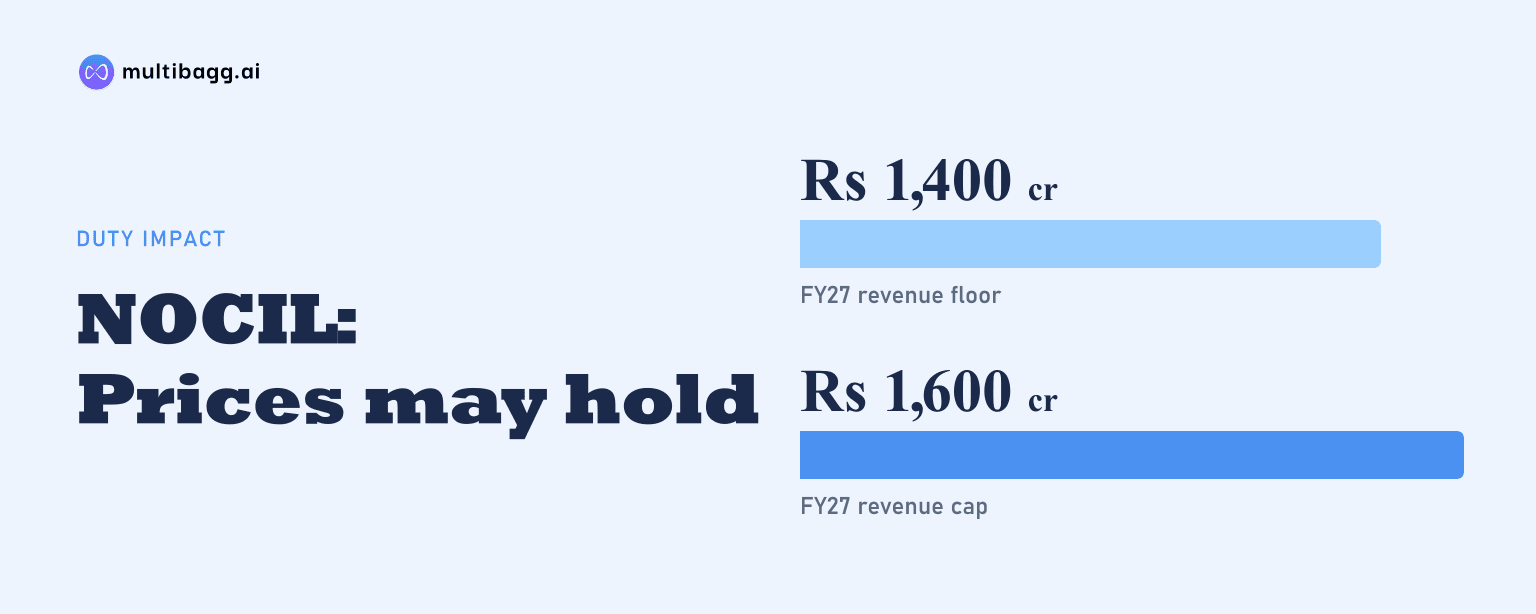
- Management expects FY27 revenue toward the upper end of Rs 1,400 crore to Rs 1,600 crore, with EBITDA margin around 10%.
powered by IRIS
NOCIL Limited said on October 30, 2026, that a potential antidumping duty on 4ADPA may raise domestic PILFLEX-13 production costs but may not lift finished-product prices because PILFLEX-13 imports remain outside duty coverage. Management did not quantify a margin benefit and said the outcome would depend on import pricing and the final market response.
Know NOCIL inside out
Results, valuation, peers and who's buying, in one view.
Why would a 4ADPA duty have limited direct benefit for NOCIL?
A 4ADPA duty would have limited direct benefit for NOCIL because imported PILFLEX-13 would continue competing without finished-product antidumping protection. P. Srinivasan described 4ADPA as an intermediate and precursor to PILFLEX-13, rather than the finished product. He said the earlier antidumping-duty recommendation on PILFLEX-13 could not be notified or was not accepted by the Central government.
If a 4ADPA duty is notified, domestic producers using that input could face a higher cost of making PILFLEX-13. However, Srinivasan said that may not result in a higher PILFLEX-13 selling price because imports remain outside the antidumping zone. NOCIL’s assessment was that domestic suppliers would still compete against imports, leaving the market price unresolved.
The possible effect is therefore indirect rather than a stated gain in revenue or earnings. Management said other domestic producers could face difficulty in production or produce at a higher cost if the duty takes effect. NOCIL did not provide the percentage-margin estimate sought by an analyst and did not say it could automatically pass cost pressure through to customers.
What is the status of PILFLEX-13 antidumping protection?
PILFLEX-13 had no notified antidumping duty protection at the October 30, 2026 earnings call, according to NOCIL management. Srinivasan said the recommendation for PILFLEX-13 was not notified or accepted by the Central government. Consequently, a duty on the 4ADPA intermediate would not place the finished imported product within the same protection framework.
The 4ADPA process was also unresolved at the time of the call. Srinivasan said NOCIL did not know the eventual outcome and referred to what could happen after three months. Even if the duty is notified, management said the result would depend on the market price of PILFLEX-13 and on how imported material is priced.
V. S. Anand said NOCIL had not seen fresh Chinese capacity announcements in the preceding few months beyond projects already announced or coming on stream earlier. That comment does not establish future imports, but it indicates that management had not identified an additional recently announced capacity source while assessing competition in PILFLEX-13.
How much antidumping benefit does NOCIL currently report?
NOCIL said the existing antidumping-duty benefit is not significant across its overall product basket and cannot be precisely quantified. In response to questions about realizations, Srinivasan said the current duty applies only to sulfonamides and provides some benefit. He said no exact figure could be calculated.
Product mix limits the relevance of the sulfonamides measure to total results. Management said antioxidants account for 60% of NOCIL’s business, while sulfonamides are a smaller share. It said higher pricing reflected increased costs, an improved delta between price and cost, and some antidumping-duty contribution rather than a single policy effect.
NOCIL reported H1FY27 revenue from operations of Rs 830 crore, up 36% year on year, while earnings before interest, tax, depreciation and amortisation, or EBITDA, rose 54% to Rs 81 crore. The H1FY27 EBITDA margin was 9.8%, compared with 8.4% in Q2FY27, although the company did not attribute those figures solely to sulfonamides protection.
Got a follow-up? Ask IRIS
What changed in NOCIL’s margins and market conditions?
NOCIL’s Q2FY27 EBITDA was Rs 36 crore, down 20% quarter on quarter, despite rising 61% year on year. Management said the first-half market environment had improved relative to the prior year, but it did not attribute that change exclusively to duty protection, inventory effects or any one product category.
In discussing gross profit per tonne, Srinivasan said some sulfonamides antidumping-duty benefit was present in Q2FY27, but it was not the sole factor. He compared a current run rate of about Rs 700 crore with approximately Rs 520 crore to Rs 525 crore per annum in the previous year, citing an improved run rate and better market conditions in the first six months.
Coal and gas costs, domestic freight and sea freight raised conversion costs during H1FY27, management said. Supply-side challenges also prevented normal operating-leverage benefits from accruing during the half. These cost and production factors are why NOCIL did not present antidumping protection as a standalone driver of its 9.8% H1FY27 EBITDA margin.
What will determine whether NOCIL gains from a 4ADPA duty?
Any gain from a 4ADPA duty would depend on notification, domestic producers’ cost response, import pricing and the final PILFLEX-13 market price. Management said all three domestic producers would continue competing with imports if a duty is notified. NOCIL did not disclose its own 4ADPA sourcing position, a projected PILFLEX-13 price increase or a quantified earnings outcome.
Sulfonamides data also limit measurement of the policy effect. Srinivasan said import data were unavailable, so NOCIL could not determine the extent of undercutting by imported products or the prices at which imports were sold. Management said it considers some amount in pricing decisions but cannot calculate the exact benefit.
NOCIL is pursuing operating measures separately from the trade-policy process. Anand said power and supply constraints experienced earlier in FY27 had been addressed, while captive power-boiler benefits should begin in H2FY27. Management also expects fuller turbine utilisation as volumes rise in coming months, which could affect conversion costs independently of any 4ADPA decision.
Conclusion
NOCIL’s message is that a 4ADPA antidumping duty could change domestic cost structures without necessarily creating higher PILFLEX-13 prices. Finished-product imports remain outside duty coverage, constraining potential pass-through. Existing sulfonamides protection provides some benefit, management said, but antioxidants represent 60% of the business and the company cannot quantify the duty’s total earnings contribution.
The next issue is the unresolved 4ADPA duty outcome, which management indicated could become clearer after about three months. Separately, management expects FY27 revenue toward the upper end of its Rs 1,400 crore to Rs 1,600 crore range, with EBITDA margin around 10%, and is targeting 8% to 10% volume growth from domestic and international markets.