










NOCIL Expects FY27 Revenue Near Rs 1,600 Crore as Pricing Rises
Key highlights
- NOCIL retained its FY27 revenue range of Rs 1,400 crore to Rs 1,600 crore and expects to finish near the upper end.
- NOCIL reported H1FY27 revenue of Rs 830 crore and EBITDA of Rs 81 crore, with a 9.8% EBITDA margin.
- NOCIL's Q2FY27 revenue rose 33% year on year to Rs 427 crore, although volumes declined 3% year on year.
- NOCIL expects FY27 volume growth of 8% to 10% and an H2FY27 volume index of 160 to 165 versus a Q1FY20 base of 100.
powered by IRIS
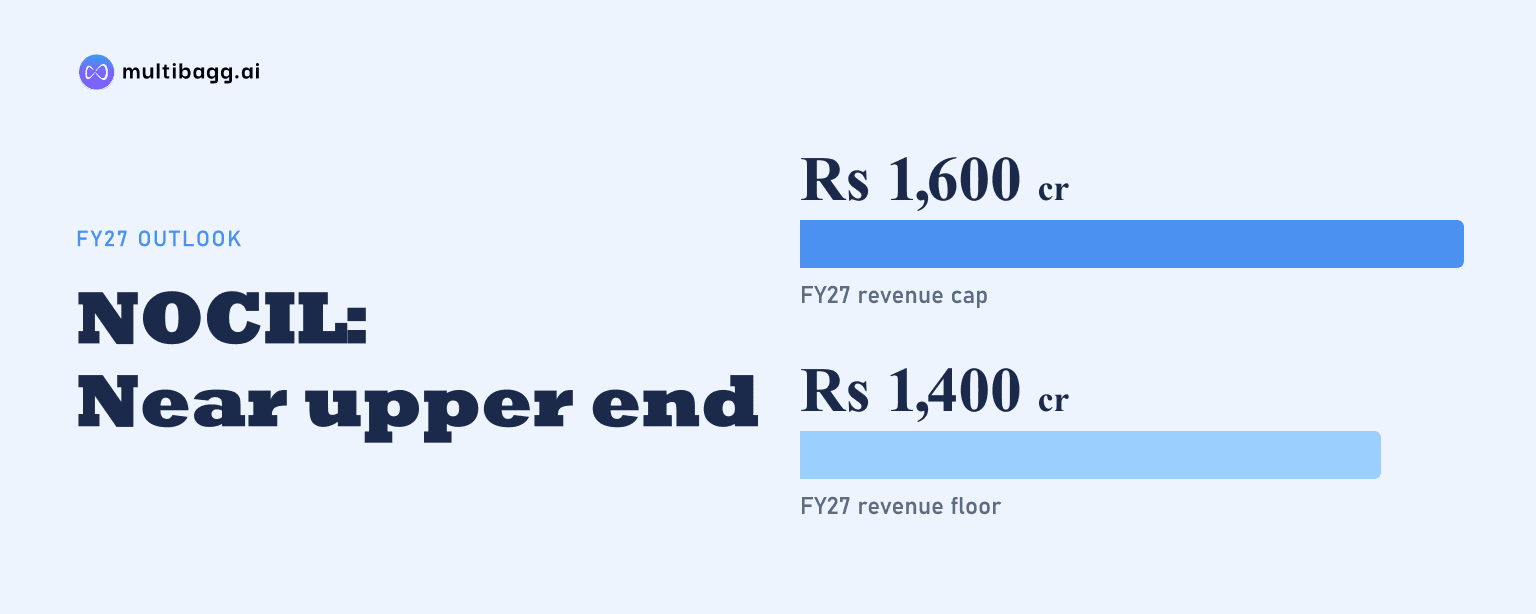
NOCIL Limited expects FY27 revenue to finish near the Rs 1,600 crore upper end of its Rs 1,400 crore to Rs 1,600 crore range after reporting Rs 830 crore of H1FY27 revenue and Rs 427 crore of Q2FY27 revenue, which rose 33% year on year mainly on higher average selling prices.
Know NOCIL inside out
Results, valuation, peers and who's buying, in one view.
What is NOCIL's FY27 revenue and margin outlook?
NOCIL expects FY27 revenue near the upper end of Rs 1,400 crore to Rs 1,600 crore and an earnings before interest, tax, depreciation and amortisation, or EBITDA, margin of around 10%. Managing Director V. S. Anand said on the October 30, 2026 earnings call that the outlook reflected H1FY27 performance and current momentum, while the operating environment remained uncertain.
Management did not raise the Rs 1,600 crore upper bound on the call. Anand said the range contained some conservatism because conditions can evolve from one quarter to the next, and added that NOCIL would seek to achieve more. That was not a revised numerical forecast, so Rs 1,400 crore to Rs 1,600 crore remains the company’s stated FY27 revenue range.
The revenue outlook is linked to management’s expectation of 8% to 10% FY27 volume growth, compared with 3% volume growth in H1FY27. NOCIL expects an H2FY27 volume index of 160 to 165, against a Q1FY20 base of 100, with domestic sales and international opportunities both expected to contribute.
How did NOCIL perform in Q2FY27 and H1FY27?
NOCIL reported Q2FY27 revenue from operations of Rs 427 crore, up 33% year on year and 6% sequentially, while H1FY27 revenue from operations was Rs 830 crore. Management’s opening remarks described H1 revenue growth as 26% year on year, whereas the Chief Financial Officer’s financial summary cited 36% year-on-year growth for the same Rs 830 crore revenue figure.
The Q2 comparison shows that higher average selling prices lifted revenue even as volumes declined 3% year on year and 7% sequentially. In contrast, H1FY27 combined Rs 830 crore of revenue with 3% volume growth. Management attributed the quarterly volume decline to temporary supply constraints and logistics disruption arising from the geopolitical situation.
NOCIL’s Q2FY27 EBITDA was Rs 36 crore, 61% above the year-earlier quarter but 20% below Q1FY27, resulting in an 8.4% margin. H1FY27 EBITDA was Rs 81 crore, up 54% year on year, and the 9.8% margin was closer to management’s approximately 10% full-year objective than the Q2 margin.
Q2FY27 PBT was Rs 28 crore, rising 52% year on year but declining 24% sequentially, while PAT was Rs 24 crore, up 98% year on year and down 13% from Q1FY27. For H1FY27, PBT reached Rs 65 crore, up 57% year on year, and PAT was Rs 52 crore, up 76% year on year.
Why does NOCIL expect second-half volumes to recover?
NOCIL expects H2FY27 volumes to recover because management said the power, supply and logistics constraints affecting Q2FY27 had been addressed. Anand said captive-power boiler benefits should start contributing in the second half and that turbine utilisation should increase as production volumes rise in the coming months.
The expected recovery is material relative to the Q2FY27 index of 135, measured against Q1FY20 at 100. Management’s 160 to 165 H2FY27 index expectation supports its 8% to 10% FY27 volume-growth outlook, although analysts on the call cited moderated tire-demand growth and geopolitical uncertainty.
Domestic volumes recorded single-digit growth in H1FY27, supported by better demand following the implementation of GST 2.0, according to management. Export volumes also grew by a single-digit percentage as customer engagements converted into business opportunities, but management said specialised rubber chemicals would remain in broadly similar proportions within international volumes.
NOCIL identified a weaker monsoon and inflationary pressures as potential near-term demand headwinds for the tire industry. Management nevertheless cited replacement demand, original equipment manufacturer, or OEM, volumes and longer-term industry drivers when explaining its confidence in an H2FY27 volume index of 160 to 165.
Got a follow-up? Ask IRIS
What could affect NOCIL's FY27 margin delivery?
NOCIL’s ability to deliver an EBITDA margin of around 10% depends on fuel, utility and freight costs as well as the operating leverage from volume recovery. Management said coal and gas costs increased significantly in H1FY27, while both domestic freight and sea freight also rose.
The difference between the 9.8% H1FY27 margin and the 8.4% Q2FY27 margin illustrates the pressure from those costs and lower volumes. Q2FY27 revenue increased 6% sequentially to Rs 427 crore, but EBITDA declined 20% sequentially to Rs 36 crore because supply constraints limited the volume-related benefits that would normally accompany higher output.
Management said antidumping duty, or ADD, on sulfonamides contributed some amount to Q2FY27 gross profit, but was not significant across the full portfolio. The Chief Financial Officer said antioxidants account for 60% of NOCIL’s business and could not quantify the ADD contribution to pricing or margins.
NOCIL said its annual gross-margin run rate had improved to about Rs 700 crore, compared with about Rs 520 crore to Rs 525 crore in the previous year. Management attributed the change to market conditions, price-cost dynamics and some ADD contribution, rather than solely to duty protection or legacy inventory effects.
What projects and market developments could shape NOCIL's next phase?
NOCIL’s brownfield TDQ expansion at Dahej awaits customer approvals, after which management hopes to capitalise the project in Q3FY27. The project involves Rs 220 crore of investment, and the Chief Financial Officer estimated annual depreciation of about Rs 1 crore a month, or Rs 3 crore a quarter, after capitalisation.
The integrated specialty rubber chemicals project was progressing as planned as of October 30, 2026, although management gave no commissioning date or investment figure. NOCIL said the projects are intended to broaden its product portfolio and manufacturing capabilities, alongside efforts to expand domestic and export customer relationships.
NOCIL is also exploring inorganic opportunities in chemicals to make the business more resilient to cycles and deploy its cash resources, but disclosed no transaction, target or timetable. Management said it would provide an update if there was a development, leaving any acquisition effect outside the FY27 revenue range of Rs 1,400 crore to Rs 1,600 crore.
On competitive conditions, management said it had not seen new Chinese capacity additions in the preceding few months beyond projects already announced or coming on stream earlier. It also said a possible ADD on 4ADPA could raise other domestic producers’ costs, but might not increase PILFLEX-13 prices because imports would remain outside the antidumping zone.
Conclusion
NOCIL’s FY27 outlook combines Rs 830 crore of H1FY27 revenue, a 9.8% H1 EBITDA margin and an expectation that corrected supply constraints will lift volumes in H2FY27. Q2FY27 showed that pricing can support revenue, with sales reaching Rs 427 crore despite lower volumes, but it also showed the margin effect of higher utility and freight costs, with EBITDA margin at 8.4%.
The next disclosed items to watch are volume movement toward the 160 to 165 H2FY27 index range, the contribution from captive-power boilers and higher turbine utilisation, and pending customer approvals for the Dahej TDQ expansion. Management hopes to capitalise the Rs 220 crore TDQ project in Q3FY27, while its stated FY27 targets remain revenue near the top of Rs 1,400 crore to Rs 1,600 crore and EBITDA margin of around 10%.