










NOCIL retains 8%-10% volume growth target through FY28
Key highlights
- NOCIL reported a Q2FY27 volume index of 135, using Q1FY20 volume as the base of 100.
- NOCIL management targets a 160-165 volume index in H2FY27.
- NOCIL retained an 8%-10% volume-growth assumption for FY27 and said it was fair for FY28.
- NOCIL Q2FY27 revenue was Rs 427 crore, up 33% year on year, while volumes declined 3% year on year.
powered by IRIS
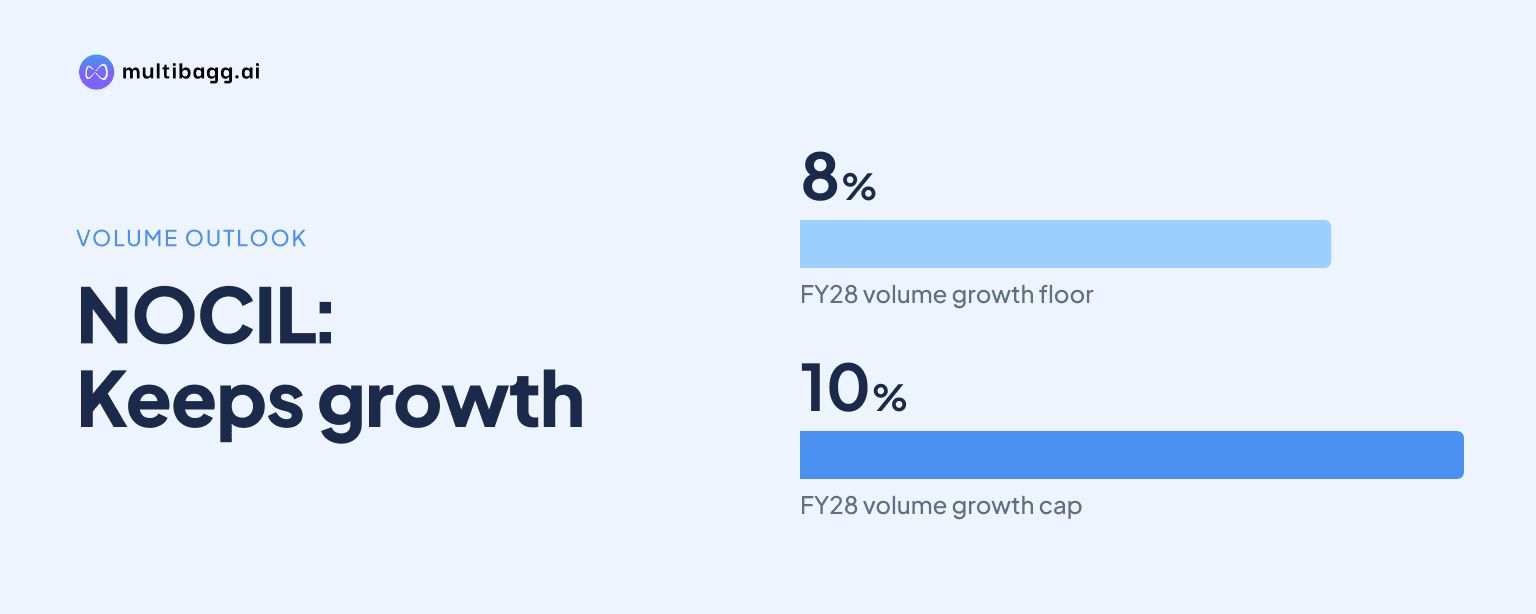
NOCIL Limited retained its 8%-10% volume-growth target for FY27 and FY28, despite Q2FY27 volume falling 3% year on year to an index of 135. Management aims for a 160-165 volume index in H2FY27 after resolving power, supply and logistics constraints that curtailed production and deliveries during the first half.
Know NOCIL inside out
Results, valuation, peers and who's buying, in one view.
What volume growth is NOCIL targeting through FY28?
NOCIL is targeting 8%-10% volume growth in FY27, and management said the same assumption was fair for FY28. Managing Director V. S. Anand reaffirmed the range on the October 30, 2026 call after an analyst calculated that NOCIL would need an H2FY27 volume index near 165 to achieve the FY27 assumption.
NOCIL said it should achieve at least the 160 range in H2FY27, specifying an index of 160-165. The company uses Q1FY20 volume as the base of 100, and its reported Q2FY27 index was 135. The target therefore requires a higher production and sales run rate than the second-quarter level.
Management did not disclose separate volume targets for domestic and export markets. It said both markets would contribute to the FY27 target: domestic volume grew in single digits in H1FY27 following GST 2.0, while export volume also recorded single-digit growth as customer engagements turned into business opportunities.
Why did NOCIL volume fall in Q2FY27?
NOCIL volume declined 3% year on year and 7% sequentially in Q2FY27 because of temporary supply-side constraints and logistics challenges associated with the geopolitical situation. An analyst also referred to power issues in Q1FY27, while management said the operational challenges had been addressed by the October 30 call.
The volume decline contrasted with a 33% year-on-year rise in Q2FY27 revenue from operations to Rs 427 crore. NOCIL said average selling prices drove the revenue increase, which was also 6% above the preceding quarter, rather than an increase in physical sales volumes.
Earnings before interest, tax, depreciation and amortisation, or EBITDA, reached Rs 36 crore in Q2FY27, up 61% year on year but down 20% sequentially. The EBITDA margin was 8.4%, compared with 9.8% for H1FY27, when EBITDA rose 54% year on year to Rs 81 crore on revenue of Rs 830 crore.
How does NOCIL plan to restore H2FY27 volumes?
NOCIL plans to restore H2FY27 volumes through resolved supply constraints, higher production and contributions from domestic and international markets. Management said volumes should start picking up in the coming months, while international opportunities that are now fructifying should help mitigate more moderate market expectations.
The company said benefits from its captive power boilers should start accruing in H2FY27. Full utilisation of turbines will occur as volume increases, according to management, meaning the expected operational benefit depends on production reaching a higher level rather than solely on the equipment being installed.
NOCIL also said H1FY27 operating leverage was limited by higher coal, gas, domestic freight and sea-freight costs. Chief Financial Officer P. Srinivasan said supply-side disruptions prevented the normal leverage benefits from accruing in the first half, though management expects some benefit as H2FY27 volumes rise.
Specialised rubber chemicals are not expected to provide a separate step-up in export growth. Anand said this part of exports should move in similar ratios, with no significant jump expected. The 160-165 H2FY27 index objective therefore depends on broad execution across domestic and overseas business rather than a disclosed product-mix change.
Got a follow-up? Ask IRIS
How does the volume target support NOCIL's FY27 outlook?
NOCIL retained its FY27 revenue outlook of Rs 1,400 crore to Rs 1,600 crore and said it expected to close toward the upper end with EBITDA margin of around 10%. Management described the outlook as conservative because conditions can evolve from one quarter to the next, particularly before Q4FY27.
Management said Q3FY27 pricing showed a marginal uptick over H1FY27 levels. Srinivasan nevertheless linked the outlook to the volume index of 160 and above, indicating that higher physical sales remain integral to reaching the revenue range rather than pricing alone.
NOCIL reported profit before tax of Rs 28 crore in Q2FY27, up 52% year on year but down 24% sequentially. Profit after tax was Rs 24 crore, up 98% year on year and down 13% sequentially; H1FY27 profit after tax was Rs 52 crore, a 76% year-on-year increase.
The Dahej brownfield TDQ expansion is progressing toward customer approvals, which management expects over the coming months. NOCIL hopes to capitalise the Rs 220 crore project in Q3FY27 after pending approvals, with annual depreciation estimated at about Rs 12 crore, or roughly Rs 3 crore a quarter.
What could prevent NOCIL from meeting its H2FY27 target?
NOCIL said weaker monsoon conditions and inflationary pressures could produce near-term demand headwinds, while crude oil prices rose in Q2FY27 amid geopolitical tensions. An analyst cited tyre-volume expectations moderated to 4%-5% from 8%, and management said it had factored such moderation into its assessment.
Import competition remains another uncertainty. NOCIL cited import dumping, while management said antidumping duty on sulfonamides covers only a portion of its portfolio. Antioxidants account for 60% of NOCIL business, so management said company-wide results cannot be attributed solely to antidumping measures.
Management could not quantify the eventual effect of a possible antidumping duty on 4ADPA, an intermediate used in the precursor to PILFLEX-13. It said a duty, if notified, could raise other domestic producers' costs, but imported PILFLEX-13 would remain outside antidumping protection and the marketplace outcome would still need to be seen.
Inventory management is also relevant to second-half execution. Srinivasan said working capital as a percentage of sales had declined to around 25% from more than 30%, or more than 32%, around March 2025, while inventory generally turns over in about 40 to 60 days. Management said it saw no significant inventory effect for the next quarter as of the call date.
Conclusion
NOCIL's unchanged 8%-10% volume assumption through FY28 rests on a marked H2FY27 recovery from the Q2FY27 index of 135 to a targeted 160-165. Revenue growth in Q2FY27 was led by higher selling prices despite lower volumes, making restored production, supply reliability and domestic and export execution central to the company's FY27 operating outlook.
The next disclosures to watch are progress toward the 160-165 H2FY27 index, the operational effect of captive power and fuller turbine utilisation, and customer approvals for the Dahej TDQ project expected over the coming months. Management also retained its Rs 1,400 crore to Rs 1,600 crore FY27 revenue range and EBITDA-margin outlook of around 10%, while identifying Q4FY27 conditions as unresolved.