










National Securities Depository Ltd Q2 Income Rises 34.8%
Key highlights
- NSDL reported Q2 FY27 consolidated total income of ₹582.6 crore, up 34.8% year-on-year.
- Consolidated revenue from operations rose 36.5% year-on-year to ₹545.9 crore in Q2 FY27.
- Consolidated profit after tax increased 10.9% year-on-year to ₹122.2 crore.
- India added nearly 90 lakh demat accounts in Q2 FY27, taking the total above 24 crore.
powered by IRIS
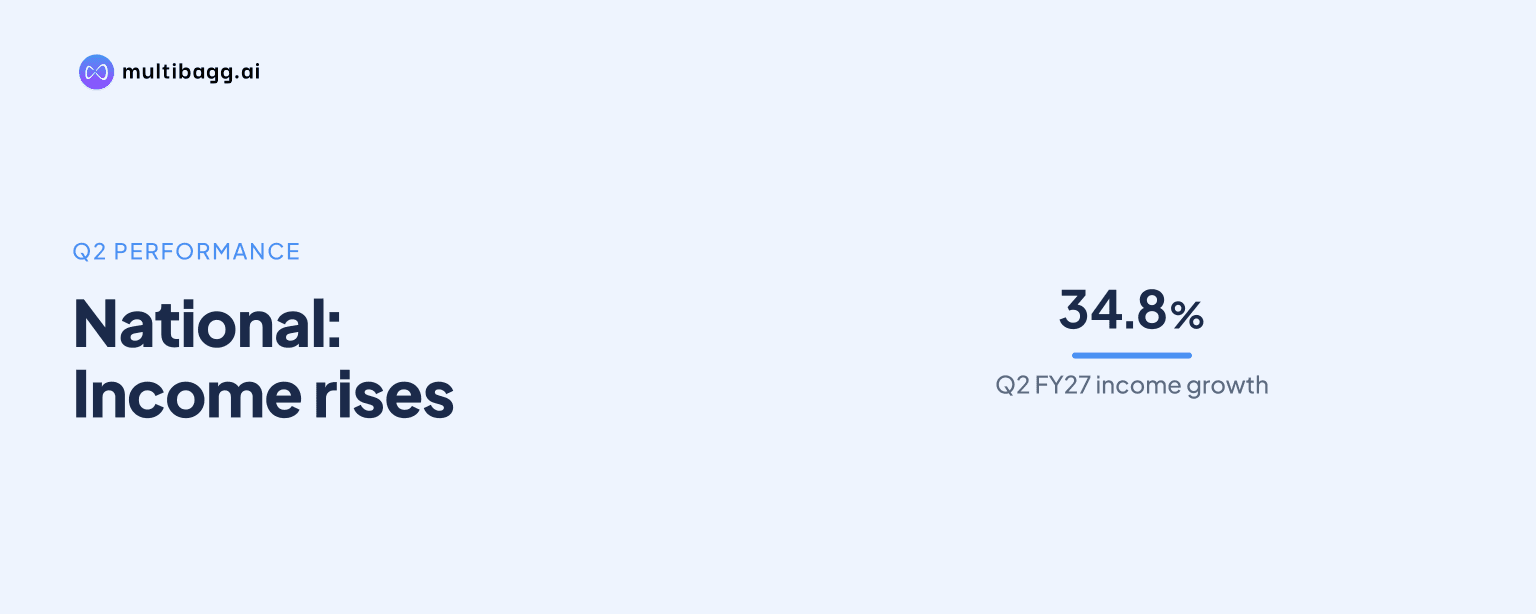
National Securities Depository Ltd reported consolidated total income of ₹582.6 crore in Q2 FY27, a 34.8% year-on-year increase, while consolidated net profit rose 10.9% to ₹122.2 crore as market activity and demat account additions supported revenue growth.
Know National Securities Depository inside out
Results, valuation, peers and who's buying, in one view.
What did National Securities Depository Ltd report for Q2 FY27?
National Securities Depository Ltd reported a substantial increase in consolidated income for the quarter ended September 30, 2026. Total income rose to ₹582.6 crore from ₹432.2 crore in Q2 FY26, while revenue from operations increased 36.5% year-on-year to ₹545.9 crore from ₹400 crore.
The company's consolidated EBITDA was ₹178.5 crore during the quarter, compared with ₹158.8 crore a year earlier. Consolidated profit after tax was ₹122.2 crore, compared with ₹110.4 crore in Q2 FY26. This represented 10.9% year-on-year growth in profit, lower than the increase in total income.
A separate financial-results disclosure cited standalone total income of ₹582.6 crore and net profit of ₹122.5 crore for Q2 FY27. The earnings-call presentation, however, described ₹582.6 crore as consolidated total income and reported consolidated profit after tax of ₹122.2 crore. The reported figures should therefore be read according to the relevant standalone or consolidated filing.
What supported NSDL's quarterly revenue growth?
NSDL linked its business performance to healthy activity in India's primary market and continuing investor participation. During the first nine months of calendar 2026, India's primary market raised more than ₹1.17 lakh crore through 244 initial public offerings, according to management's earnings-call comments.
Management said nearly ₹90,000 crore of this amount was raised in Q2 FY27, including the listing of National Stock Exchange. Primary-market issuance, new listings and broader securities-market participation are relevant to a depository because they add to the volume of securities held and serviced through the market infrastructure system.
The total number of demat accounts in India crossed 24 crore, with nearly 90 lakh accounts added in Q2 FY27, management said. These additions indicate continued expansion in the base of investors using dematerialised securities accounts. NSDL did not provide a separate figure in the supplied information for its own account additions or market share.
On a sequential basis, NSDL reported 5.7% growth in consolidated revenue from operations and 3.9% growth in total income. Consolidated net profit rose 24.6% from the preceding quarter, according to the earnings call.
Why did profit grow slower than NSDL's income?
NSDL's consolidated total income grew 34.8% year-on-year, whereas consolidated profit after tax increased 10.9%. The company described ongoing investments in technology infrastructure and digital platforms, and commentary around the results noted that elevated technology-modernisation costs affected the pace of profit growth.
The reported EBITDA increased by ₹19.7 crore year-on-year to ₹178.5 crore. However, the provided material does not set out a detailed cost breakdown, margin figure or a quantified amount of spending on each technology initiative. As a result, the results establish that profit growth lagged income growth, but do not support a more specific attribution across expense categories.
NSDL is a Securities and Exchange Board of India-registered market infrastructure institution that provides products and services for India's financial and securities markets. Its results therefore reflect a mix of transaction-linked activity, investor participation and operational spending required to maintain and develop depository infrastructure.
Got a follow-up? Ask IRIS
What is Demat 2.0 and what has NSDL announced?
NSDL said it has achieved a pilot launch of Demat 2.0, which it described as a next-generation platform using distributed ledger technology. The platform is intended to support tokenised securities and enable real-time settlement through integration with the Reserve Bank of India's central bank digital currency infrastructure.
The announcement places Demat 2.0 within NSDL's broader technology investments. The supplied disclosures do not provide a commercial launch date, a revenue target, customer rollout schedule or financial contribution from the pilot. The initiative remains a pilot based on the information available.
For investors and market participants, the development is relevant because a depository is central to the holding and transfer of electronic securities. Any implementation of technology supporting tokenised securities or real-time settlement would need to operate within the applicable market-infrastructure and regulatory framework.
NSDL also made the audio recording of its Q2 FY27 financial-results conference call available on its website following the November 2, 2026 call. The conference call had been scheduled to discuss the quarterly performance with investors and analysts.
How do NSDL's results affect investors and the securities industry?
The Q2 figures show that NSDL benefited from a period of strong capital-market activity. Revenue from operations of ₹545.9 crore and total income of ₹582.6 crore provide evidence of this operating momentum, while the rise in demat accounts points to continued retail and institutional participation in securities markets.
At the same time, profit after tax growth of 10.9% was materially below the 34.8% increase in total income. This difference is important for investors assessing how much of the higher activity is translating into earnings while NSDL funds technology modernisation and newer initiatives.
The wider industry context includes a large IPO pipeline and rising use of demat accounts. For market participants, depositories provide essential post-trade infrastructure rather than direct exposure to the price direction of listed shares. Their business activity can nevertheless be influenced by issuance volumes, investor onboarding and securities-market transactions.
Conclusion
National Securities Depository Ltd delivered Q2 FY27 consolidated total income growth of 34.8% to ₹582.6 crore, supported by active primary markets and a growing demat-account base. Consolidated profit after tax increased 10.9% to ₹122.2 crore, showing that earnings rose at a slower pace than income during a period of technology investment.
The next disclosed area to watch is the progress of the Demat 2.0 pilot, including any updates on rollout, integration or commercial use. Investors can also track future disclosures for changes in primary-market activity, demat-account additions, operating costs and the distinction between standalone and consolidated financial measures.