










NSDL rolls out tokenised bonds and market APIs in H1 FY27
Key highlights
- NSDL developed DEMAT 2.0, a DLT platform for near real-time corporate-bond settlement through the RBI’s wholesale CBDC infrastructure.
- NSDL integrated with NSE for electronic gold receipts and launched APIs for online bond platforms during H1 FY27.
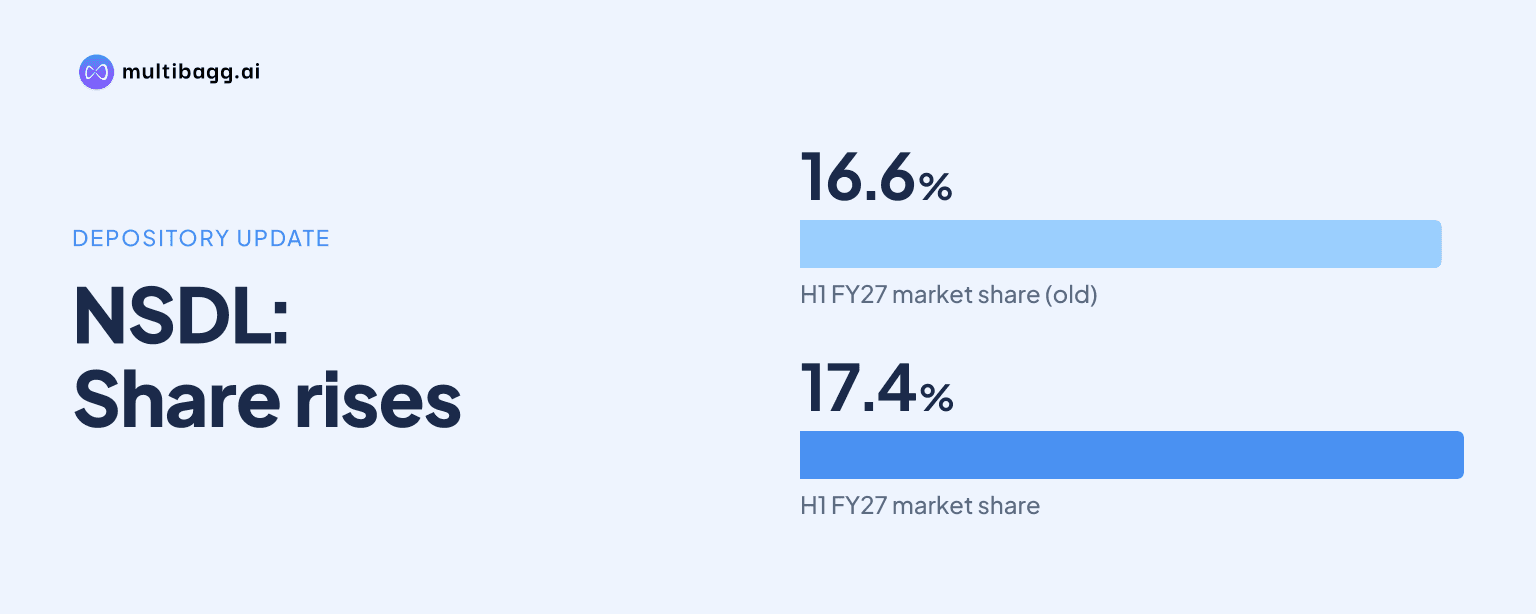
- NSDL added 32.4 lakh gross and 27.9 lakh net demat accounts in H1 FY27, lifting incremental market share to 17.4% from 16.6%.
- NSDL added 10 depository participants in H1 FY27, taking its network to 320.
powered by IRIS
NSDL expanded its market-infrastructure services in H1 FY27 by developing DEMAT 2.0, a tokenised corporate-bond platform designed for near real-time settlement, integrating with NSE for electronic gold receipts, and adding online bond-platform APIs. The initiatives were disclosed alongside 32.4 lakh gross demat-account additions and 10 new depository participants.
Know National Securities Depository inside out
Results, valuation, peers and who's buying, in one view.
What did NSDL introduce in H1 FY27?
NSDL introduced DEMAT 2.0 for tokenised bonds, an NSE integration for electronic gold receipts (EGRs), and application programming interface (API) connectivity for online bond platform providers (OBPPs) in H1 FY27. These three items were among six key achievements reported for the half year, together with 10 new depository participants (DPs) and 32.4 lakh gross account additions.
DEMAT 2.0 addresses corporate bonds, while the NSE connection applies to dematerialised ownership of gold held in approved vaults. The OBPP connection covers real-time account and holdings validation and electronic instruction submission for bond transactions. NSDL also identified a 2022 blockchain-based platform for monitoring bond and debenture security and covenants, placing the H1 FY27 developments after an earlier bond-market technology deployment.
How does NSDL's tokenised-bond platform work?
NSDL developed DEMAT 2.0 as a distributed ledger technology (DLT) platform for corporate bonds, designed for near real-time settlement through the Reserve Bank of India's (RBI) wholesale central bank digital currency (CBDC) infrastructure. The Q2 FY27 presentation describes the proposed settlement mechanism but does not provide a launch date, transaction count, client count or settlement volume for the platform.
The corporate-bond platform sits beside NSDL's core depository activities, including dematerialisation, market and off-market transfer settlement, corporate actions, account management and pledges. In the Q2 FY27 custody-value mix, debt accounted for 13.9%, compared with 80.0% for equity and 6.1% for other assets. This split shows that the bond workflow serves a separate part of NSDL's custody base rather than replacing its equity-led depository services.
NSDL's timeline records a commercial-paper issuance platform in 2021 and a blockchain-based platform in 2022 for managing and monitoring security and covenant matters related to bond issuance. DEMAT 2.0 therefore adds a DLT-based corporate-bond settlement design to platforms already identified for commercial paper and bond-related monitoring.
How do NSDL's EGR and OBPP APIs operate?
NSDL's NSE API integration automates EGR creation and is intended to improve processing. EGRs represent dematerialised ownership of physical gold in approved vaults, making the integration a link between the receipt-creation process and NSDL's depository infrastructure. The H1 FY27 update does not disclose EGR creation volumes, processing times or a measured change in processing performance.
NSDL's OBPP API provides real-time validation of accounts and holdings and enables electronic instruction submission, which the presentation says simplifies bond transactions. The mechanism combines validation and instruction workflows for online bond platforms. NSDL does not state how many OBPPs were connected or how many instructions were submitted through the API during H1 FY27.
The OBPP API is distinct from NSDL's existing Depository Account Validation service, which validates a DP identification number, client identification number and Permanent Account Number (PAN). The H1 FY27 OBPP service is specifically described as connectivity for online bond platforms, while the established validation service is listed among NSDL's ancillary products and value-added services.
Got a follow-up? Ask IRIS
How do the new services fit NSDL's technology offerings?
NSDL's H1 FY27 services extend a technology timeline that includes its New Depository System in 2010, e-Voting in 2012, a T+1 rolling settlement cycle in 2023 and a beta T+0 rolling settlement cycle in 2024. In 2025, NSDL reported implementation of direct payout settlement for securities. The newer DLT, EGR and OBPP initiatives address bond settlement, gold-receipt processing and bond-platform instructions rather than those equity-settlement milestones.
NSDL also widened digital access to Form 121 in H1 FY27. Any investor can submit Form 121 on the public NSDL website using PAN and a one-time password (OTP), without logging in; previously, the facility was limited to registered NSDL users. This change concerns investor access rather than the three integrations, but it similarly shifts a process to a digital workflow.
NSDL's existing e-services include SPEED-e for electronic delivery instructions, SPICE for digital submission of power-of-attorney instructions to DPs, IDeAS for online demat account statements and STeADY for encrypted straight-through trade processing. The EGR and OBPP APIs add market-specific connections to an existing set of electronic account, instruction and processing services.
What changed in NSDL's network and account base?
NSDL added 10 DPs in H1 FY27, taking its DP network to 320, while gross demat-account additions reached 32.4 lakh and net beneficiary-owner account additions reached 27.9 lakh. The presentation says incremental accounts from new DPs aided the 14.9% increase in NSDL's H1 FY27 incremental accounts.
NSDL's 27.9 lakh net additions in H1 FY27 were 3.6 lakh above the 24.3 lakh reported in H1 FY26. Industry net incremental accounts increased 9.9% to 160.8 lakh, while NSDL's increased 14.9%. NSDL's incremental market share rose to 17.4% from 16.6% across the same half-year comparison.
In Q2 FY27, NSDL added 17.8 lakh gross accounts and 15.6 lakh net accounts, compared with 16.1 lakh gross and 13.9 lakh net accounts in Q2 FY26. Net beneficiary-owner accounts reached 471.8 lakh in Q2 FY27, up from 418.9 lakh a year earlier. These account and network figures describe NSDL's distribution base, not usage of DEMAT 2.0, EGR creation or OBPP connectivity.
Conclusion
NSDL's H1 FY27 developments combine three market workflows: tokenised corporate-bond settlement designed around the RBI's wholesale CBDC infrastructure, automated EGR creation through NSE integration, and online bond-platform connectivity for validation and electronic instructions. The additions follow NSDL's earlier commercial-paper issuance platform and blockchain-based bond-monitoring platform, while its DP network reached 320 and net account additions reached 27.9 lakh.
The next disclosure to watch is operating use of DEMAT 2.0, the NSE EGR integration and the OBPP API. NSDL's H1 FY27 presentation provides the platform designs and functions but leaves transaction volumes, connected clients, processing outcomes and settlement activity unresolved.