










Nuvama sees Rs 85-90 crore pipeline as IPOs rebound
Key highlights
- Nuvama disclosed an Rs 85-90 crore probability-adjusted pipeline from about 30 ECM and nine advisory mandates.
- IPOs in Nuvama’s target market increased from four in Q1 to 38 in Q2.
- Nuvama said ECM revenue rose by more than 2.5-2.6 times from Q1 to Q2.
- Management estimated CAS reduced Institutional Equities broking income by at least Rs 2-3 crore per month.
powered by IRIS
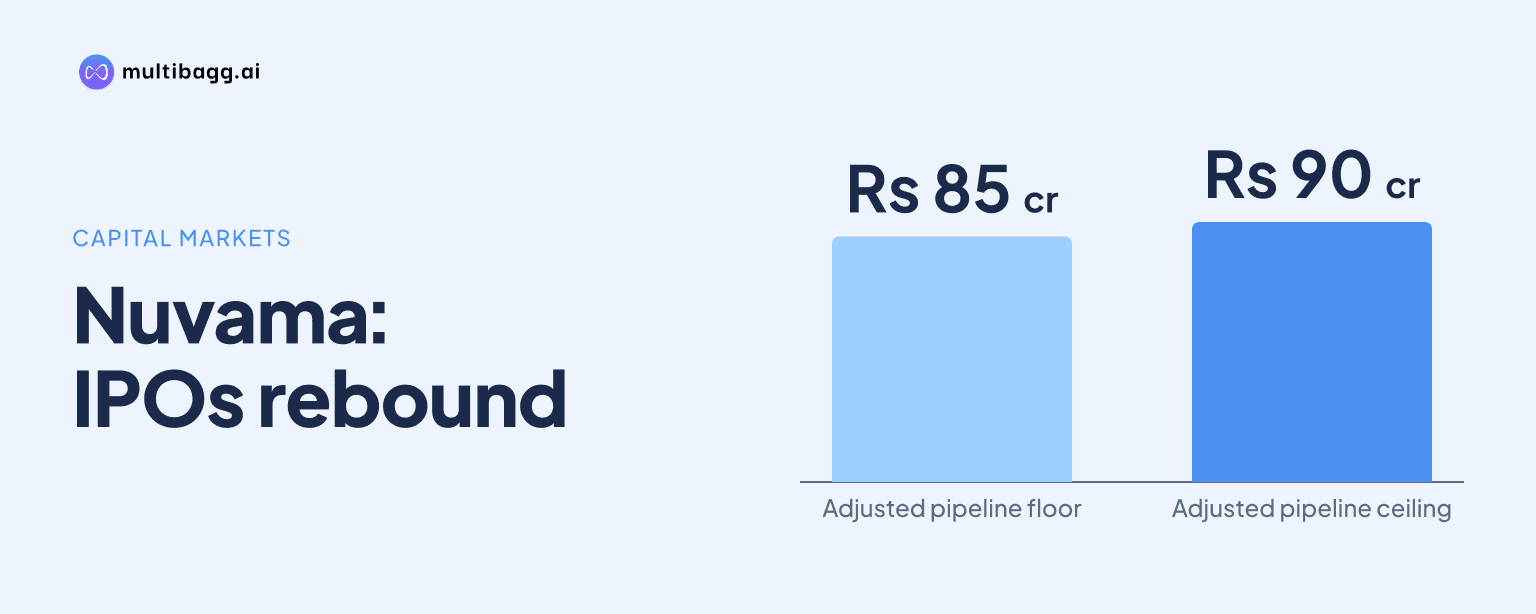
Nuvama Wealth Management Limited disclosed an Rs 85-90 crore probability-adjusted capital-markets revenue pipeline after initial public offerings, or IPOs, in its target market increased from four in the first quarter, or Q1, to 38 in the second quarter, or Q2. Management said equity capital markets revenue rose by more than 2.5 times sequentially.
Know Nuvama Wealth Management inside out
Results, valuation, peers and who's buying, in one view.
What is Nuvama’s current capital-markets pipeline?
Nuvama has about 30 equity capital markets, or ECM, mandates and nine advisory mandates, together carrying probability-adjusted revenue of Rs 85-90 crore. Management presented the amount as a pipeline estimate based on the likelihood of individual transactions completing, not as booked revenue or a financial target.
The pipeline's timing remains dependent on execution and revenue recognition. Management said revenue from some ECM deals completed during Q2 would be recognised in Q3, meaning the increase in IPO activity does not translate fully into revenue in the same reporting period.
Nuvama estimated its participation in 15%-18% of ECM transactions by count, describing this as roughly 18-20 mandates out of every 100 transactions. Management said it has lower representation in block deals, better positioning in qualified institutional placements and stronger participation in IPOs, and is working to increase its block-deal share.
Why did Nuvama’s ECM revenue increase in Q2?
Nuvama’s ECM revenue rose by more than 2.5-2.6 times from Q1 to Q2 because IPOs in its target market increased from four to 38 and it captured a large number of transactions. Management described Q1 as fully dry for issuance in its relevant market segment.
The change also altered the mix within Capital Markets. Fixed-income revenue in Q1 had been Rs 20-25 crore above management’s business-as-usual run rate, and it declined by a similar amount in Q2 as that activity returned to a steadier level. ECM moved in the opposite direction as IPO issuance revived.
Institutional Equities faced a separate effect from CAS, which management said reduced broking income by at least Rs 2-3 crore a month. Management said the earlier model was expected to return from December and should reverse that impact, while ECM deal revenue increased alongside the IPO recovery.
How does IPO activity compare with Nuvama’s other capital-markets trends?
The IPO recovery offset part of the disruption in Institutional Equities but did not make performance uniform across products. Management identified three Q2 vectors: fixed income normalising after its Rs 20-25 crore Q1 uplift, ECM revenue increasing with issuance, and CAS reducing Institutional Equities broking income by at least Rs 2-3 crore monthly.
Asset Services did not experience a CAS impact, management said. Its Q2 revenue declined sequentially despite assets increasing because the cash component of collateral normalised after new clients initially brought in collateral with a higher cash proportion during Q1.
Nuvama said activity in the options market was returning to normal and agreed that growth of about 4%-5% from current levels was an appropriate expectation. The Rs 85-90 crore ECM and advisory pipeline is therefore relevant to near-term Capital Markets activity, but it does not remove product-specific movements in fixed income, broking or Asset Services.
Got a follow-up? Ask IRIS
What new services is Nuvama planning in Asset Services?
Nuvama plans to introduce registrar and transfer agent, or RTA, and trustee services for alternative investment funds, or AIFs, and portfolio management services, or PMSs. Management said the RTA service would launch with a minimum offering by the end of November or December, become full-blown by March, and trustee services would go live between Q3 and Q4.
These products are separate from the Rs 85-90 crore capital-markets pipeline. In clearing, management said yields could remain at 2.5%-2.8% for the next two years if cash collateral remains around 38%-40% of the mix and deposit yields stay within 50 basis points of their current level.
Management also said four or five Asset Services clients had started using commodities markets, although it assessed the present opportunity at only 7%-8% of the size of equity derivatives. It expects another two or three quarters may be needed to establish steady-state activity because clients must build research, infrastructure, algorithms and testing capabilities.
What competitive factors could affect Nuvama’s Asset Services business?
Nuvama said Asset Services and custody already face about 18-19 competitors, and management expects more custody licences over the next two years if the regulator remains liberal in issuing them. It said the market has expanded multi-fold over the past 10 years, while service providers have not increased at the same pace.
In domestic clearing, Nuvama estimated its share of the full PMS book at 6%-7% and said it captures about 25% of new registrations in the PMS and AIF segment. Management said the company is focused on a specific group of high-frequency trading and systematic quantitative AIFs rather than long-only AIFs.
Management said a proposed acquisition of the remaining custody stake would be a legal adjustment rather than a change in the business outlook, subject to board and regulatory processes. It also said current licences do not cover foreign portfolio investor business and that this could take at least two or three more years to evolve.
Conclusion
Nuvama’s Rs 85-90 crore probability-adjusted pipeline gives its ECM and advisory operations identified deal visibility after target-market IPOs increased from four in Q1 to 38 in Q2. The rise in issuance drove a more than 2.5-times sequential increase in ECM revenue, while fixed income returned from a Rs 20-25 crore Q1 uplift and CAS reduced Institutional Equities income by at least Rs 2-3 crore a month.
The next disclosures to watch are Q3 revenue recognition from Q2 ECM transactions and conversion of the 30 ECM and nine advisory mandates. Management also plans a minimum RTA launch by the end of November or December, a full RTA offering by March, trustee services between Q3 and Q4, and expects the earlier CAS model to return from December.