










Nuvama Wealth holds dividend as gearing reaches 2.9x
Key highlights
- Nuvama Wealth’s loan book increased by Rs 2,000 crore in the first six months of FY27.
- Nuvama Wealth reported debt-to-equity gearing of 2.9x versus management’s preferred level of about 2.5x.
- Nuvama Wealth reported Q2 FY27 revenue of Rs 937 crore, up 21% year on year.
- Nuvama Wealth plans to reconsider dividend policy with annual results expected in April 2027.
powered by IRIS
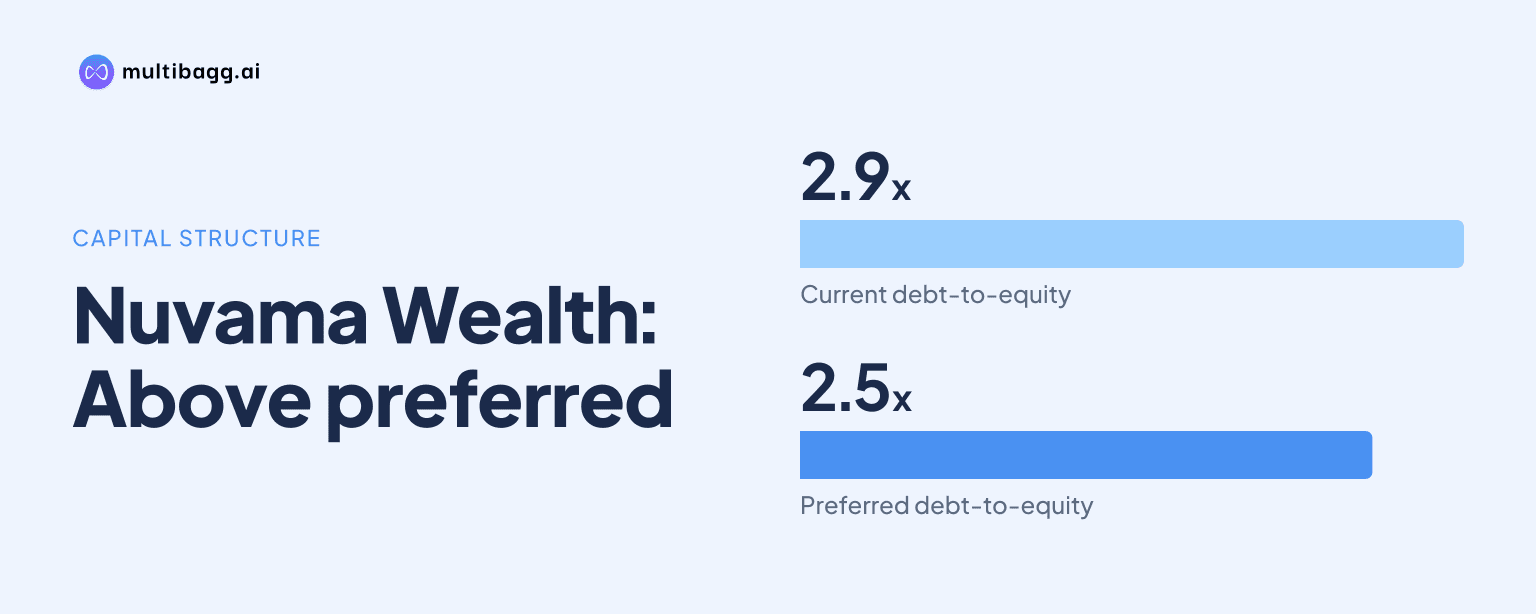
Nuvama Wealth withheld an interim dividend for the first half (H1) of financial year 2027 (FY27) after its loan book increased by Rs 2,000 crore in six months and debt-to-equity gearing reached 2.9x, above management’s preferred 2.5x. Management said retained capital could support lending, syndication and asset-management investment opportunities before the board considers a final dividend in April 2027.
Know Nuvama Wealth Management inside out
Results, valuation, peers and who's buying, in one view.
Why did Nuvama Wealth withhold its H1 FY27 dividend?
Nuvama Wealth withheld the H1 FY27 dividend because the board wants to preserve capital while the lending book is expanding and gearing stands at 2.9x. Management said it would be more comfortable with debt-to-equity of about 2.5x, allowing for minor variation, and cited opportunities in lending, syndication and asset management that may require investment.
The decision is an interim capital-allocation choice rather than a disclosed change to a formal payout formula. Management said the board will revisit dividend policy with the annual results, expected in April 2027, when it will assess how much capital to retain, how much to return to shareholders and how much to deploy in the business. Nuvama Wealth also reported return on equity, or ROE, of about 29%, which management said would form part of that review.
How far is Nuvama Wealth from its preferred gearing level?
Nuvama Wealth’s reported debt-to-equity gearing of 2.9x is 0.4 times above management’s indicated 2.5x comfort level. The difference matters because management linked the balance-sheet position directly to a Rs 2,000 crore expansion in the loan book during the first six months of FY27, rather than presenting the dividend decision as a response to an earnings shortfall.
The lending business was already expanding before the H1 decision. Management said both the lending book and net interest income, or NII, grew about 50% on an H1 basis, while yields remained stable. It also said there was still capacity to improve the lending book, indicating that retained earnings could support further lending growth while debt-to-equity moves closer to the stated 2.5x level.
Management has not disclosed the absolute loan-book balance, the amount of capital it intends to retain, or a timetable for reaching 2.5x gearing. As a result, the transcript establishes the direction of capital allocation but does not quantify the equity funding needed to meet the preferred leverage level. It also does not specify whether future lending growth will be funded solely by retained profits or through a mix of internal capital and debt.
Where could Nuvama Wealth deploy retained capital?
Nuvama Wealth said retained capital could be used for lending, syndication opportunities and investments connected with asset management. In lending, management’s stated view that yields are stable and more book growth is possible provides the clearest operating use for retained earnings. The Rs 2,000 crore H1 FY27 increase shows that lending has already become a material claimant on capital.
Asset management has several product launches that management expects to create activity over the next two to three quarters. Nuvama Wealth said its second commercial real-estate fund was due to launch within about two weeks with a Rs 5,000 crore fundraising target. It also planned to launch its first private-credit fund within 25 to 30 days, targeting Rs 1,500 crore to Rs 2,500 crore over eight to 10 months.
These initiatives do not mean the stated fund-raising targets will become Nuvama Wealth balance-sheet investments. However, management explicitly included syndication and asset-management opportunities among the reasons for retaining capital. It also said the commercial real-estate and private-credit products could generate co-investment and syndication opportunities, alongside potential improvements in transaction income and annual recurring revenue, or ARR.
The product buildout also carries near-term costs. Management said a private-credit team had been put in place before revenues started, while its public-markets business was adapting to a new fund structure. It said a more meaningful asset-management cost-to-income picture may emerge only after 12 to 15 months, as fund-raising progresses and revenue begins to accrue.
Got a follow-up? Ask IRIS
Does Nuvama Wealth have earnings capacity while retaining capital?
Nuvama Wealth reported Rs 937 crore of quarterly revenue, up 21% year on year, and Rs 319 crore of quarterly profit, up 26%, indicating that the board’s decision came alongside higher earnings. H1 revenue was about Rs 1,850 crore, up around 20%, while wealth and private businesses together crossed Rs 500 crore of quarterly revenue, up about 14%.
The mix of growth was not confined to one division. Asset services generated Rs 245 crore of second-quarter revenue, up about 53% year on year, partly against a lower second-quarter FY26 base. Capital markets generated Rs 175 crore, up 9%, while management said institutional equities increased both year on year and sequentially despite a regulatory change during August and September.
Costs are also scheduled to rise. Employee cost increased 19% year on year to Rs 382 crore after Nuvama Wealth added about 250 employees over 12 months, with 85% to 90% in business-facing roles. Management expects operating expenses of about Rs 520 crore to Rs 530 crore for FY27, and about Rs 550 crore including a Rs 25 crore right-of-use accounting charge for its new head office.
Nuvama Wealth also reported a one-time post-tax charge of about Rs 16 crore from pre-closing a venture-debt fund launched in FY23. Management said the charge related to writing off unamortised distribution costs after the fund’s early closure, not to committed investor returns. It expects a further Rs 9 crore to Rs 10 crore of accelerated amortisation over roughly the next 12 months.
Conclusion
Nuvama Wealth’s decision combines a higher-leverage balance sheet with management’s preference to finance lending and selected opportunity-led investments from retained capital. The key disclosed facts are the Rs 2,000 crore H1 FY27 loan-book increase, 2.9x debt-to-equity gearing and management’s stated preference for around 2.5x. Higher quarterly revenue and profit provide context, but the transcript does not establish a fixed timetable for deleveraging or a future payout amount.
The next scheduled capital-allocation event is the annual-results review in April 2027, when management said the board would reconsider dividend policy and the allocation between retention, payouts and business investment. Before then, execution points include the planned commercial real-estate fund with a Rs 5,000 crore target, the private-credit fund targeting Rs 1,500 crore to Rs 2,500 crore, and the lending book’s growth relative to the 2.5x gearing preference.