










OBSC Perfection builds capacity for ₹1,200-crore order book
Key highlights
- OBSC Perfection reported an order book exceeding ₹1,200 crore as of 30 September 2026.
- Automotive represented ₹989 crore, or 82%, of OBSC Perfection’s reported order book.
- OBSC Perfection has 12,000 tonnes of annual forging capacity operating at about 35% utilisation in H1 FY27.
- OBSC Perfection installed stamping capacity in H1 FY27, with more than 30 presses operating at 13% utilisation.
powered by IRIS
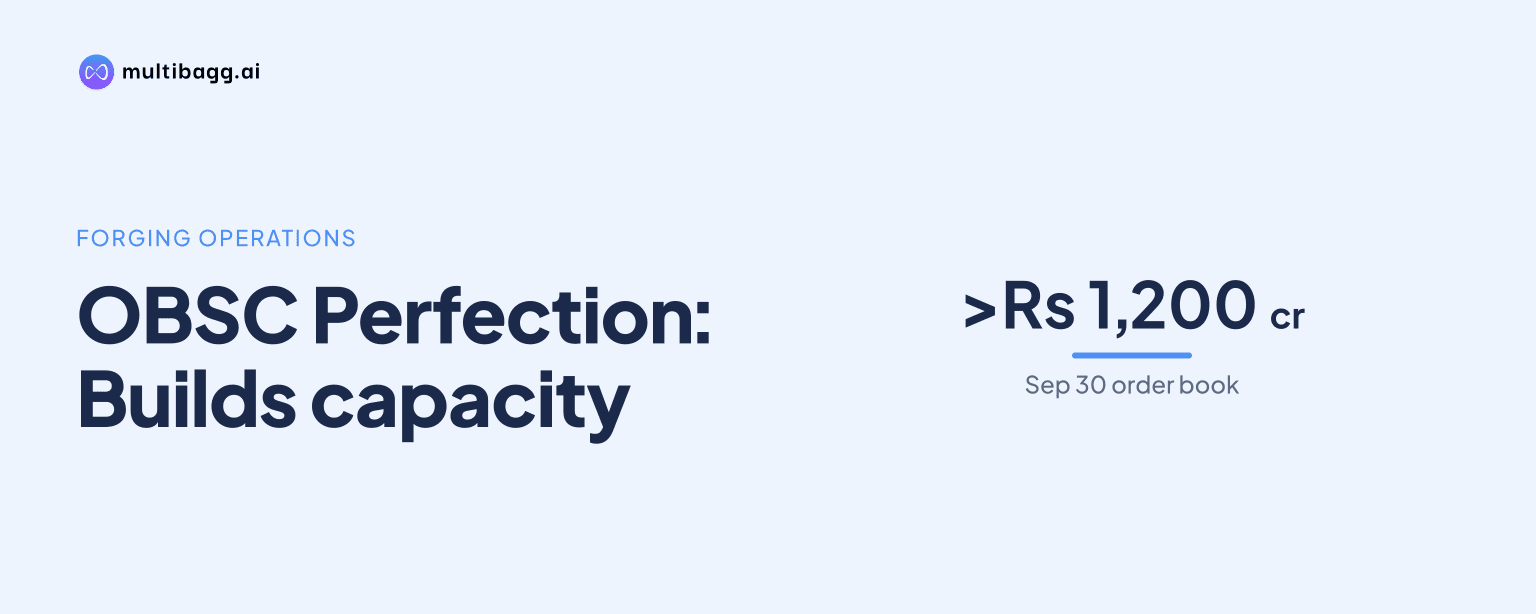
OBSC Perfection Limited is building capacity for its ₹1,200+ crore order book as of 30 September 2026 through about 11.8 acres of land, 12,000 tonnes a year of forging capacity and stamping presses operating at 13% utilisation in the first half of financial year 2027 (H1 FY27).
Know OBSC Perfection inside out
Results, valuation, peers and who's buying, in one view.
How large is OBSC Perfection’s order book?
OBSC Perfection reported an order book exceeding ₹1,200 crore on 30 September 2026, with an average order-book life of five to six years. Automotive represented ₹989 crore, or 82%, while non-automotive business represented ₹211 crore, or 18%, making automotive the company’s largest disclosed order-book segment.
OBSC Perfection’s geography summary shows ₹665 crore of export orders and ₹535 crore of domestic orders, equivalent to a 55% and 45% split respectively. Management attributed increased automotive order flow over the preceding year to global supply-chain uncertainty, while the presentation describes defence orders as largely smaller contracts at various approval stages.
How is OBSC Perfection expanding factory space?
OBSC Perfection disclosed about 11.8 acres of acquired land in Maharashtra and Gujarat for a centralised mega factory intended to provide about five times additional space for future expansion. Its existing six facilities in Pune, Chennai and Faridabad cover 177,041 square feet, with one owned unit and five rented units.
At Supa, Maharashtra, the presentation lists 10.8 acres of land and says an additional 2.4 acres was acquired in the first quarter of FY27, with ground-breaking planned in the second half. At Gujarat Industrial Development Corporation Sanand, OBSC Perfection lists about one acre and says construction had reached phase 2. The source does not disclose a commissioning date, project cost or future utilisation target for the mega facility.
What forging and stamping capacity has OBSC Perfection added?
OBSC Perfection installed combined hot- and cold-forging capacity of 12,000 tonnes per year during the fourth quarter of FY26, with annualised utilisation of about 35% in H1 FY27. Hot forging was introduced at Pune Unit 5 in 2025 and cold forging at Faridabad Unit 6 in 2025.
Management says the forging additions support production of larger and more complex parts, particularly for defence and aerospace. The company identifies hot forging with large-component production and complex-shape formation, while its cold-forging process is designed for high-strength components and material-grain refinement.
OBSC Perfection installed stamping capacity in H1 FY27 and began generating revenue in that half-year. The business has more than 30 pneumatic presses rated from 50 tonnes to 500 tonnes, reported 13% utilisation, and acquired recurring business of about ₹2 crore a month. Management says the combination of machining and stamping moves the business towards assembly manufacturing.
Got a follow-up? Ask IRIS
How does current production compare with installed capacity?
OBSC Perfection’s machining installed capacity rose to 757.2 lakh units a year in H1 FY27 from 451.5 lakh units in FY26, while annualised output was 544.4 lakh units. As a result, machining utilisation declined to 71.9% from 85.0% in FY26 despite higher production volume.
Investment-casting capacity remained 900 tonnes a year in FY26 and H1 FY27, while annualised production fell to 660 tonnes from 700 tonnes. This reduced utilisation by 4.5 percentage points to 73.3%. The presentation states that capacity and utilisation figures, including H1 FY27 data, are annualised.
Which orders and sectors could use the added capacity?
OBSC Perfection received five-year purchase orders worth ₹31.4 crore for machined parts under the DaVinci DCx programme in September 2026. It also reported an ₹8.9 crore Elbit fuze order in October 2026, which the presentation classifies as a subsequent event to the 30 September order-book date.
The company had onboarded three of seven defence public-sector undertakings, including two new vendors, and received prototype orders for MK-48 fins and 155 millimetre shells. Its aerospace division received AS 9100D certification recommended by TÜV India on 7 September 2026, after which customer discussions began. OBSC Perfection also reported its first medical-implants order and participation in a humanoid-robot parts supply chain.
Revenue from operations rose 91% year on year to ₹169.41 crore in H1 FY27 from ₹88.64 crore in H1 FY26. Profit after tax increased 107% to ₹21.83 crore from ₹10.51 crore, while the profit-after-tax margin rose to 12.6% from 11.6%. These results show higher reported activity during the period, but do not establish the timing of order-book conversion.
Conclusion
OBSC Perfection’s capacity programme combines a ₹1,200+ crore order book with a fivefold planned space expansion and newer forging and stamping processes. Automotive accounts for ₹989 crore of the disclosed order book, while the added processes are intended to enable larger and more complex component work in sectors including defence and aerospace.
The next disclosed milestones are the planned H2 FY27 ground-breaking at Supa and further phase-2 construction at Sanand. Management’s execution priorities include raising utilisation from about 35% in forging and 13% in stamping, while defence approvals and aerospace customer discussions following the 7 September 2026 certification remain unresolved developments to watch.