










OCCL operating cash flow falls to Rs 40.68 crore outflow in H1 FY27
Key highlights
- OCCL reported a Rs 40.68 crore operating cash outflow in H1 FY27, versus a Rs 12.64 crore inflow in H1 FY26.
- Inventory increased by Rs 72.86 crore and trade and other receivables increased by Rs 68.48 crore in H1 FY27.
- OCCL generated Rs 69.77 crore of financing cash inflow, including Rs 79.41 crore of net proceeds from current borrowings.
- OCCL reported Rs 68.11 crore of H1 FY27 profit after tax and Rs 476.71 crore of revenue from operations.
powered by IRIS
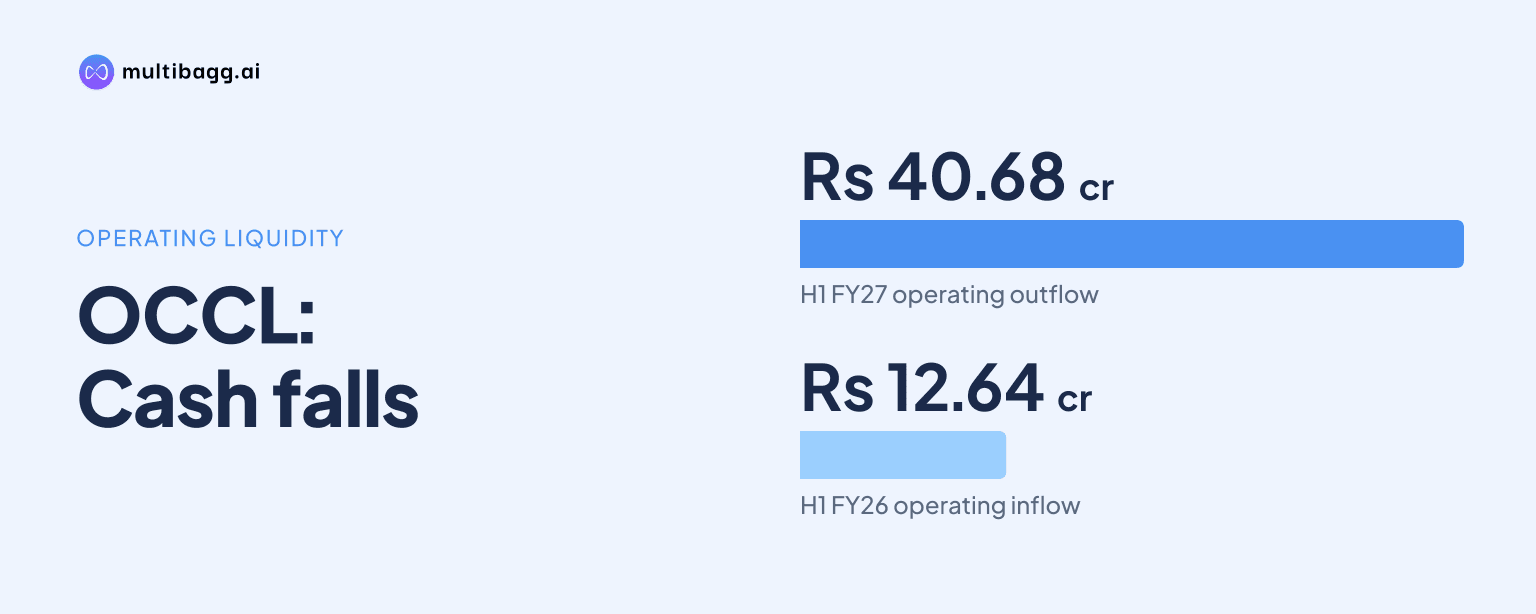
OCCL Limited reported a Rs 40.68 crore net cash outflow from operating activities in H1 FY27, despite Rs 68.11 crore of profit after tax, because inventory and trade-and-other-receivable increases absorbed Rs 141.34 crore of cash. The operating cash-flow result reversed a Rs 12.64 crore inflow in H1 FY26.
Know OCCL inside out
Results, valuation, peers and who's buying, in one view.
Why did OCCL report negative operating cash flow in H1 FY27?
OCCL reported negative operating cash flow because working-capital movements outweighed cash generated before those movements. Operating profit before working-capital changes rose to Rs 111.24 crore in H1 FY27 from Rs 47.50 crore in H1 FY26, supported by Rs 91.51 crore of profit before tax, Rs 14.66 crore of depreciation and amortisation, and Rs 5.77 crore of finance costs.
That pre-working-capital cash generation was reduced by a Rs 72.86 crore increase in inventories and a Rs 68.48 crore increase in trade and other receivables. A Rs 3.47 crore increase in trade and other payables partly offset those uses of cash, but cash generated from operations before tax was still negative at Rs 26.63 crore. OCCL then paid Rs 14.05 crore of direct tax, resulting in the Rs 40.68 crore operating outflow.
The comparison with the prior year illustrates the change in cash conversion. In H1 FY26, inventory consumed only Rs 0.32 crore and trade and other receivables consumed Rs 22.57 crore, while payables declined by Rs 6.72 crore. Those movements left Rs 17.90 crore of cash generated before tax; after Rs 5.26 crore of tax paid, operating activities produced a Rs 12.64 crore inflow.
How much did OCCL's inventory and receivables increase?
OCCL's balance-sheet inventory rose by Rs 72.86 crore to Rs 167.30 crore at September 30, 2026, from Rs 94.44 crore at March 31, 2026. The cash-flow statement records the same Rs 72.86 crore increase as a cash use, making inventory the largest individual working-capital absorption in the first half.
Trade receivables increased by Rs 63.98 crore to Rs 148.64 crore at September 30 from Rs 84.66 crore at March 31. The cash-flow statement shows a larger Rs 68.48 crore cash outflow under trade and other receivables, a category that includes more than the balance-sheet trade-receivable line. Other current assets also rose by Rs 4.45 crore to Rs 31.90 crore over the six months.
The rise in working capital came alongside a sharp expansion in reported activity. Revenue from operations was Rs 476.71 crore in H1 FY27, compared with Rs 242.73 crore in H1 FY26, while total income increased to Rs 478.97 crore from Rs 244.11 crore. Profit after tax more than tripled to Rs 68.11 crore from Rs 21.83 crore, but that accounting profit did not translate into positive operating cash flow during the period.
Management said the Insoluble Sulphur business recorded higher sales volume and realisation in the September quarter. It attributed domestic demand to reduced Chinese imports following provisional anti-absorption duties and precautionary inventory stocking amid geopolitical uncertainties, while citing supply constraints from China, shipping disruptions and the Huatai plant closure for stronger global demand. These comments provide the disclosed operating context, but the filing does not separate the inventory increase by product, location or customer.
Got a follow-up? Ask IRIS
How was OCCL's cash outflow financed?
OCCL funded the operating outflow principally through financing cash inflows of Rs 69.77 crore in H1 FY27, compared with Rs 14.56 crore in H1 FY26. Net proceeds from current borrowings were Rs 79.41 crore, while the company received Rs 13.00 crore of non-current borrowings and repaid Rs 7.51 crore, leaving a net Rs 5.49 crore contribution from non-current borrowing flows.
Financing cash inflows were reduced by Rs 8.99 crore of dividend paid, Rs 5.57 crore of finance costs paid and Rs 0.57 crore of lease-liability repayments. The company also generated Rs 2.52 crore from investing activities, compared with an investing outflow of Rs 24.74 crore a year earlier. H1 FY27 investing inflows included Rs 13.14 crore from the sale of current investments, offset by Rs 13.51 crore of payments for property, plant and equipment, capital work-in-progress, intangible assets and capital advances.
Current borrowings on the balance sheet rose to Rs 156.68 crore at September 30, 2026, from Rs 78.64 crore at March 31, 2026. Non-current borrowings increased to Rs 12.35 crore from Rs 5.49 crore. The balance-sheet movements are not identical to the cash-flow borrowing lines because the financial statements present closing liabilities and cash flows under separate accounting captions, but both show higher borrowings during the half year.
The combined operating, investing and financing movements increased cash and cash equivalents by Rs 31.60 crore. OCCL ended September 30 with Rs 35.42 crore of cash and cash equivalents, versus Rs 3.81 crore at March 31. It also had Rs 0.46 crore of bank balances other than cash equivalents, compared with Rs 0.26 crore at the preceding year-end.
What do OCCL's balance-sheet changes show about working capital?
OCCL's current assets increased by Rs 159.98 crore during H1 FY27 to Rs 384.55 crore, while current liabilities increased by Rs 85.11 crore to Rs 209.35 crore. The asset increase was led by inventory, trade receivables and cash, whereas the liability increase was led by current borrowings, which rose by Rs 78.04 crore.
Total assets rose to Rs 758.29 crore at September 30 from Rs 601.65 crore at March 31. Non-current assets declined by Rs 3.35 crore to Rs 373.73 crore, even as capital work-in-progress increased to Rs 7.43 crore from Rs 2.09 crore. That means the growth in total assets during the period was concentrated in current assets, particularly items connected with working capital and cash.
Equity increased by Rs 59.12 crore to Rs 490.39 crore, reflecting the first-half earnings position in the reported balance sheet. Other equity was Rs 480.40 crore at September 30, up from Rs 421.28 crore at March 31, while paid-up equity share capital remained Rs 9.99 crore. The Board declared an interim dividend of Rs 2 per equity share for FY 2026-27, amounting to a total payout of Rs 9.99 crore.
Profitability also changed within H1 FY27. OCCL reported Rs 40.25 crore of profit after tax in the June 2026 quarter and Rs 27.86 crore in the September 2026 quarter. Management said the first-quarter profit was higher than the second-quarter profit mainly because of the impact of inventory valuation gain, a factor relevant when comparing the half-year earnings figure with the cash absorbed in inventory.
Conclusion
OCCL's H1 FY27 financial statements show a divergence between earnings and operating cash flow. Profit after tax rose to Rs 68.11 crore and operating profit before working-capital changes reached Rs 111.24 crore, but a Rs 72.86 crore inventory build and a Rs 68.48 crore increase in trade and other receivables led to a Rs 40.68 crore operating cash outflow. Financing inflows of Rs 69.77 crore, particularly from current borrowings, supported the overall cash increase.
The disclosed next event is the interim dividend: the Board fixed November 13, 2026 as the record date for the Rs 2-per-share dividend and said payment would be made within 30 days of declaration. For subsequent results, the relevant reported items to watch are inventory, trade and other receivables, current borrowings and whether operating cash flow changes from the H1 FY27 outflow.