










Om Galaxy says H1 FY27 underlying revenue growth was 45%
Key highlights
- Om Galaxy reported H1 FY27 revenue from operations of Rs 78 crore, up 72% from Rs 45.4 crore in H1 FY26.
- A Rs 12 crore one-time and lumpy order meant Om Galaxy reported normalized H1 FY27 revenue growth of 45%.
- Automotive revenue reached Rs 17.1 crore and cleaning-products revenue reached Rs 9.1 crore in H1 FY27.
- Om Galaxy disclosed an H1 FY27 order book of about Rs 165 crore, including Rs 93 crore of regular business.
powered by IRIS
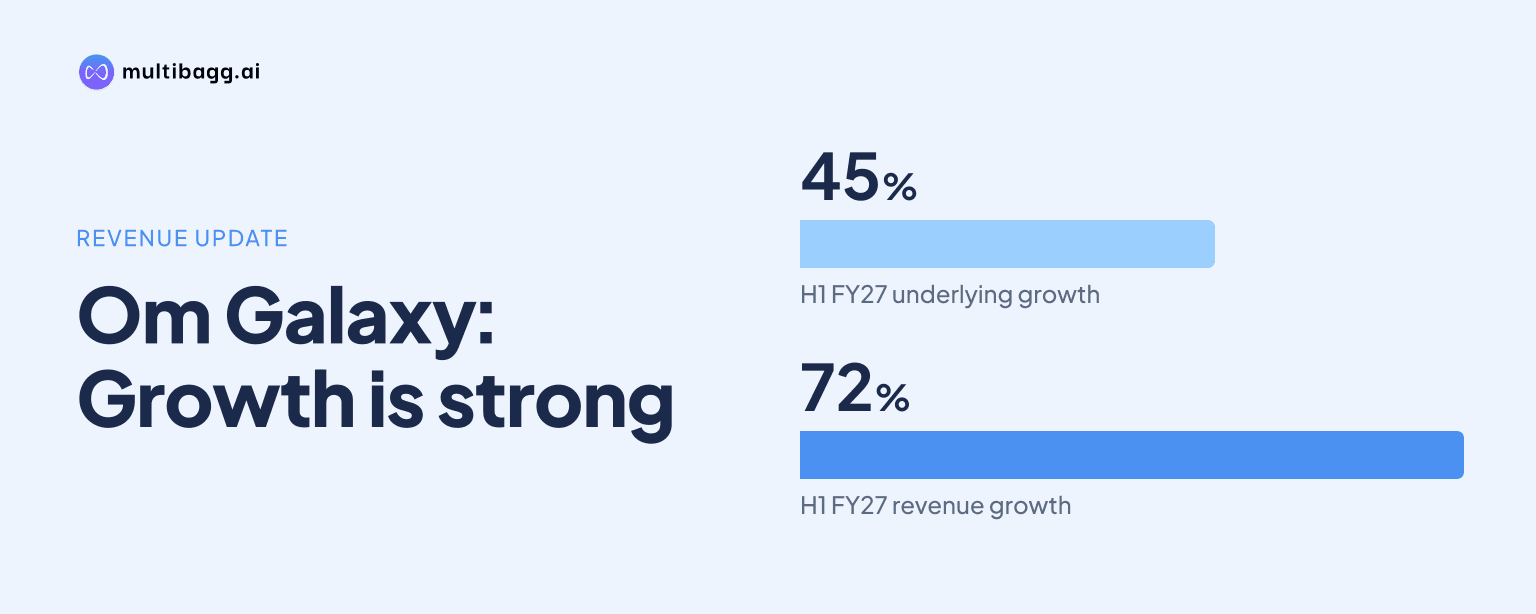
Om Galaxy Limited said underlying revenue growth was 45% in H1 FY27 after excluding Rs 12 crore recognised from a one-time and lumpy order, compared with reported revenue growth of 72%. Revenue from operations reached Rs 78 crore, versus Rs 45.4 crore in H1 FY26, while earnings before interest, tax, depreciation and amortisation rose 66% to Rs 19.3 crore.
Know Om Galaxy inside out
Results, valuation, peers and who's buying, in one view.
Why was Om Galaxy's reported H1 FY27 growth 72%?
Om Galaxy reported 72% revenue growth because H1 FY27 included Rs 12 crore of revenue from a one-time and lumpy order. Revenue from operations increased by Rs 32.6 crore, from Rs 45.4 crore in H1 FY26 to Rs 78 crore in H1 FY27. Management said normalized revenue growth, after accounting for that exceptional order, was 45%.
The disclosed Rs 12 crore order represented about 37% of the Rs 32.6 crore increase in reported revenue between the two half-year periods. Removing that order from H1 FY27 revenue leaves Rs 66 crore, which is consistent with management's stated 45% normalized growth measure against Rs 45.4 crore in H1 FY26.
Om Galaxy described the Rs 12 crore as one-time and lumpy, rather than regular business. The presentation does not identify the customer, product, segment or recognition date for that revenue. It therefore does not establish whether the order was included in pipe fitting, automotive, industrial, hot runner systems or cleaning products revenue.
How did Om Galaxy's H1 FY27 revenue mix change?
Om Galaxy's revenue mix moved towards automotive and cleaning products in H1 FY27, although pipe fitting remained its largest segment at Rs 47.7 crore. Pipe fitting revenue increased from Rs 33.1 crore in H1 FY26, but its contribution to total revenue declined to 61% from 73%. Automotive's share increased to 22% from 14%, while cleaning products rose to 12% from 4%.
Automotive revenue rose by Rs 10.6 crore to Rs 17.1 crore, while cleaning products increased by Rs 7.4 crore to Rs 9.1 crore. Together, those two segments added Rs 18 crore against the Rs 32.6 crore rise in total revenue. Pipe fitting added Rs 14.6 crore, hot runner systems added Rs 0.4 crore, and industrial revenue declined by Rs 0.3 crore.
The presentation's displayed segment growth labels do not all align with the rounded revenue figures in its tables. It labels automotive growth at 162%, cleaning products at 428%, hot runner systems at 275%, and industrial at 10%, despite showing respective revenue movements of Rs 6.5 crore to Rs 17.1 crore, Rs 1.7 crore to Rs 9.1 crore, Rs 1 crore to Rs 1.4 crore, and Rs 3 crore to Rs 2.7 crore. Om Galaxy gives no explanation for the differences.
Got a follow-up? Ask IRIS
Did Om Galaxy's H1 FY27 margins and working-capital metrics change?
Om Galaxy's earnings before interest, tax, depreciation and amortisation, or EBITDA, rose 66% to Rs 19.3 crore in H1 FY27, but its EBITDA margin declined to 24.8% from 25.7% in H1 FY26. Profit after tax increased 56% to Rs 8.8 crore, while the profit-after-tax margin declined to 11.2% from 12.4% a year earlier.
The margin comparisons show that profit increased in rupee terms but represented a smaller percentage of revenue than in H1 FY26. EBITDA margin declined by 0.9 percentage points and profit-after-tax margin fell by 1.2 percentage points, while revenue increased from Rs 45.4 crore to Rs 78 crore. The presentation does not give a segment-level explanation for the margin movements.
Om Galaxy reported debtor days of 77 in H1 FY27, compared with 106 days in FY26, and a cash conversion cycle of 149 days against 152 days in FY26. Net debt to equity was negative 0.3 times, compared with positive 0.4 times in FY26. These working-capital comparisons use the full FY26 period rather than H1 FY26.
Return on equity was 14.1% in H1 FY27 versus 22.8% in FY26, while return on capital employed was 12.9% versus 25.5%. The source does not provide H1 FY26 figures for either return measure, so it does not offer a like-for-like half-year comparison. Om Galaxy also does not state whether the Rs 12 crore one-time order affected these reported return metrics.
What does Om Galaxy's order book indicate for H2 FY27?
Om Galaxy disclosed an order book of about Rs 165 crore as of H1 FY27 and said the full amount was executable in H2 FY27. Management classified Rs 72 crore of the order book as one-time and lumpy and Rs 93 crore as regular business. The disclosed order book was larger than the Rs 78 crore revenue reported in H1 FY27.
The Rs 72 crore one-time portion of the order book is distinct from the Rs 12 crore one-time revenue already recognised in H1 FY27. Om Galaxy does not state whether the H1 revenue formed part of the Rs 72 crore lumpy order-book amount, or whether it relates to separate orders. It also does not allocate either amount across its five reported revenue segments.
Om Galaxy reported 88,000 square feet of manufacturing area and installed production capacity of 2,622 metric tonnes per annum as of H1 FY27. Its operating lines include pipe fitting and industrial moulds, automotive moulds, hot runner systems and Wondra cleaning products. The presentation does not connect the Rs 165 crore order book to a particular product line, customer group or capacity requirement.
Conclusion
Om Galaxy's H1 FY27 revenue growth was affected materially by Rs 12 crore from a one-time and lumpy order, resulting in management's normalized growth measure of 45% rather than the reported 72%. The reported revenue mix also changed, with automotive and cleaning products increasing their shares while pipe fitting remained the largest segment at Rs 47.7 crore.
The next point to watch is execution of the Rs 165 crore order book in H2 FY27, including Rs 93 crore classified as regular business and Rs 72 crore classified as one-time and lumpy. Management said the entire backlog was executable in H2 FY27, but did not disclose a delivery schedule, segment allocation or the link between the H1 Rs 12 crore order and the lumpy backlog.