








Om Galaxy plans 2-3x mould capacity with 190,000-sq-ft site

Find your next multibaggerBe a Pro Investor
Research stocks and track your picks on the go. Download the app.
Key highlights
- Om Galaxy plans to operate from a 190,000-sq-ft facility versus about 80,000 sq ft currently.
- Management expects mould-making capacity to increase two to three times from around 1,200 metric tonnes.
- The new site is intended to enable 25-30-tonne moulds, compared with roughly 10-15-tonne moulds currently.
- Om Galaxy’s Rs 165 crore order book included Rs 70 crore of one-time project work.
powered by IRIS
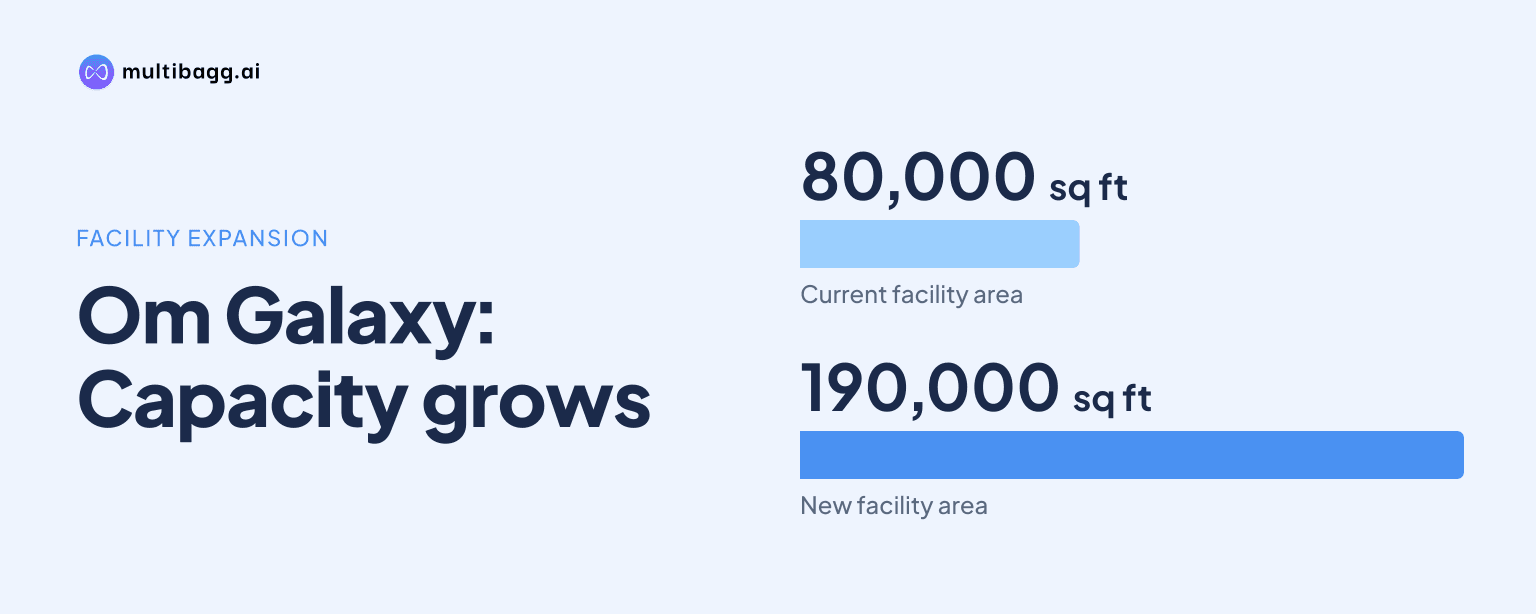
In its November 20, 2026 call, Om Galaxy Limited said its planned 190,000-square-foot facility should lift mould-making capacity two to three times from its current setup, while increasing its mould-weight capability to 25-30 tonnes from roughly 10-15 tonnes. Management expects the move to widen its addressable product range as well as add output capacity.
Know Om Galaxy inside out
Results, valuation, peers and who's buying, in one view.
How much will Om Galaxy’s new facility increase capacity?
Om Galaxy said the 190,000-square-foot facility should increase manufacturing capacity by two to three times, compared with approximately 80,000 square feet used currently. Management also described the new building as having three times current capacity, against an existing capacity stated at around 1,200 metric tonnes.
The expansion includes more than added floor area. Management said it will install additional machines at the new unit, which should raise manufacturing capacity alongside the larger workspace. Om Galaxy also said it currently uses outside work to meet demand rather than declining orders, because management does not want customers to shift their business elsewhere.
Om Galaxy reported an order book of Rs 165 crore during the call, of which Rs 70 crore was identified as a one-time project order. Management distinguished such capital-investment projects from recurring mould orders, which can arise when customers change products, add stock-keeping units or replace moulds.
When will Om Galaxy shift to the 190,000-sq-ft facility?
Om Galaxy said the building was initially targeted for completion by March, but management later expected completion around June or July 2027. It said shifting would start after that point, with the existing plant located close enough to allow operations to be transferred progressively.
Management estimated that the shift would take nine months to one year and clarified that the process would start in 2027 and finish in 2028. When an analyst said the larger capacity could start showing in financial year 2028-29, management agreed, indicating that the revenue effect is expected to build gradually rather than begin at full utilisation on commissioning.
Om Galaxy also said the facility would be under installation after its expected June or July 2027 readiness. Management stated that revenue growth in the following year would be marginal because capacity utilisation would be ramped up over time, separating building completion from installed and productive capacity.
As of September 30, following its September 18 listing, management said initial public offering proceeds had been deployed only marginally apart from construction billing over the 12-day period and loan repayment on the listing date. It said the remaining proceeds were expected to be deployed by the following June or July.
Got a follow-up? Ask IRIS
What moulds and sectors will Om Galaxy add at the new plant?
Om Galaxy plans to make 25-30-tonne moulds at the new facility, compared with moulds of roughly 10-15 tonnes currently. Management said the higher mould-weight capability would support more complex work and allow production of mould categories that are currently made only in limited quantities because of space constraints.
The company currently operates in two to three sectors, according to management. After entering the larger plant, it plans to explore packaging, high-cavitation moulds, large automobile moulds and precision moulds for the health industry. These are management’s stated areas of exploration, not disclosed customer orders or quantified revenue commitments.
High-cavitation work is linked to Om Galaxy’s hot-runner system, which management said is integrated with the mould to reduce material waste and customer cycle time. Management said it developed its own system after importing and modifying other systems, and that the company holds a patent relating to its hot-runner solution.
Management said it supplies both the mould and the hot-runner system, providing customers with one party responsible for repairs or operating issues. It also said existing customers seek repair and reconditioning work annually in some cases, with maintenance costs continuing at 10% to 15% of total cost in the example discussed on the call.
What demand conditions are behind Om Galaxy’s expansion plan?
Om Galaxy said it is unable to fully cater to existing customer orders in automotive tooling. Management cited direct interactions with original equipment manufacturers, or OEMs, including Mahindra, Tata Motors, TVS Motor and Royal Enfield, and said it was also engaging with Maruti.
Management said OEMs had shared vehicle-launch periods and tooling requirements to help capacity planning through 2030. The transcript does not state the value, timing or contractual status of the prospective automotive work, but management said expected launches were part of its capacity-planning process.
Pipe fittings remain a material source of orders. Management said a new entrant in irrigation or drainage pipe fittings may require a complete range of 200-300 moulds, while a company widening its product range from 50 products to 500 products may generate a larger capital-investment order.
The Rs 70 crore one-time order within the Rs 165 crore order book reflects that distinction between project-led and recurring demand. Management said the order related to a customer’s major capital investment, while recurring business can come from product changes and additions. It also said it aimed to maintain earnings before interest, tax, depreciation and amortisation, or EBITDA, margin around 25%-26%, subject to variation from negotiated one-time orders.
Conclusion
Om Galaxy’s 190,000-square-foot project is intended to change both its output capacity and the type of moulds it can manufacture. The planned two-to-three-times capacity increase, extra machines and 25-30-tonne mould capability are designed to address larger automobile, packaging, high-cavitation and health-industry precision applications beyond its current two-to-three sectors.
The next disclosed milestones are expected building completion in June or July 2027, subsequent installation and the phased shift that management expects to finish in 2028. Management has also said remaining initial public offering proceeds should be deployed by the following June or July, while capacity utilisation and revenue contribution are expected to build gradually.

