










OneSource injectable shutdown lasts through Q3, lines in January
Key highlights
- OneSource said its injectable-site shutdown will continue through Q3, with expanded lyophilisation capacity available from January.
- OneSource has visibility of more than 80% utilisation at its existing softgel facility after capacity increased almost threefold from last year.
- OneSource’s DDC Line 2 began commercial batches in September and doubled annualised sterile production days, according to management.
- OneSource reported Q2 revenue above Rs 500 crore, up 37% year on year, and EBITDA margin of 32%.
powered by IRIS
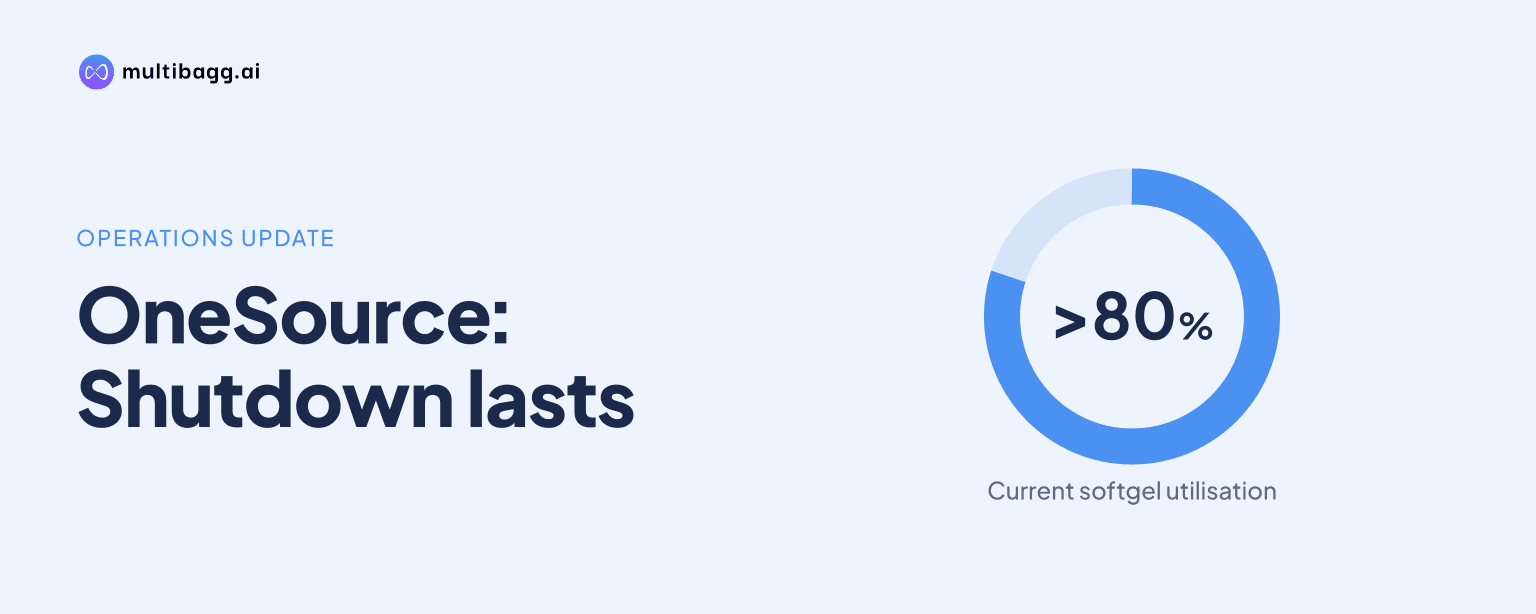
OneSource Specialty Pharma Limited said its injectable-site shutdown, which began at the back end of Q2 ended September 30, 2026, will continue through Q3, with expanded lyophilisation capacity available from January. Management also reported visibility of more than 80% utilisation at its existing softgel facility after capacity there increased almost threefold from last year.
Know OneSource Specialty Pharma inside out
Results, valuation, peers and who's buying, in one view.
When will OneSource’s injectable facility return to operation?
OneSource expects its injectable-site shutdown to continue through the current Q3 and said the upgraded lines will be available from January. The shutdown began only at the back end of Q2 ended September 30, 2026, so the company did not quantify a full-quarter production or revenue effect in Q2.
The work is intended to add lyophilisation capacity and capability to the base injectable business. Lyophilisation is a freeze-drying process used for certain injectable products. OneSource said both its injectable and softgel businesses grew in Q2 despite the late-quarter start of the shutdown, with multiple launches occurring in several markets.
The January date is a management timetable rather than a reported operating result. OneSource did not disclose the number of lyophilisation lines being added, their production output, project cost, customer commitments or a specific day for the site’s restart.
Why is OneSource adding lyophilisation capacity?
OneSource is adding lyophilisation capacity because management sees a global supply-demand gap in this part of injectable manufacturing. Management said injectables account for 70% to 75% of shortages cited in Europe and on the United States Food and Drug Administration shortage list, and described lyophilisation as a major contributor to those shortages.
The company said the added capability should help improve supplies to US and European markets. It also said it is adding prefilled-syringe capability within the base injectable business, although the call did not provide a timeline, output estimate or customer list for that work.
The injectable upgrade is separate from OneSource’s drug-device combination, or DDC, cartridge-filling expansion. Management attributed Q2 growth primarily to additional DDC capacity that came online during the quarter, not to the injectable project scheduled to become available in January.
In Q2, OneSource reported revenue of more than Rs 500 crore, up 37% year on year and 15% sequentially. Earnings before interest, tax, depreciation and amortisation, or EBITDA, rose 53% year on year and 32% sequentially, while EBITDA margin reached 32%, more than 400 basis points above the preceding quarter.
How utilised is OneSource’s current softgel facility?
OneSource said its existing softgel facility has visibility of more than 80% capacity utilisation after capacity increased almost threefold from last year. Management did not give a precise utilisation rate or say how much of that visibility represents commercial production rather than committed future demand.
Management said softgel utilisation is rising partly because customers are transferring work from other contract development and manufacturing organisation, or CDMO, sites. It characterised this ramp as gradual because such transfers take time, even though the facility also recorded multiple product launches during Q2.
OneSource said it cannot expand the existing softgel site further. It is therefore pursuing a greenfield softgel facility that management said would add significant capacity and enable containment and high-potency softgel work, but the call did not disclose its location, capital expenditure, construction timetable or commissioning date.
The softgel position differs from the injectable plan. Softgel has more than 80% utilisation visibility at a site with no further expansion room, while injectables are undergoing a Q3 interruption to add lyophilisation capability. These are separate capacity constraints and expansion paths within the base business.
Got a follow-up? Ask IRIS
How is OneSource increasing DDC cartridge capacity?
OneSource’s second DDC cartridge line began commercial batches in September and is currently ramping customers to 500-litre batches, compared with a maximum 200 litres on Line 1. Management said Line 2 immediately doubled total sterile production days on an annualised basis.
Management estimated like-for-like output from Line 1 at roughly 50,000 to 55,000 pens, versus about 120,000 to 130,000 pens at 500 litres on Line 2. The estimate varies by product and customer yield, and Line 2 has technical capability to handle batches of up to 750 litres even though customers are currently moving to 500 litres.
Line 2 will initially carry a mix of commercial supply and manufacturing service agreements, or MSAs. Management described a typical steady-state mix as 75% commercial work and 25% MSAs, but said Line 2 will ramp as customer market volumes develop and as pending work for existing customers is addressed.
Management said larger batch sizes lower manufacturing cost per unit and that it shares part of those efficiency benefits with customers. It also said pricing is volume-based rather than market-based and reported no major shift in realisations as markets such as Canada and emerging markets develop.
What capacity milestones does OneSource expect next?
OneSource said its third DDC line has completed factory acceptance testing in Germany and has arrived at its site for qualification. Management is seeking to start the line in Q4, but said commercialisation could move to the start of FY28 because qualification involves multiple European vendors and bespoke equipment.
Management nevertheless expects all three DDC lines to be fully operational and available in FY28. It said DDC will be a strong contributor in the second half and in FY28, supported by demand from existing customers, new market approvals and the ability to take on additional work after prior capacity constraints.
OneSource also said active pharmaceutical ingredient supply for Dr. Reddy’s had commenced, with product supplies expected first to Canada during the current quarter and later to other approved markets. Management said approvals in some additional markets were expected over the next two quarters, but did not quantify related OneSource revenue.
The company separately reported that shipping disruptions had extended working-capital cycle times by 45 to 60 days. Its chief financial officer said the effect was temporary and expected normalisation within one or two quarters, while also noting that higher shipment volumes had increased receivables.
Conclusion
OneSource’s capacity programme has two different near-term effects: its injectable business faces a Q3 shutdown before expanded lyophilisation capability becomes available in January, while the existing softgel site has more than 80% utilisation visibility but no room for further expansion. At the same time, the September start of commercial batches on DDC Line 2 is increasing cartridge capacity through larger 500-litre batches.
The next disclosed milestones are January availability for the injectable lines and qualification of DDC Line 3, which management said could begin commercialisation in Q4 or at the start of FY28. Management’s expectation that shipping-related working-capital delays normalise within one or two quarters and the progress of the planned greenfield softgel site are also items to watch.