










OneSource targets 225-230 sterile days for second DDC line
Key highlights
- OneSource targets 225-230 sterile production days annually for DDC Line 2.
- Line 2 is currently ramping to 500-litre customer batches, versus Line 1’s 200-litre maximum.
- Management estimates Line 2 output at 120,000-130,000 pens per day, compared with 50,000-55,000 pens for Line 1.
- OneSource expects a steady-state DDC mix of 75% commercial revenue and 25% MSA activity.
powered by IRIS
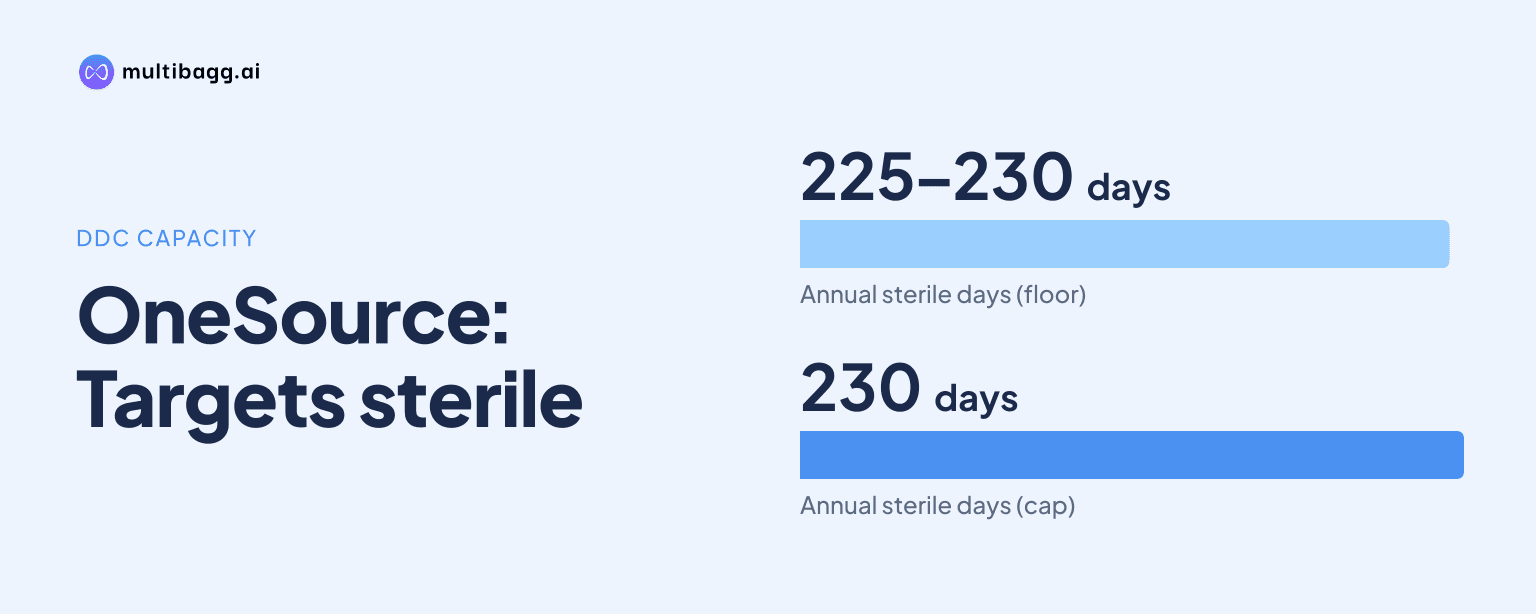
OneSource Specialty Pharma Limited expects its second drug-device-combination (DDC) line to reach 225 to 230 sterile production days a year, with a steady-state revenue mix of 75% commercial work and 25% MSA activity. The line became active in September and is currently ramping customers to 500-litre batches, versus 200 litres on Line 1.
Know OneSource Specialty Pharma inside out
Results, valuation, peers and who's buying, in one view.
How many sterile production days is OneSource targeting for Line 2?
OneSource is targeting 225 to 230 sterile production days a year for its second DDC line. Management said the measure accounts for sterile-process requirements, including media fills and quality reviews, rather than all calendar days at the facility. It expects the line to reach this annual operating range fairly rapidly because of demand from existing customers, prospective customers and markets awaiting product approvals.
The second line became active in September, leaving only a limited operating period in Q2 FY27. Management therefore did not provide a representative commercial-to-MSA revenue split for that quarter, saying it would not show the mature operating profile. Instead, it identified annual sterile days as the relevant utilisation measure while the line moves from initial development and customer-support work into higher commercial production.
Management also said the 225-to-230-day pattern should apply to Line 3 after it begins operating. The third line was already at the site, but its contribution in FY28 depends on the qualification of a bespoke installation. Management had said all three lines should be available in FY28, while noting that Line 3 could be available for all or only part of Q4 FY28.
What commercial-to-MSA mix does OneSource expect on Line 2?
OneSource expects Line 2 to settle at 75% commercial revenue and 25% MSA activity. Management described this as the typical steady-state profile for a line, while stressing that Line 2 is still ramping and its initial utilisation includes both commercial work and MSA batches. It did not disclose a date for achieving the 75:25 mix or a separate MSA revenue figure for DDC.
The commercial share should increase as customers' market volumes develop. Management said manufacturing ramps alongside demand in customer markets, rather than reaching full commercial use immediately after installation. The second line supports commercial supply for Canada and other markets, while giving OneSource capacity to complete pending work for existing customers and add customers it could not onboard during the previous year because of capacity constraints.
MSA activity can make early line utilisation different from commercial sales. In its comments on biologics, management described MSA revenue as pre-approval research and development revenue; for DDC, it said the new line was available only from September in Q2 FY27. That short period is why management advised against using the reported quarter as a benchmark for the eventual 75% commercial and 25% MSA revenue mix.
Got a follow-up? Ask IRIS
How much larger is OneSource Line 2 than Line 1?
OneSource is currently ramping Line 2 customers to 500-litre batches, compared with the 200-litre maximum batch size achieved on Line 1. Management said Line 2 has capability of up to 750 litres, but customer programmes are presently moving to 500 litres. Line 1 began with 30-litre batches before customers advanced to its 200-litre level.
At the cited batch sizes, management estimated Line 1 output at roughly 50,000 to 55,000 pens a day and Line 2 output at about 120,000 to 130,000 pens a day. That is more than twice the daily pen output on a like-for-like basis, although management said yields differ by product and customer. The comparison is therefore an operating range, not a fixed output commitment.
Management said the second line doubles OneSource's sterile days on an annualised basis. Sterile days and pens per day measure different things: the first captures available production time after process and quality requirements, while the second changes with product-specific yield and batch size. Larger batches also lower manufacturing cost per unit, management said, and OneSource may share those efficiency benefits with customers that can support higher batch sizes.
What could affect Line 2’s ramp and economics?
Qualification is the principal factor that can delay the start of a bespoke sterile line, according to management. It said the new installation includes a German isolator and a German filling line, with multiple vendors involved in the process from installation through commercial batches. Once qualification is complete, management expects utilisation to rise relatively quickly given the demand it sees across existing and new customer programmes.
Management expects operating-expense leverage as Line 2 revenue rises because incremental costs are limited relative to incremental revenue. It linked quarter-on-quarter improvement in earnings before interest, tax, depreciation and amortisation (EBITDA) margins to that mechanism, but did not disclose a standalone DDC margin, a Line 2 margin target or a timetable for reaching full economics.
Costs can vary during the ramp. The chief financial officer said consumables change with fresh batches, engineering batches and material volume increases, while employee costs reflect the build-out of specialised capabilities at Unit 2. Management said Unit 2, its flagship site, is ramping capacity by two to three times during the year, making staffing part of the preparation for expanded manufacturing activity.
Commercial conversion also depends on customer approvals and market launches. Management cited demand in Canada, Brazil, India and other emerging markets, and said its capital-expenditure commitment reflects customer demand and broader market demand. However, capacity alone does not determine commercial revenue timing because approvals and the pace of customer launches vary by geography.
Conclusion
OneSource has set out a defined operating model for its second DDC line: 225 to 230 sterile days annually, a 75% commercial and 25% MSA revenue mix at steady state, and current batch ramp-up to 500 litres. Compared with Line 1's 200-litre batches and estimated output of 50,000 to 55,000 pens a day, Line 2 is estimated at 120,000 to 130,000 pens a day, subject to yields.
The next disclosed milestone is qualification and availability of Line 3, which management said may affect whether it contributes for all or only part of Q4 FY28. Investors can also watch for customer approvals and launches in Canada, Brazil and India, and for evidence that Line 2's reported revenue mix moves toward management's 75:25 commercial-to-MSA target.