










ONGC output falls as KG-98/2 issues delay pipeline projects
Key highlights
- ONGC's Q2 FY27 standalone crude output was 4.437 million metric tonnes, versus 4.630 million metric tonnes in Q2 FY26.
- Standalone gas production was 4.839 billion cubic metres in Q2 FY27, down from 4.918 billion cubic metres a year earlier.
- ONGC awarded Western Offshore development projects worth about Rs 11,800 crore with estimated potential of 22 million metric tonnes of oil equivalent.
- bp mobilised its TSP-2 technical-service team for most of Western Offshore in August 2026.
powered by IRIS
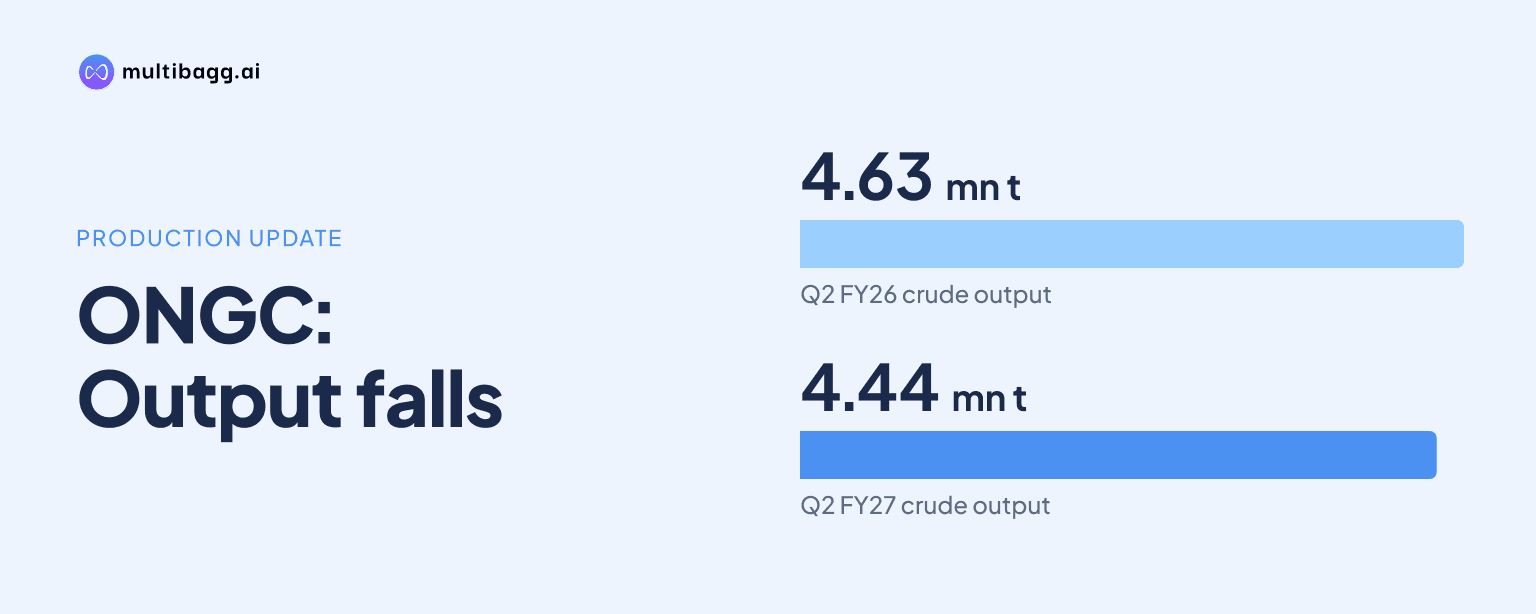
Oil and Natural Gas Corporation Limited reported Q2 FY27 standalone crude-oil production of 4.437 million metric tonnes, down from 4.630 million metric tonnes a year earlier, as reservoir complexity at KG-98/2, monsoon disruptions and pipeline-replacement delays affected output. ONGC said production was broadly stable against Q1 FY27, while onshore gas sales were also constrained by lower customer offtake.
Know Oil & Natural Gas Corpn inside out
Results, valuation, peers and who's buying, in one view.
Why did ONGC's production fall year on year?
ONGC attributed the year-on-year moderation in Q2 FY27 production principally to reservoir-behaviour complexities at its KG-98/2 Asset in the Eastern Offshore Basin. The company also cited monsoon-related operating challenges and associated delays to PRP-8 and PRP-9, its Pipeline Replacement Projects, as contributors to lower quarterly output compared with Q2 FY26.
The effects extended to gas operations on land during the quarter ended 30 September 2026. ONGC said gas production from onshore fields was affected by lower customer offtake after disruptions at certain major consumer facilities temporarily reduced demand. That distinction means the reported production outcome reflected both offshore field and project conditions and downstream customer demand for onshore gas.
ONGC nevertheless described total production in Q2 FY27 as broadly stable compared with Q1 FY27. The release does not provide Q1 FY27 production volumes, so it does not allow a numerical quarter-on-quarter comparison. Its disclosed year-on-year data show lower production across standalone crude, standalone gas, condensate and production from joint ventures operated by others.
How did ONGC's oil and gas volumes compare?
ONGC's Q2 FY27 standalone crude output was 4.437 million metric tonnes, 0.193 million metric tonnes below the 4.630 million metric tonnes reported in Q2 FY26. Standalone natural-gas production was 4.839 billion cubic metres, down 0.079 billion cubic metres from 4.918 billion cubic metres a year before, while condensate fell to 0.239 million metric tonnes from 0.254 million metric tonnes.
The first-half comparison shows the moderation was not limited to the September quarter. Standalone crude output in H1 FY27 was 8.890 million metric tonnes, compared with 9.314 million metric tonnes in H1 FY26, and standalone gas was 9.595 billion cubic metres against 9.763 billion cubic metres. Joint ventures operated by others reported crude production of 0.505 million metric tonnes in H1 FY27, down from 0.613 million metric tonnes.
ONGC's combined standalone oil and oil-equivalent gas, excluding joint ventures, was 9.515 million metric tonnes in Q2 FY27 versus 9.802 million metric tonnes in Q2 FY26. For H1 FY27, that measure was 18.960 million metric tonnes, below 19.581 million metric tonnes a year earlier. Oil-equivalent gas means gas volumes expressed on an equivalent energy basis alongside oil, allowing ONGC to present a combined production measure.
Got a follow-up? Ask IRIS
What is ONGC doing in Western Offshore?
ONGC has expanded bp's role as technical service provider across the Western Offshore to address natural decline at mature fields and accelerate development activity. bp mobilised its TSP-2 team in August 2026 for the entire Western Offshore except the MH field, complementing the TSP-1 arrangement.
The engagement is part of ONGC's stated strategy to enhance production from mature fields through focused interventions designed to arrest natural decline and speed development. The disclosure does not quantify a production target or a timetable for the technical-service work. It specifies that TSP-1 and TSP-2 cover the wider Western Offshore, while TSP-2 excludes the MH field.
Western Offshore investment is also aimed at replacing infrastructure linked to long-term operating reliability. ONGC awarded PRP-X, a subsea pipeline installation and ageing-pipeline replacement project, at an estimated cost of more than Rs 4,300 crore. The company said the project is intended to improve asset integrity, operational reliability and long-term production sustainability after the Q2 FY27 delays associated with PRP-8 and PRP-9.
Which projects and discoveries could affect ONGC's future output?
ONGC awarded two offshore development projects in Western Offshore with combined capital investment of about Rs 11,800 crore and estimated hydrocarbon potential of 22 million metric tonnes of oil equivalent. The projects cover MBOSN-2005-1, SD-4 and BS-17, plus additional development of Ratna-1 and NLM-14, and are intended to unlock future output from the region.
ONGC also reported an exploration result in Mahanadi deepwater. Its first exploratory well, MNDWO181HDB-1, in OALP Block MN-DWHP-2018/1 was proved gas-bearing under the National Offshore Exploration Scheme. The release provides no reserves estimate, development schedule or prospective production volume for that well, so its contribution to future output remains unspecified.
During Q2 FY27, ONGC notified two onshore hydrocarbon discoveries, Amraghat-1 and Vadatal-48. Amraghat-1 in Assam's Cachar District was notified as a new prospect discovery after gas flowed from the exploratory well, while Vadatal-48 in the Cambay Basin was notified as a new pool discovery after new sand was encountered below Chhatral Pay.
The production update came alongside higher reported financial results for the quarter ended 30 September 2026. Standalone gross revenue rose 32.8% year on year to Rs 43,875 crore and standalone net profit increased 57.3% to Rs 15,489 crore, while nominated crude-oil realisation was US$92.33 per barrel against US$67.34 per barrel in Q2 FY26. These price and earnings changes were reported separately from the volume decline.
Conclusion
ONGC's Q2 FY27 production report shows that output was broadly steady sequentially but lower than a year earlier across key oil and gas measures. KG-98/2 reservoir complexity, monsoon-linked operational constraints, pipeline-project delays and lower onshore customer offtake explain the reported decline, even as Q2 standalone net profit rose to Rs 15,489 crore.
The next production indicators will be progress on PRP-8 and PRP-9, the more than Rs 4,300 crore PRP-X award, and bp's expanded Western Offshore technical work following its August 2026 TSP-2 mobilisation. ONGC has also identified 22 million metric tonnes of oil equivalent potential in the Rs 11,800 crore Western Offshore development awards, but disclosed no delivery dates or output targets for those projects.