










Onida sees EBITDA break-even at Rs 250-260 crore revenue
Key highlights
- Onida said EBITDA break-even could be reached at Rs 250-260 crore turnover if current margins hold.
- Q2 FY 2026-27 brand business revenue rose 65% year-on-year to Rs 150.4 crore.
- H1 FY 2026-27 business margin was 17.8%, compared with 15% a year earlier after excluding a one-off.
- Onida expects pending OEM orders to continue for another 8 to 12 months at most.
powered by IRIS
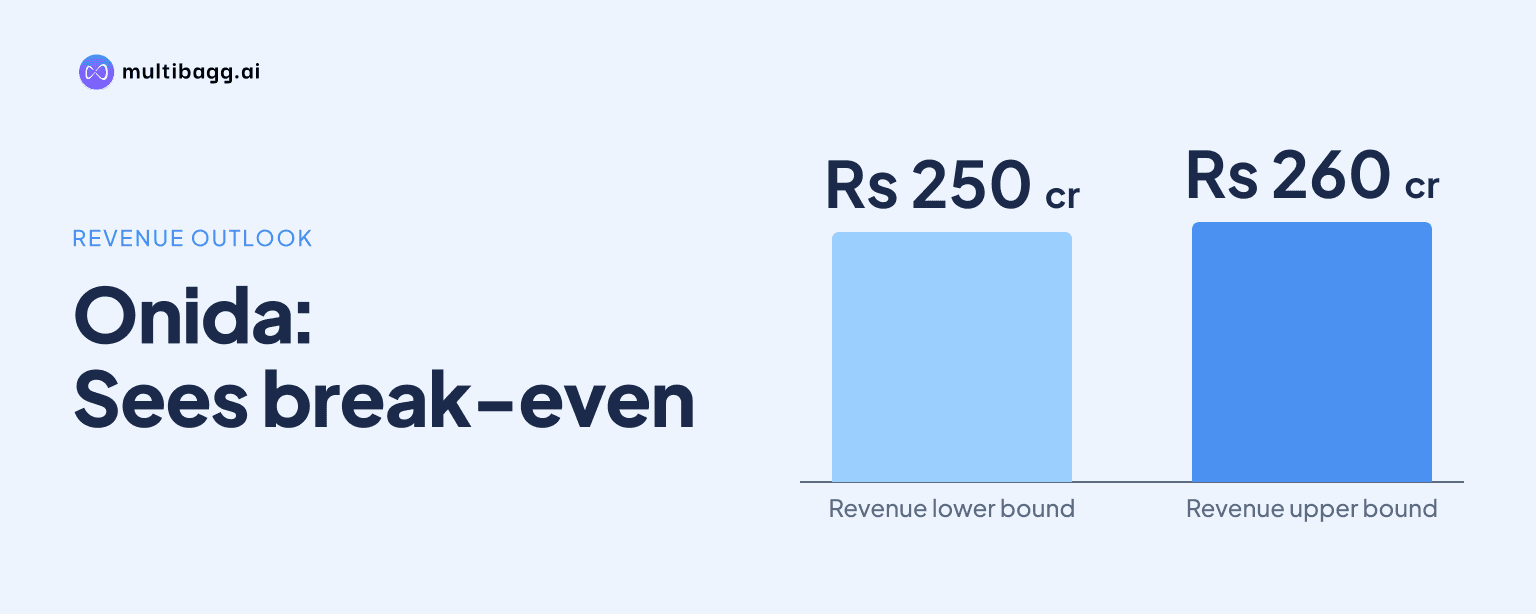
Onida said it could reach earnings before interest, tax, depreciation and amortisation (EBITDA) break-even at turnover of about Rs 250-260 crore if current margins continue, after brand business revenue rose 65% year-on-year to Rs 150.4 crore in Q2 FY 2026-27. Management said raw-material inflation and incomplete price pass-through remain risks to that outcome.
Know Onida Electronics inside out
Results, valuation, peers and who's buying, in one view.
What revenue does Onida need for EBITDA break-even?
Onida said EBITDA break-even could occur at about Rs 250-260 crore of turnover, conditional on retaining the gross margin it currently earns. Management did not identify whether the threshold applies to a quarter, a full year or another period, describing it instead as a broad operating-scale estimate.
Management said gross margin drives the costs below it and is therefore central to the break-even calculation. It is trying to make more expenditure variable and linked to volume, while individual managers are leading cost-optimisation projects intended to provide room for gross-margin disruption and one-time outlays.
Q2 total revenue from operations was Rs 198.6 crore, up 22% year-on-year, while H1 FY 2026-27 total revenue was Rs 381.1 crore, up 25%. Brand business revenue was Rs 150.4 crore in Q2 and Rs 325.7 crore in H1, but management did not directly equate either reported period with the Rs 250-260 crore break-even threshold.
What could stop Onida from reaching break-even?
Onida identified commodity and component inflation as the immediate risk to margin retention. Management said the unresolved situation in West Asia was raising industry input costs and that the effect in some product categories could be about 200 to 400 basis points where increases cannot be fully passed to channel partners or consumers.
Management said price hikes cannot be made every month because channel partners need visibility on product selling. Its stated response is calibrated pricing, cost optimisation, tactical sourcing and a better product mix, rather than a disclosed company-wide price-increase target.
Onida said tactical sourcing early in FY 2026-27 helped protect margins, and it may lock in committed volumes when opportunities arise. The company also said it works with original equipment manufacturer (OEM) partners for periodic input-cost information and manages profitability through volume mix and model mix.
How is the brand business changing Onida's margin mix?
Onida said branded products carry high-double-digit margins, while OEM business operates at low-single-digit margins. In Q2 FY 2026-27, brand business revenue grew 65% year-on-year to Rs 150.4 crore and business margin was 17.7%, up 470 basis points over the prior year after setting aside a one-off item.
In H1 FY 2026-27, brand business revenue rose 48% year-on-year to Rs 325.7 crore and business margin was 17.8%, compared with 15% a year earlier after setting aside a one-off. The 280-basis-point H1 margin increase coincided with total revenue growth of 25%, slower than the 48% growth in brand revenue.
Onida is slowing OEM activity to focus management resources on branded products, although it will not exit immediately. Management said pending OEM orders could run for another 8 to 12 months at most and OEM revenue should decline over subsequent quarters.
Got a follow-up? Ask IRIS
How is Onida building sales scale?
Onida said it added 57 distributors and 127 direct dealers in the first six months of FY 2026-27. Management said it had completed more than 50% of its target to add 4,000 outlets, but did not provide the exact number of outlets reached during the call.
The company had 425 service centres and said customer-service leader Ganesh joined about two months before the call. Management said distribution and service expansion had largely reached the level planned for the current financial year, with the next three to four months focused on consolidating productivity.
Air conditioners and LED products are largely contract manufactured, while washing machines combine outsourced production with manufacturing at the Roorkee plant. Management said Roorkee would be strengthened over time, but contract manufacturing would continue until Onida reaches greater scale.
What demand trends matter for Onida's plan?
Onida said its objective over the next two years is to outgrow the market from what management called a relatively low base. Management said that higher-than-market growth after reaching the relevant turnover scale could support sustainable progress, but it gave no numerical revenue target, EBITDA margin target or date for sustained profitability.
Management said festive buying had improved during the two to three weeks before the call, while October growth remained in line with its earlier trend. It remained positive on Diwali demand, although it said the main festive sell-out had not yet occurred at the time of the discussion.
In H1 FY 2026-27, e-commerce air-conditioner volume growth exceeded offline growth, according to management. The company expects complete television and washing-machine offerings on e-commerce in coming months, while air-conditioner demand had picked up in western and southern India but remained lower in northern and eastern regions because of winter conditions.
Conclusion
Onida has provided its first broad indication of the turnover needed for EBITDA break-even: Rs 250-260 crore, provided current gross margins hold. Faster growth in brand business than in total revenue, alongside a 17.7% Q2 business margin and 17.8% H1 business margin, supports management's emphasis on branded products and variable-cost discipline.
The next measures to watch are margin retention amid the stated 200-to-400-basis-point exposure in some categories, productivity from the expanded distribution and service network, and the planned OEM run-off over 8 to 12 months. Management also said it expects to reveal a contemporary Onida brand positioning in coming months and to set new reach-expansion targets in the next financial year.