










Orchid Pharma Q2 EBITDA rises 148% as margin reaches 39%
Key highlights
- Orchid Pharma’s Q2 FY27 revenue rose about 14% year on year to Rs 341 crore.
- Orchid Pharma’s Q2 FY27 gross margin increased to about 39% from 31%.
- Orchid Pharma’s Q2 FY27 EBITDA including other income rose about 148% to Rs 52 crore.
- Orchid Pharma reported H1 FY27 operating cash flow of about Rs 118 crore.
powered by IRIS
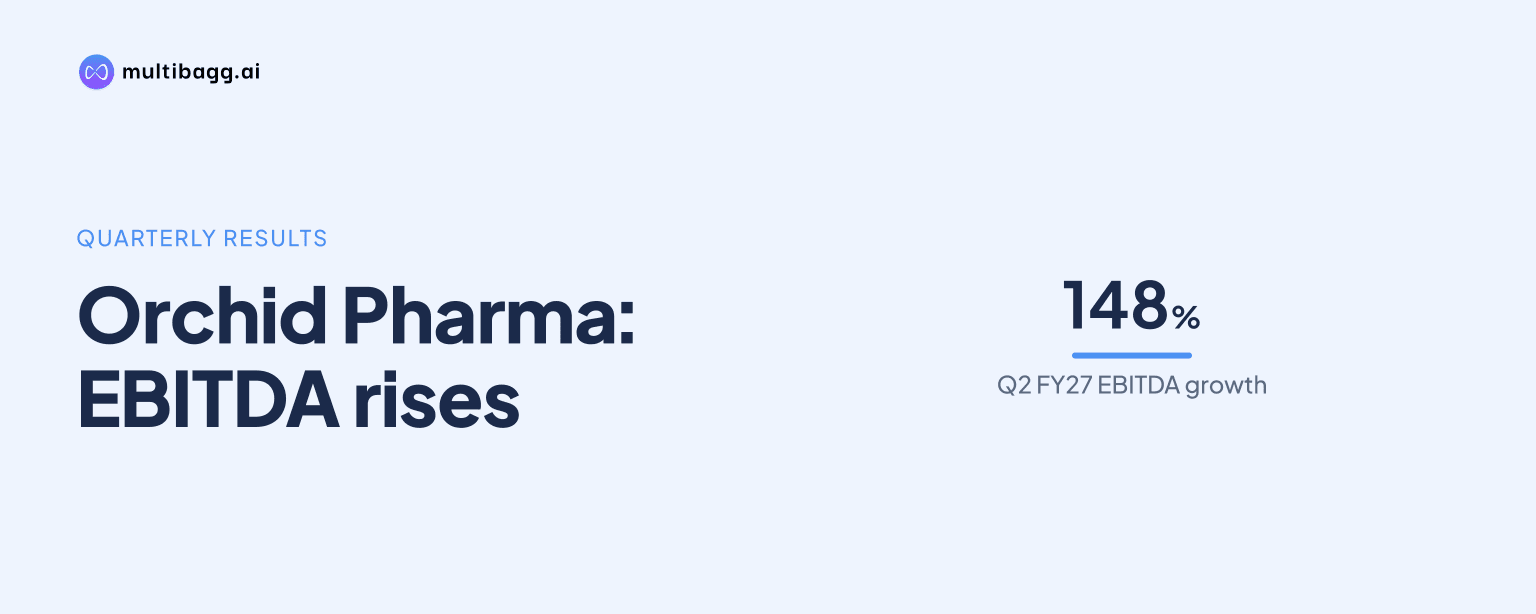
Orchid Pharma Limited reported Q2 FY27 EBITDA including other income of Rs 52 crore, up about 148% from Rs 21 crore a year earlier, as gross margin rose eight percentage points to about 39%. The result absorbed two accounting charges of about Rs 5 crore each and fuel and energy costs that were nearly 30% higher year on year.
Know Orchid Pharma inside out
Results, valuation, peers and who's buying, in one view.
How did Orchid Pharma perform in Q2 FY27?
Orchid Pharma’s Q2 FY27 revenue from operations rose about 14% year on year to Rs 341 crore from Rs 299 crore, and was about 12% above Q1 FY27. EBITDA including other income increased to Rs 52 crore from Rs 21 crore, taking EBITDA margin to 15% from 7% in Q2 FY26.
Profit after tax was Rs 2,860 lakh in Q2 FY27, compared with a loss of Rs 90 lakh a year earlier, and earnings per share were Rs 4.77. The reported result included an expected credit-loss provision of about Rs 5 crore and a merger-related impairment loss of about Rs 5 crore.
The H1 FY27 figures showed a similar improvement, although the quarterly gross and EBITDA margins were above the half-year levels. Revenue for the six months rose about 15% to Rs 645 crore from Rs 562 crore, while EBITDA increased about 148% to Rs 77 crore from Rs 31 crore and EBITDA margin rose to 12% from 6%.
Why did Orchid Pharma’s gross margin reach 39%?
Orchid Pharma said Q2 FY27 gross margin reached about 39% because inventory was gradually normalising, volumes improved and product mix was more favourable. The Q2 FY26 comparison was affected by high-cost inventory-related write-offs, which had reduced gross margin to about 31%.
The same factors lifted H1 FY27 gross margin to about 36% from 30% in H1 FY26, an increase of around six percentage points. Management said the six-month movement reflected both the normalisation after the prior-year inventory correction and better volumes and mix.
Management did not describe the 39% quarterly margin as a fixed run rate. It said margins remain sensitive to product mix and market conditions, while core-market pricing and demand remain competitive; injectable cephalosporins showed recovery in the last quarter, but oral cephalosporins continued to face constraints.
An analyst cited Q2 FY27 EBITDA excluding other income of around Rs 24 crore and asked whether adding back the two accounting charges of about Rs 5 crore each resulted in adjusted EBITDA of around Rs 34 crore. Management confirmed that calculation, distinguishing it from reported EBITDA including other income of Rs 52 crore.
What costs and cash-flow changes affected Orchid Pharma?
Orchid Pharma said fuel and energy costs were nearly 30% higher year on year in Q2 FY27, which management linked to the Middle East war. It also recognised an expected credit-loss provision of about Rs 5 crore under Indian Accounting Standards and company policy, describing it as a provision rather than a write-off and expecting recovery of most underlying receivables.
The other charge was an impairment loss of about Rs 5 crore associated with completion of the Dhanuka Laboratories merger, effective July 10, 2026, with an appointed date of April 1, 2024. Management described the impairment as one-time, and said comparative figures had been restated on a combined basis after the merger.
H1 FY27 employee expense was Rs 59 crore against Rs 58 crore in H1 FY26, an increase of about 2% compared with 15% revenue growth. Other expenses rose to Rs 135 crore from Rs 114 crore, mainly due to higher power and fuel costs and selling and distribution expenses accompanying revenue growth.
Working-capital utilisation fell to Rs 412 crore at the end of September 2026 from Rs 464 crore in March 2026. Working-capital days declined to 118 from 137, receivable days fell to 100 from 113, and H1 FY27 operating cash flow was about Rs 118 crore.
Got a follow-up? Ask IRIS
What could support Orchid Pharma’s operating recovery?
Orchid Pharma said its priority is to convert gross-margin recovery into sustained operating profitability through cost control and higher productivity. Following the July 2026 merger, it began integration across procurement, manufacturing, quality systems, product planning and support functions, with the first savings expected toward the end of FY27.
The antimicrobial stewardship business had a quarterly EBITDA drag of about Rs 1.5 crore in Q2 FY27, lower than before, according to management. The platform is being developed for products including ORBLICEF and cefiderocol, and Orchid Pharma said it had 15 distinct products and 18 stock-keeping units, or SKUs.
Orchid Pharma said it was working regularly with more than 120 hospitals and had reached around 400 hospitals in total. Management reported a quarterly growth trend of about 10% to 15% for the platform over the previous four quarters, while maintaining that the business would be built with financial discipline.
EXBLIFEP royalties and licensing fees were improving each quarter, according to management, although registration and launches remain necessary before wider sales can begin. Russia and Latin America partners require country-specific registrations that management said could take 12 to 24 months, while commercial launches in the Middle East and South Africa were expected in Q1 2027 after regional disruption.
What milestones does Orchid Pharma need to meet next?
Orchid Pharma had invested Rs 173 crore in its cefiderocol project as of September 30, 2026. Management targeted commissioning by December 2026, validation and initial batches between January and March 2027, and an inauguration on January 18, 2027.
The targeted India launch for cefiderocol is Q3 FY27, subject to successful validation, a manufacturing licence, an expected clinical-trial waiver, commercial arrangements and other regulatory requirements. Management also said it was discussing potential EXBLIFEP partnerships in Australia, Southeast Asia, Japan, other Latin American markets and North Africa, with three to four possible agreements over the next two quarters not yet concluded.
The Jammu 7-ACA project, designed for 1,000 metric tonnes of annual capacity, was scheduled to begin commercial operations in March 2027. Pilot technology had been validated, but management said it was continuing to improve yields against committed parameters, making plant start-up and subsequent operating performance separate execution tests.
Conclusion
Orchid Pharma’s Q2 FY27 improvement extended beyond revenue growth: sales rose about 14%, gross margin increased to 39% from 31%, and EBITDA including other income rose 148% to Rs 52 crore. The quarter also included nearly 30% higher fuel and energy costs and two charges of about Rs 5 crore each, while H1 working capital, receivable days and operating cash flow improved.
The next disclosed milestones are the expected integration savings toward the end of FY27, cefiderocol commissioning by December 2026 and its targeted Q3 FY27 India launch, subject to regulatory steps. Management’s March 2027 schedule for the Jammu 7-ACA plant, alongside EXBLIFEP registrations and possible licensing agreements over the next two quarters, will determine how quickly these initiatives contribute.