










Orient services reached 59.6% of Q2 revenue from operations
Key highlights
- Orient said services represented approximately 59.6% of Q2 FY27 revenue from operations, up from 51.9% in Q1 FY27.
- Standalone IT infrastructure and application-services revenue rose to Rs 128.569 crore in Q2 FY27 from Rs 102.405 crore in Q1 FY27.
- Standalone IT infrastructure-solutions revenue declined to Rs 88.785 crore in Q2 FY27 from Rs 97.089 crore in Q1 FY27.
- Orient reported a consolidated Q2 FY27 EBITDA margin of 10.2%, compared with 7.57% in Q1 FY27.
powered by IRIS
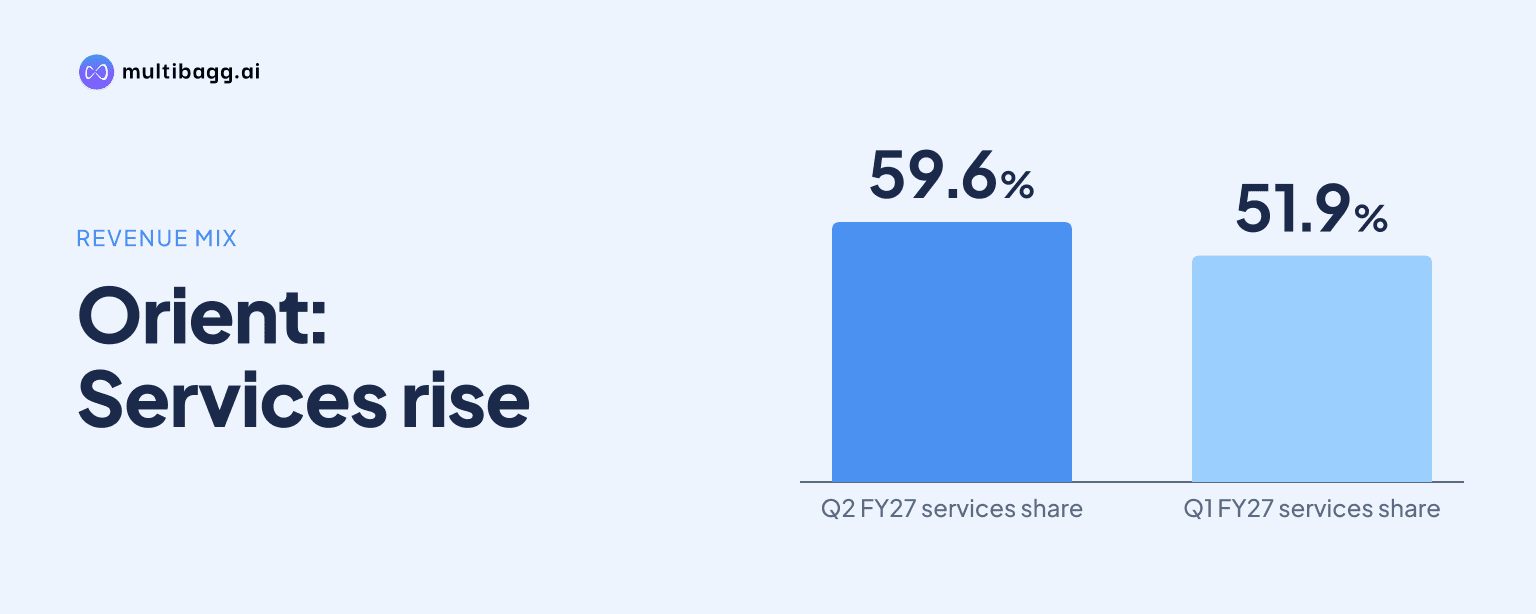
Orient said services represented approximately 59.6% of revenue from operations in Q2 FY27, up from 51.9% in Q1 FY27, as standalone IT infrastructure and application services revenue rose to Rs 128.569 crore. Over the same quarter, standalone IT infrastructure solutions revenue fell to Rs 88.785 crore from Rs 97.089 crore.
Know Orient Technologies inside out
Results, valuation, peers and who's buying, in one view.
How did Orient’s revenue mix change in Q2 FY27?
Orient’s services revenue mix increased by 7.7 percentage points sequentially to approximately 59.6% of revenue from operations in Q2 FY27, compared with 51.9% in Q1 FY27. The disclosed movement made services the larger component of the Q2 revenue base, rather than a segment growing alongside infrastructure solutions.
The mix movement coincided with higher revenue in IT infrastructure and application services and lower revenue in IT infrastructure solutions. Orient identifies cloud and DevOps, digital transformation, infrastructure managed services and Device as a Service as services offerings, while data-centre solutions, end-user computing and cybersecurity are included in infrastructure solutions.
Which offerings drove Orient’s services revenue growth?
Orient’s standalone IT infrastructure and application-services revenue increased to Rs 128.569 crore in Q2 FY27 from Rs 102.405 crore in Q1 FY27 and Rs 91.586 crore in Q4 FY26. The sequential increase was Rs 26.164 crore, based on Orient’s standalone segment disclosures.
The services portfolio includes managed infrastructure and subscription-oriented offerings as well as deployment work. For H1 FY26-27, Orient said it expanded managed services and workplace solutions through lifecycle-led engagements, subscription-based endpoint management and operating-expenditure, or OPEX, driven IT-consumption models. It also reported cloud and digital-transformation customer engagements across enterprise and public-sector opportunities.
What happened to Orient’s infrastructure-solutions revenue?
Orient’s standalone IT infrastructure-solutions revenue decreased to Rs 88.785 crore in Q2 FY27 from Rs 97.089 crore in Q1 FY27, a reduction of Rs 8.304 crore. The Q2 FY27 figure was also below Rs 89.749 crore in Q4 FY26, so the services increase was not matched by sequential growth in the conventional solutions segment.
The infrastructure-solutions category covers data-centre solutions, end-user computing and cybersecurity. Orient said its H1 FY26-27 activity included enterprise infrastructure deployments, modernisation and mission-critical IT environments, alongside strategic partnerships and service-delivery investments supporting integrated security and managed-services offerings. The presentation does not provide a product-level split within the Rs 88.785 crore Q2 FY27 solutions revenue.
Got a follow-up? Ask IRIS
How did the mix shift relate to Orient’s profitability?
Orient reported a consolidated earnings before interest, tax, depreciation and amortisation, or EBITDA, margin of 10.2% in Q2 FY27, compared with 7.57% in Q1 FY27. Management described this as a 263-basis-point sequential improvement, alongside the increase in services revenue mix to about 59.6%.
For H1 FY26-27, Orient reported consolidated total income of Rs 423.831 crore, EBITDA of Rs 37.869 crore and an EBITDA margin of 8.94%. Profit before tax was Rs 21.316 crore and profit after tax was Rs 16.896 crore. These are consolidated measures, whereas the segment comparison is labelled standalone, so the figures are not directly interchangeable.
Orient’s standalone H1 FY27 revenue was Rs 418.982 crore, down 14.25% from Rs 488.603 crore in H1 FY26. Standalone gross profit declined 3.43% to Rs 78.722 crore, while EBITDA fell 9.21% to Rs 35.673 crore; the presentation reported an H1 FY27 EBITDA margin of 8.51%. The Q2 margin improvement therefore occurred during a half year in which standalone revenue and EBITDA were lower year on year.
Which customer markets and plans could shape Orient’s revenue mix?
Orient’s largest disclosed Q2 FY26-27 industry exposure was mid-market and others at 39.20% of revenue, followed by information technology-enabled services, or ITES, at 29.10% and banking, financial services and insurance, or BFSI, at 19.15%. Government and public-sector undertakings accounted for 10.79%, while telecommunications represented 1.76%.
The mid-market and others category includes healthcare, manufacturing, infrastructure, real estate, logistics, education, e-commerce, conglomerates, energy and service industries. Orient listed Coal India in government and public-sector undertakings, Integreon in ITES, and ACG and Jyothy Labs in pharma and healthcare as customer examples. These examples identify sectors served but do not disclose customer-level revenue or contract values.
Orient also said it had recently entered Device as a Service and aims to capitalise on that market opportunity. Its commissioned July 2024 industry report projected India’s IT hardware equipment and mobile-phone leasing industry at Rs 54,000 crore to Rs 57,000 crore by FY28P, compared with Rs 33,600 crore in FY23. The presentation also said Orient’s cloud and data-management-services revenue share rose from 16.03% in FY21 to 24.07% in FY25.
Conclusion
Orient’s Q2 FY27 disclosures show a measurable move toward services: the share of revenue from operations attributed to services increased to about 59.6%, while standalone IT infrastructure and application-services revenue reached Rs 128.569 crore. The decline in standalone IT infrastructure-solutions revenue to Rs 88.785 crore shows that the mix movement reflected different segment trajectories rather than sequential growth across both businesses.
The next reported results should show whether managed services, workplace solutions, cloud, digital transformation and Device as a Service sustain the higher services contribution. Investors can also watch whether the Q2 FY27 consolidated EBITDA margin of 10.2% remains above the 7.57% reported for Q1 FY27 as Orient pursues OPEX-driven and subscription-based customer engagements.