










Orient Technologies shifts mix as Q2 EBITDA margin hits 10.2%
Key highlights
- Orient Technologies' Q2 FY27 EBITDA margin rose 263 basis points sequentially to 10.2%.
- Services revenue rose 24.95% sequentially to Rs 130.99 crore and reached 59.6% of Q2 revenue.
- Orient Technologies reported a Rs 331.61 crore order book at September 30, 2026, including about Rs 199 crore of services orders.
- Management said H1 FY27 revenue declined 14% year on year, primarily because of infrastructure supply constraints.
powered by IRIS
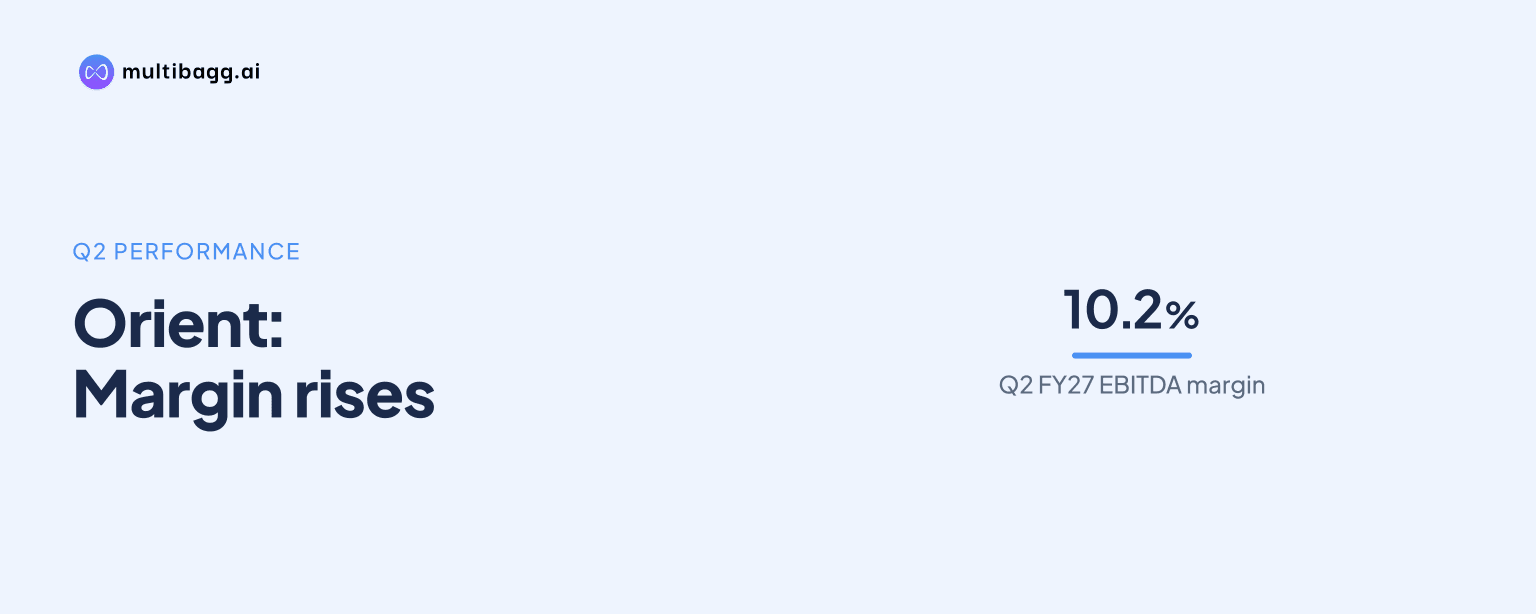
Orient Technologies Limited lifted its Q2 FY27 EBITDA margin to 10.2%, from 7.57% in Q1, as services rose to 59.6% of revenue and management redirected the business toward managed services amid infrastructure supply delays and price increases. The shift came while management said H1 FY27 revenue fell 14% year on year.
Know Orient Technologies inside out
Results, valuation, peers and who's buying, in one view.
Why did Orient Technologies' revenue mix change in H1 FY27?
Orient Technologies changed its mix because infrastructure-product deliveries have become slower and prices have risen, according to management. Chairman and Managing Director Ajay Sawant said these conditions had persisted for about one year and could continue for another year. Management also said original equipment manufacturer, or OEM, supply lead times had reached 16 to 18 weeks, making it difficult to commit to delivery in the following quarter for orders received late in a quarter.
The consequence was a reported 14% decline in H1 FY27 revenue from the year-earlier period, which management attributed primarily to infrastructure revenue. Customers are increasingly preferring operating expenditure, or Opex, models over capital expenditure, or Capex, Mr. Sawant said. Orient Technologies is therefore selecting infrastructure deals more selectively while putting greater emphasis on its Orient hosted managed services across data centres, cloud, cybersecurity, infrastructure management and digital transformation.
That strategy is intended to change both the type and duration of customer engagement. Management described cloud, cybersecurity, digital transformation and infrastructure-management services as recurring revenue streams, while most managed-services contracts are structured for three years. Some contracts run for five or seven years. In contrast, the company cited a Rs 76.20 crore National Payments Corporation of India server order received in July 2026, which carried an 18-week delivery schedule and a seven-year warranty.
How did Orient Technologies' mix lift Q2 FY27 profitability?
Orient Technologies' Q2 FY27 profitability improved because service revenue grew faster while product revenue declined. Revenue from services increased 24.95% sequentially to Rs 130.99 crore, whereas product revenue was Rs 88.78 crore, compared with Rs 97.09 crore in Q1 FY27. As a result, services represented 59.6% of revenue in Q2, up from 51.92% in Q1, providing the mix change management linked to margin expansion.
Revenue from operations rose 8.84% quarter on quarter to Rs 219.77 crore from Rs 201.92 crore, but EBITDA grew 45.6% to Rs 22.45 crore from Rs 15.42 crore. This lifted the EBITDA margin by 263 basis points to 10.2% from 7.57%. A basis point is one-hundredth of a percentage point. Profit before tax increased to Rs 14.74 crore from Rs 6.58 crore, and profit after tax rose to Rs 11.72 crore from Rs 5.17 crore.
The Q2 movement also exceeded the change in total income, which increased 7.99% sequentially to Rs 220.06 crore. Earnings per share rose to Rs 2.56 from Rs 1.13. For H1 FY27, Orient Technologies reported total income of Rs 423.83 crore, EBITDA of Rs 37.87 crore and an EBITDA margin of 8.94%, alongside profit after tax of Rs 16.90 crore and earnings per share of Rs 3.69.
Got a follow-up? Ask IRIS
What does Orient Technologies' order book say about services?
Orient Technologies' order book indicates that services account for the larger disclosed portion of work scheduled to be built by March 31, 2027. The order book stood at Rs 331.61 crore on September 30, 2026. Management said approximately Rs 199 crore represented services orders and Rs 132 crore represented product orders, reinforcing its stated focus on recurring managed-services engagements despite smaller service ticket sizes than product orders.
The sector mix in Q2 FY27 was also broad rather than concentrated in one vertical. Mid-market and other customers contributed 39.2% of revenue, information technology-enabled services contributed 29.1%, banking, financial services and insurance contributed 19.15%, government and public-sector undertakings contributed 10.79%, and telecommunications accounted for 1.76%. Management said the integrated portfolio enables cross-selling between cloud, cybersecurity, end-user computing and digital-transformation offerings.
Orient Technologies is adding credentials and partnerships to support this approach. It received Amazon Web Services Managed Service Provider recognition, which management said validates its capabilities in cloud implementation, optimisation and security. In September 2026, it also expanded its Securonix relationship to become an exclusive value-added distributor and joint go-to-market partner in India under a three-year agreement, as it pursues cybersecurity managed-services opportunities.
What could affect Orient Technologies' execution in H2 FY27?
Orient Technologies' principal disclosed constraint is infrastructure availability, with management saying OEM delivery times are now 16 to 18 weeks and may remain difficult even through 2028. That limitation affects the timing of product billing and explains why management does not commit to supplying an order in the next quarter if it is received during November or December. Management said this supply environment was a central reason for moving resources toward managed services.
The National Payments Corporation of India order is an immediate execution test. Management said on November 3 that the Rs 76.20 crore server order, placed in July, remained within its 18-week schedule and was expected to be delivered and implemented in the following week. The company said it did not expect a delivery delay or customer penalty on that order, although the broader supply position remains uncertain.
Working-capital control is another stated priority for H2 FY27. Management said Orient Technologies was debt-free and intended to remain debt-free through March 2027. For Device as a Service, or DaaS, it said it is being selective about customers and provides the asset-based offering only after credit approval. This approach is intended to limit credit exposure while the company expands an Opex-oriented proposition.
Conclusion
Orient Technologies' Q2 FY27 result shows a deliberate reshaping of revenue rather than a simple return in infrastructure demand. Services rose to 59.6% of revenue, helping EBITDA increase 45.6% sequentially to Rs 22.45 crore and margin reach 10.2%, even as management said H1 revenue was 14% lower year on year because of infrastructure constraints. The Rs 199 crore services component of the disclosed order book supports that direction.
The next points to watch are management's execution of the Rs 76.20 crore National Payments Corporation of India order, the pace at which the Rs 331.61 crore September order book is built by March 31, 2027, and progress in commercialising the security operations centre and network operations centre. Management expects the latter facilities to reach full capacity usage by calendar year 2027 and plans to hire about 100 cybersecurity professionals while targeting a 12% expansion in its cybersecurity customer base.