










Oriental says dividend exemption survives 25% SPV surcharge
Key highlights
- Oriental says the SPV surcharge under the new tax regime increased to 25% from 10%.
- Oriental says unitholder dividends remain exempt even when an SPV opts for the new regime.
- The tax update appears in Oriental's Q2’FY2027 Operations & Finance Report.
- Oriental says SPVs can still choose the most efficient tax regime for their circumstances.
powered by IRIS
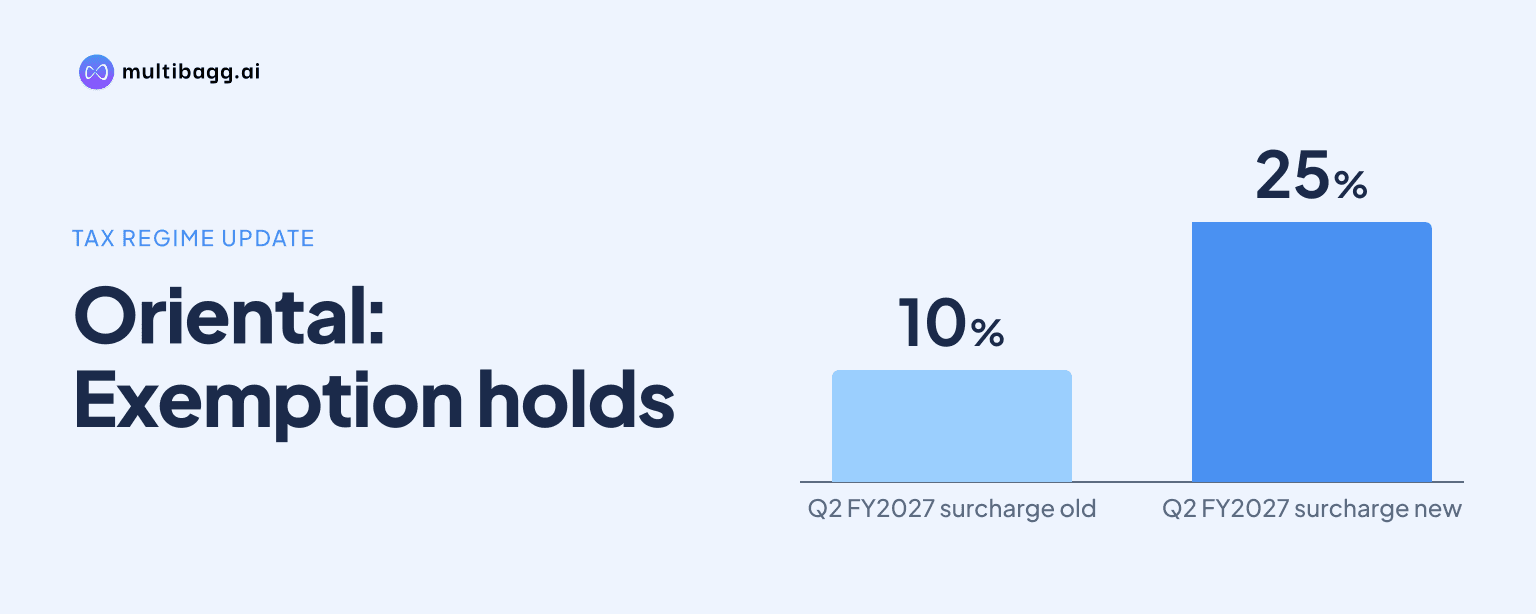
Oriental Infra Trust says the Taxation and Other Laws (Amendment) Act, 2026 preserves dividend exemption for unitholders when a special purpose vehicle chooses the new tax regime, although the SPV surcharge has increased to 25% from 10%. Oriental presented the change as expected to be favourable for investors in its Q2’FY2027 Operations & Finance Report.
Know Oriental Infra Trust inside out
Results, valuation, peers and who's buying, in one view.
What did Oriental's 2026 tax amendment change for SPVs?
The 2026 amendment raised the surcharge to 25% from 10% for a special purpose vehicle, or SPV, of a business trust that opts for the new tax regime. Oriental identifies this 15-percentage-point increase as the direct change affecting SPVs within the Infrastructure Investment Trust, or InvIT, structure addressed in its Q2’FY2027 tax update.
Oriental says the 25% surcharge does not remove an SPV's ability to select a tax regime. Its Q2’FY2027 presentation says SPVs can still choose the most efficient regime for their circumstances, meaning the amendment changes the cost of the new-regime option rather than requiring every SPV to use it.
Why are Oriental unitholder dividends still exempt?
Oriental says a unitholder's dividend is now exempt even if the SPV opts for the new tax regime. Before the Taxation and Other Laws (Amendment) Act, 2026, the exemption applied only when the SPV had not opted for that regime, according to Oriental's Q2’FY2027 tax update.
The change removes the previous link between an SPV's new-regime election and the unitholder's dividend exemption. Under the earlier condition described by Oriental, choosing the new regime meant the stated condition for exemption was not met; under the 2026 amendment, the same choice no longer prevents the dividend from being exempt.
Oriental says this preserves the tax-efficient pass-through nature of the InvIT structure. In the trust's presentation, that conclusion rests on the continuation of the dividend exemption at the unitholder level, while the separate 10%-to-25% surcharge applies at the SPV level for an entity choosing the new regime.
How does Oriental compare the 25% surcharge with dividend taxation?
Oriental says the 25% SPV surcharge costs less than taxing dividends in the hands of taxable unitholders. This is Oriental's stated comparison in the Q2’FY2027 presentation rather than an investor-specific calculation, and it compares the higher SPV charge with the alternative of dividend taxation for taxable holders.
The tax update does not provide a distribution amount, an individual unitholder tax rate or a numerical post-amendment yield. As a result, the 25% surcharge alone cannot establish a particular investor's tax liability, even though Oriental states that the higher SPV surcharge is less costly than taxing dividends in taxable unitholders' hands.
Oriental also says greater certainty supports continued cash distributions with post-tax yields intact. That statement is management's view of the impact of the 2026 exemption change; the tax-update section does not disclose a per-unit distribution, an ex-date or a distribution target for Q2’FY2027.
Got a follow-up? Ask IRIS
Can Oriental SPVs still choose a tax regime?
Yes, Oriental says its SPVs can still choose the most efficient tax regime for their circumstances after the 2026 amendment. The 25% surcharge specifically applies where an SPV opts for the new regime, while the presentation does not say that every SPV must make that election.
The retained choice is significant because the earlier rule attached a unitholder consequence to an SPV's tax-regime decision. Oriental says the amendment safeguards dividend exemption while allowing SPVs to select a regime, and it therefore describes the expected effect as favourable for investors.
Oriental does not disclose in the Q2’FY2027 tax update how many SPVs it has, which tax regime each SPV uses or whether any SPV will change its election. It also does not quantify the surcharge effect in rupees, limiting the disclosed conclusion to the 10%-to-25% rate change, continuing exemption and retained choice.
What should Oriental unitholders take from the tax update?
Oriental says unitholders should understand that dividend exemption is maintained despite the SPV surcharge rising to 25% from 10% under the new regime. The stated benefit is the removal of the former condition that required an SPV not to choose the new regime for the exemption to apply.
The Q2’FY2027 tax update addresses SPV surcharge rates, dividend treatment and the InvIT pass-through mechanism rather than operating performance. Oriental's IFRS result section separately reported revenue from operations of Rs 597.3 crore for the quarter ended 30 September 2026, but the tax section does not revise that operating figure or disclose a tax-driven change to it.
The report's tax assessment is therefore structural rather than a forecast of a defined cash payment. Oriental says the amended framework supports continued distributions and intact post-tax yields, but does not provide a numerical yield, distribution schedule or SPV-by-SPV tax election in the Q2’FY2027 materials.
Conclusion
Oriental says the combined effect of the 2026 amendment is that an SPV choosing the new regime faces a 25% surcharge rather than 10%, while unitholders retain dividend exemption. The trust consequently views the amendment as preserving the InvIT pass-through framework because the SPV's tax-regime election no longer removes the stated unitholder benefit.
The next item to watch is how Oriental's SPVs use their retained tax-regime choice after the 2026 amendment. Oriental has not disclosed an SPV-by-SPV election, a rupee surcharge impact, a distribution target or a scheduled tax decision date in its Q2’FY2027 presentation, leaving those matters for later disclosure.