










Oriental InfraTrust Q2 PAT falls 91% as tax hits Rs 112 crore
Key highlights
- OIT’s Q2 FY27 profit after tax fell to Rs 5.9 crore from Rs 67.6 crore in Q2 FY26.
- Tax expense rose to Rs 112 crore in Q2 FY27 from Rs 17.3 crore a year earlier.
- Revenue from operations increased 8.5% to Rs 597.3 crore, led by Nagpur Bypass and Rajiv Chowk.
- NDCF increased Rs 36.4 crore year on year to Rs 201.7 crore in Q2 FY27.
powered by IRIS
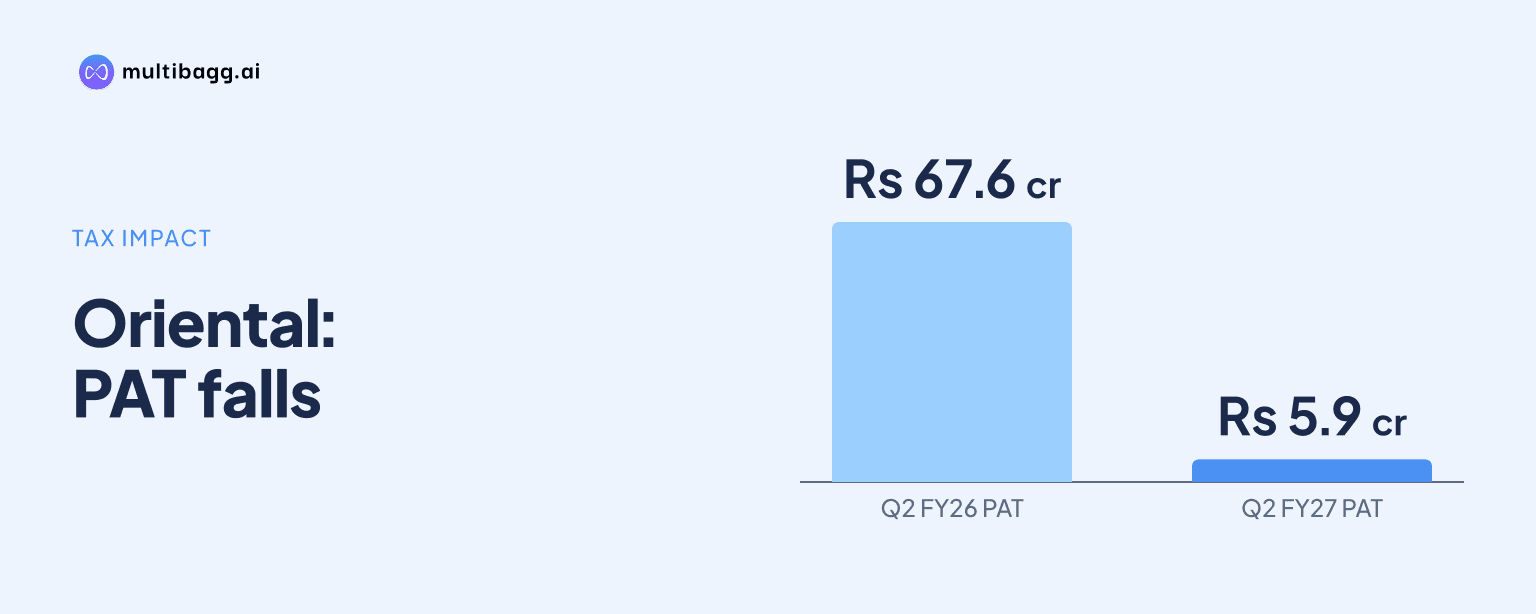
Oriental InfraTrust reported Q2 FY27 profit after tax of Rs 5.9 crore, down 91% from Rs 67.6 crore in Q2 FY26, as tax expense rose to Rs 112 crore from Rs 17.3 crore despite an 8.5% increase in revenue from operations to Rs 597.3 crore. Higher subcontracting expenses also reduced operating earnings.
Know Oriental Infra Trust inside out
Results, valuation, peers and who's buying, in one view.
Why did OIT’s Q2 FY27 profit after tax fall 91%?
OIT’s profit after tax fell 91% because the Rs 94.7 crore rise in tax expense exceeded the Rs 33 crore increase in profit before tax. Profit before tax rose to Rs 117.9 crore in Q2 FY27 from Rs 84.9 crore in Q2 FY26, but tax expense increased to Rs 112 crore from Rs 17.3 crore, leaving Rs 5.9 crore of reported profit.
The tax movement reduced OIT’s net profit margin to 1.0% in Q2 FY27 from 12.3% in Q2 FY26. Management attributed the reduction in profit-after-tax margin primarily to an approximately Rs 95 crore increase in tax expense over the corresponding quarter, rather than to a decline in revenue from operations.
How did OIT’s revenue and operating costs change?
OIT’s revenue from operations increased Rs 46.7 crore, or 8.5%, to Rs 597.3 crore in Q2 FY27, driven by higher traffic and mix, toll-rate changes and revenue from the Rajiv Chowk Project. Other income increased Rs 3.8 crore to Rs 35.7 crore, which management linked to higher interest income, investment gains, and higher cash and investment balances.
OIT’s subcontracting expense increased 68.6% to Rs 139.3 crore from Rs 82.6 crore, a Rs 56.7 crore increase that management attributed to annual escalation and the addition of the Rajiv Chowk Project. Earnings before interest, tax, depreciation and amortisation, or EBITDA, declined Rs 12.6 crore to Rs 457.3 crore, while EBITDA margin fell to 76.6% from 85.3%.
Total expenses rose to Rs 515 crore in Q2 FY27 from Rs 497.6 crore a year earlier. Employee benefits expense increased Rs 2.8 crore to Rs 14.4 crore, investment manager fees rose Rs 0.7 crore to Rs 5.5 crore, and other expenses increased Rs 3 crore to Rs 16.5 crore; depreciation and amortisation fell Rs 20.1 crore to Rs 182.1 crore.
Which OIT projects drove quarterly revenue growth?
Nagpur Bypass delivered OIT’s largest project-level revenue increase, rising Rs 28.3 crore to Rs 166.6 crore in Q2 FY27 from Rs 138.3 crore in Q2 FY26. Rajiv Chowk added Rs 17.7 crore of quarterly revenue, compared with no revenue in the prior-year comparison, consistent with management’s explanation for overall operating-revenue growth.
Hungund Hospet revenue rose Rs 8.1 crore to Rs 80.5 crore and Etawah Chakeri revenue increased Rs 5.1 crore to Rs 132.7 crore. These gains were partly offset by a Rs 22.5 crore decline at Nagpur Betul to Rs 76.4 crore, while Biaora Dewas revenue decreased Rs 1.4 crore to Rs 60.4 crore.
Got a follow-up? Ask IRIS
Did lower finance costs and cash flow offset the tax impact?
OIT’s finance cost declined Rs 7.2 crore to Rs 157.3 crore in Q2 FY27 following repayment and refinancing of higher-cost debt with lower-cost non-convertible debentures, or NCDs, in the second half of FY26. Lower finance cost, lower depreciation and no intangible-asset impairment compared with Rs 18.3 crore in Q2 FY26 contributed to the rise in profit before tax, but did not offset the tax charge at the profit-after-tax level.
Net distributable cash flow, or NDCF, increased Rs 36.4 crore to Rs 201.7 crore from Rs 165.3 crore in the corresponding quarter. At trust level, OIT received Rs 356.2 crore of cash flows from special purpose vehicles, or SPVs, recorded Rs 91.3 crore of finance cost and Rs 46.2 crore of debt repayment, and reported a yield per unit of Rs 3.46.
Cash and investments stood at Rs 1,581.1 crore at the end of Q2 FY27, up Rs 327.7 crore from Rs 1,253.4 crore a year earlier. Management cited approximately Rs 44 crore of Rajiv Chowk cash and investments, higher debt-service reserve account requirements, lower amounts withheld for the initial public offering, increased major-maintenance reserve requirements, and escalation payments pending an ALP report.
How did OIT’s leverage and year-to-date earnings compare?
OIT’s debt-equity ratio increased to 1.59 times in Q2 FY27 from 1.37 times in Q2 FY26, primarily because debt was raised to finance the Rajiv Chowk acquisition, according to management. Asset cover declined to 2.10 times from 2.20 times, debt-service coverage was 1.37 times versus 1.39 times, and interest-service coverage improved to 2.91 times from 2.86 times.
For the first half of FY27, revenue from operations rose Rs 91.6 crore to Rs 1,211.4 crore and EBITDA increased Rs 20.6 crore to Rs 972 crore. Yet year-to-date profit after tax declined Rs 45.4 crore to Rs 135.6 crore, as the prior-year period included a Rs 42.1 crore reversal of impairment of intangible assets while FY27 included Rs 5.6 crore of goodwill impairment.
OIT’s total equity was Rs 3,614.7 crore as at 30 September 2026, compared with Rs 4,158.6 crore a year earlier. Management said the decline reflected repayment of capital and movements in other equity, while total assets declined to Rs 12,048.7 crore from Rs 12,520.1 crore over the same comparison.
Conclusion
OIT’s Q2 FY27 accounts show that revenue growth, lower finance cost and higher pre-tax profit did not translate into higher reported profit because tax expense climbed to Rs 112 crore and subcontracting costs rose sharply. The difference between Rs 117.9 crore of profit before tax and Rs 5.9 crore of profit after tax explains the quarterly profit decline, while NDCF increased to Rs 201.7 crore.
Next, investors can watch the proposed upstreaming of Rs 192.6 crore retained in OPIPL through a capital reduction. OIT said National Company Law Tribunal proceedings were ongoing, with the next hearing scheduled for 21 January 2027; it is also undertaking technical due diligence to estimate costs and finalise an engineering, procurement and construction contractor for 41.5 kilometres of Nagpur Bypass capacity augmentation work.