










Pajson Agro proposes 113,000-tonne India-Africa platform
Key highlights
- Pajson Agro’s proposed Pacific Global share swap would create 113,000 metric tonnes of combined processing capacity.
- Pacific Global’s 60,000-metric-tonne Ivory Coast facility is operating at about 50% utilisation in FY27.
- Pajson Agro reported H1 FY27 total income of about Rs 145 crore, up 23% year on year.
- Vizianagaram’s 35,000-metric-tonne plant is targeted for trials around February in Q4 FY27.
powered by IRIS
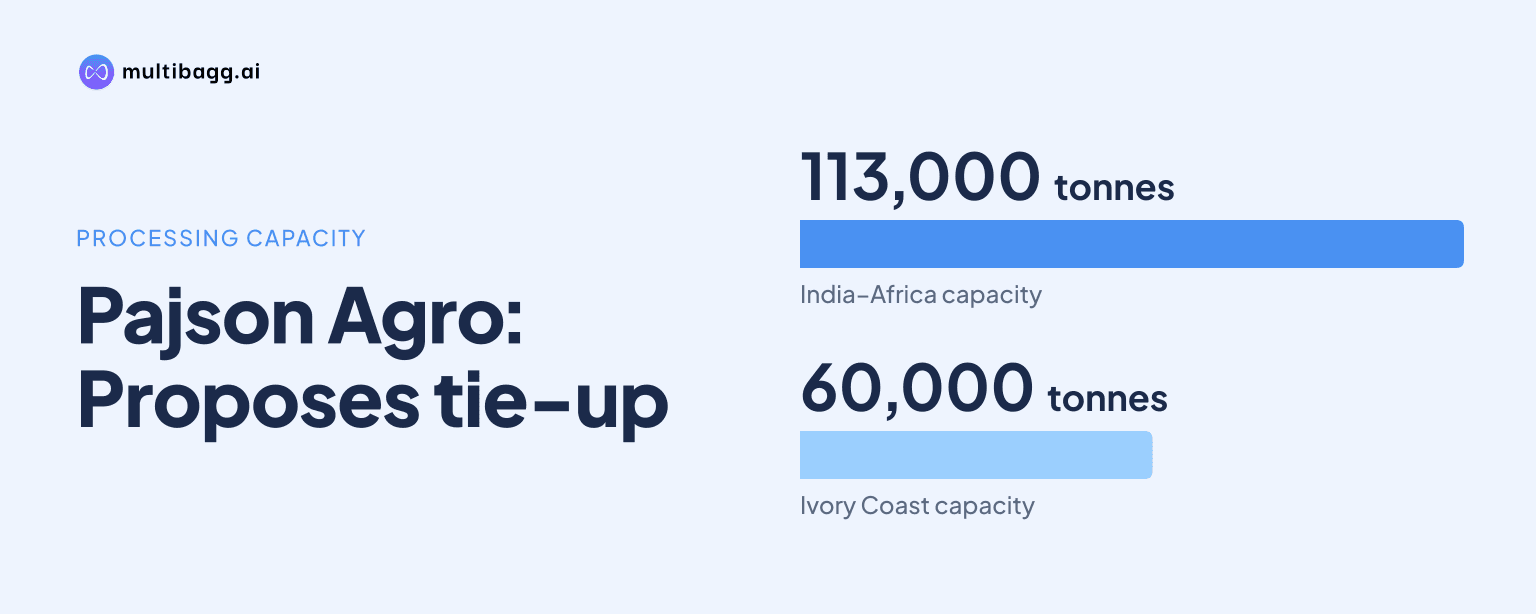
Pajson Agro India Limited proposes an all-share acquisition of Pacific Global that would create 113,000 metric tonnes of cashew-processing capacity across India and Ivory Coast, from 18,000 metric tonnes currently operating in India. The transaction remains subject to shareholder and other applicable approvals, while Pacific Global’s 60,000-metric-tonne plant is operating at about 50% utilisation in FY27.
Know Pajson Agro India inside out
Results, valuation, peers and who's buying, in one view.
What does the Pacific Global acquisition add to Pajson Agro?
Pajson Agro would acquire Pacific Global’s 60,000-metric-tonne processing facility in Ivory Coast and its global kernel-distribution activity. Pacific Global FZCO is a United Arab Emirates entity whose wholly owned Cote d’Ivoire subsidiary operates the plant, which management said started production only a few months before the call.
The transaction would combine a currently operating 18,000-metric-tonne India plant, the 35,000-metric-tonne Vizianagaram project and the Ivory Coast facility. Management said the platform would allow its India facilities to serve domestic customers while the African plant sells kernels in international markets including the United States, Europe and the Middle East.
Pacific Global’s 50% FY27 utilisation means the proposed acquisition is of an early-stage operating asset rather than a fully ramped business. Management said it expects the plant to reach full utilisation in FY28, while also saying the company would focus on stabilising its plants before seeking 85% to 90% combined production utilisation in FY29.
How would the all-share deal affect Pajson Agro shareholders?
Pajson Agro plans to pay entirely through a share swap, with no cash consideration for Pacific Global’s shareholders or the current Pajson Agro promoters. Management said preferential shares reflecting 100% of Pacific Global’s assessed value would be issued to Pacific Global’s existing shareholders, with the share price determined under Securities and Exchange Board of India regulations.
Pulkit Jain, who identified himself as Pacific Global’s majority shareholder, said promoters had used their own capital to develop supplier relationships, operating arrangements and the Ivory Coast facility. He said the promoters were not seeking a separate premium for those efforts, and that the independent valuation was close to Pacific Global’s net asset value, or NAV.
Management described the transaction as potentially earnings-per-share accretive because Pacific Global’s expected earnings would exceed the effect of the new shares issued. It did not disclose the valuation amount, the number of shares, pro forma ownership, or a per-share earnings estimate, so the dilution and accretion cannot be calculated from the call disclosures.
The deal remains conditional on shareholder and other applicable approvals. Management expected consolidation within two to three months and in FY27, but that is an expectation rather than a confirmed completion date; Aayush Jain also said promoter shareholding would remain within prescribed limits and no offer for sale was contemplated.
When will Pajson Agro’s new Indian capacity begin operating?
Pajson Agro now expects trials at its 35,000-metric-tonne Vizianagaram facility around February, in Q4 FY27. The company had earlier indicated a November-December timeline, but management said three cyclones in Andhra Pradesh delayed site work by nearly 45 days.
Management said FY27 would receive very little revenue from Vizianagaram because of the delayed start. For FY28, it anticipates 60% to 70% utilisation at the new plant while maintaining about 90% utilisation at the existing India facility, making the near-term output increase dependent on commissioning and utilisation rather than nameplate capacity alone.
The Vizianagaram project would take Pajson Agro’s India capacity to 53,000 metric tonnes from 18,000 metric tonnes. Management said the facility has greater automation and is designed to process at a lower cost per kilogram than the current plant, with its IPO proceeds being deployed to the project as planned.
The combined project and acquisition timetable makes FY27 and FY28 execution-heavy periods. Management said it would focus in the second half on commissioning Vizianagaram, pursuing Pacific Global approvals, improving margins and growing the Royal Meva consumer brand.
Got a follow-up? Ask IRIS
What do Pajson Agro’s H1 FY27 results show before consolidation?
Pajson Agro reported H1 FY27 total income of about Rs 145 crore, up 23% year on year, EBITDA of about Rs 20 crore and profit after tax of about Rs 12.6 crore. EBITDA margin was 14%, providing the reported operating benchmark before any Pacific Global consolidation.
The company processed around 8,500 tonnes in H1 FY27 and reported revenue of nearly Rs 170 per kilogram of raw cashew nut. Management said Pacific Global’s realisation would be different and could be about 15% lower, but it did not provide a precise comparable realisation for the acquired entity.
Management said H1 FY27 margins faced pressure from geopolitical disruption, foreign-exchange movements, freight costs and shipping-line surcharges introduced after seasonal procurement began. It added that the new Vizianagaram plant was not yet causing negative operating leverage because it had not entered production.
Royal Meva contributed 4.6% of H1 FY27 revenue, compared with 1.36% in H1 FY26. Management said it is expanding the brand through offline distribution, online platforms and corporate gifting, while taking a measured approach to quick commerce and targeting 15% of total revenue over the next three to five years.
What funding and execution risks remain for Pajson Agro?
Pajson Agro will not pay cash acquisition consideration under the proposed share swap, but management said working-capital needs will rise as capacity utilisation increases. It expects additional working-capital lines from financial institutions as the facilities approach 85% to 90% utilisation.
Management said direct sourcing from farmers, cooperatives and local buying agents could improve control over procurement timing, quality and pricing compared with merchant traders or exporters. It also said African processing has better margins than India processing, while placing expected margin improvement from the acquisition in the longer term after FY28 rather than FY27.
The company identified currency, freight, raw-material availability and transit delays as risks for the enlarged business. Its planned controls include structured purchasing, multiple origin-country relationships, transparent transfer pricing, strict quality controls and disciplined inventory ageing.
Management’s longer-term ambition is for Pajson Agro to obtain 5% to 8% of global cashew market share within five to seven years. It declined to provide FY28 revenue or EBITDA forecasts, leaving capacity ramp-up, utilisation and overseas sales development as the disclosed operational measures of progress.
Conclusion
The Pacific Global proposal would shift Pajson Agro from an India-based 18,000-metric-tonne operating processor toward a 113,000-metric-tonne India-and-West Africa platform. The all-share structure avoids an acquisition cash payment, but the call does not disclose enough information to quantify valuation, dilution, ownership changes or the claimed earnings-per-share effect.
The next disclosed milestones are shareholder and other approvals for the Pacific Global transaction, which management expects could permit FY27 consolidation, and Vizianagaram trials around February in Q4 FY27. Investors can also watch whether Pacific Global advances from about 50% utilisation in FY27 toward management’s FY28 full-utilisation target and whether additional working-capital facilities accompany the capacity ramp.