










Pajson Agro Delays Vizianagaram Trials Until February 2027
Key highlights
- Pajson Agro moved Vizianagaram trials to February 2027 after cyclones delayed work by nearly 45 days.
- The 35,000-metric-ton Vizianagaram project is expected to add very little revenue in FY27.
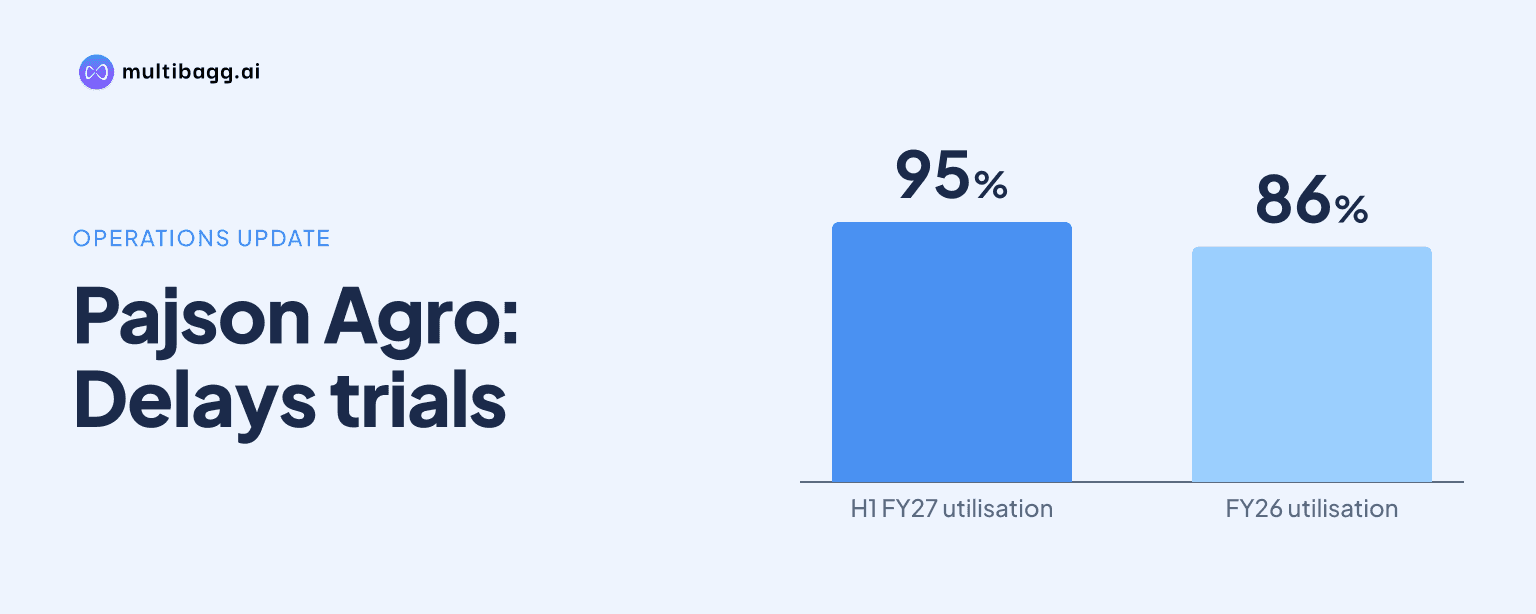
- Pajson Agro's existing plant operated at around 95% utilisation in H1 FY27, compared with 86% in FY26.
- H1 FY27 total income rose 23% year on year to about Rs 145 crore.
powered by IRIS
Pajson Agro India Limited expects trial production at its 35,000-metric-ton Vizianagaram facility by February 2027 after three cyclones in Andhra delayed work by nearly 45 days, and management said the expansion would generate very little revenue in financial year 2027 (FY27).
Know Pajson Agro India inside out
Results, valuation, peers and who's buying, in one view.
Why did Pajson Agro postpone Vizianagaram trials?
Pajson Agro postponed trials because three cyclones in Andhra disrupted construction during the 45 days before its November 5, 2026 earnings call. Managing Director Aayush Jain named Arnab and Musaru among the storms and said site work had to stop because conditions did not permit construction before, during and after the cyclones.
The weather disruption also affected labour availability at the site. Jain said the company was bringing work back on track and seeking to start trials as quickly as possible, but now expected trials by February rather than the November-December schedule communicated during the May call.
Vizianagaram is a greenfield cashew-processing facility in Andhra designed to add 35,000 metric tons of annual capacity. The project is intended to lift Pajson Agro's Indian processing capacity to 53,000 metric tons from the 18,000 metric tons of existing capacity referenced by management in its combined-capacity calculation.
How much FY27 revenue will Pajson Agro get from Vizianagaram?
Pajson Agro expects very little revenue from the Vizianagaram plant in FY27 because trials are now planned only by February 2027. Management did not disclose a rupee amount of revenue deferred or provide a revised date for commercial production, so the stated effect is a delay in contribution rather than a change to the facility's 35,000-metric-ton design capacity.
The February trial timeline contrasts with management's earlier plan to work towards commercial production in the fourth quarter of FY27. Pajson Agro's existing Andhra plant operated at around 95% utilisation in the first half of FY27 (H1 FY27), compared with 86% in FY26, showing that current capacity remained heavily used while the expansion was under construction.
Pajson Agro said the more automated Vizianagaram facility is designed to process cashews at a lower cost per kilogram than the current plant. Management expects the design to support volumes and margins as utilisation rises, but its benefits are now expected largely after FY27 rather than in the current financial year.
Got a follow-up? Ask IRIS
What utilisation does Pajson Agro expect after commissioning?
Pajson Agro anticipates 60% to 70% utilisation at the Vizianagaram plant in FY28 while continuing to run its current plant at near-90% utilisation. This is management's target after the greenfield facility enters full commercial production mode, rather than an achieved utilisation figure.
Management said demand was ahead of current capacity, making expansion a priority in India and at origin. Institutional customers contributed 37.5% of H1 FY27 revenue, up from 34% in FY26, while Pajson Agro had 178 distributors operating across more than 20 states.
The new facility's planned 35,000 metric tons is almost twice the 18,000 metric tons of existing Indian capacity cited by management. The trial delay changes the timing of the ramp, but management did not revise its stated FY28 utilisation target of 60% to 70% for the new plant.
How does the delay fit Pajson Agro's wider expansion plan?
Pajson Agro's domestic project delay comes alongside its proposed acquisition of Pacific Global FZCO, whose wholly owned Côte d'Ivoire subsidiary operates a 60,000-metric-ton cashew-processing facility. The acquisition remains subject to shareholder and other applicable approvals, and management said consideration would be paid through an issue of Pajson Agro shares rather than cash.
If the Pacific Global transaction is completed and Vizianagaram is included, Pajson Agro said processing capacity would increase from 18,000 metric tons to 113,000 metric tons across India and West Africa. Pacific Global had begun operations only a few months before the November 5 call and was expected by management to operate at 50% utilisation in FY27.
Pajson Agro reported total income of about Rs 145 crore in H1 FY27, up 23% year on year. Earnings before interest, tax, depreciation and amortisation (EBITDA) were about Rs 20 crore, equal to a 14% EBITDA margin, while profit after tax (PAT) was about Rs 12.6 crore.
Management said EBITDA increased 21% and PAT rose 19% compared with the second half, while EBITDA margin improved by 190 basis points. It also said high input costs and higher raw-nut inventory raised working-capital and interest costs during H1 FY27, although the inventory helped keep the existing plant operating steadily.
Conclusion
The shift in Vizianagaram trials to February 2027 means Pajson Agro's 35,000-metric-ton capacity addition is unlikely to alter FY27 revenue materially, despite around 95% utilisation at its existing plant in H1 FY27. The company is pursuing a substantially larger processing footprint, with the proposed Pacific Global acquisition potentially raising capacity to 113,000 metric tons across India and West Africa.
The next disclosed milestones are whether Vizianagaram trials begin by February, whether the new facility reaches management's 60% to 70% FY28 utilisation target, and whether shareholders and other authorities approve the Pacific Global share-swap transaction. Management has also stated an FY29 objective of 85% to 90% combined production utilisation after stabilising operations across the plants.