










PAN HR says cash flow may see little change by FY27 close
Key highlights
- PAN HR said about 20% of current contracts are pay-and-collect and about 80% are collect-and-pay.
- PAN HR expects recurring monthly unbilled revenue of Rs 20 crore to Rs 30 crore.
- Other current assets of Rs 23 crore at 30 September 2026 were September unbilled revenue billed in October.
- PAN HR had used Rs 2.85 crore of its Rs 9.75 crore initial public offering working-capital allocation by 30 September 2026.
powered by IRIS
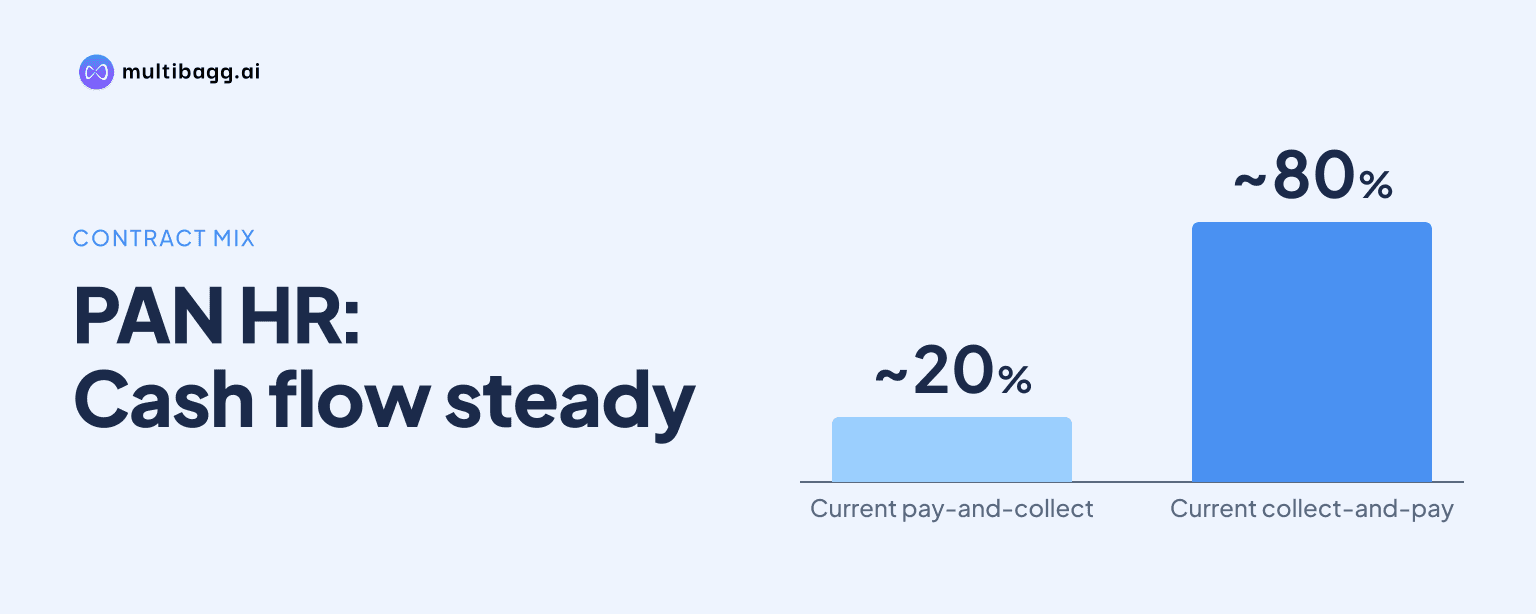
PAN HR said cash flow may see little change by the end of FY27 as it expands pay-and-collect staffing, which requires payroll funding before collections. About 20% of contracts used the model, while management expects recurring monthly unbilled revenue of Rs 20 crore to Rs 30 crore and client collections typically take 15 to 30 days.
Know PAN HR Solution inside out
Results, valuation, peers and who's buying, in one view.
How does PAN HR's pay-and-collect model affect working capital?
PAN HR's pay-and-collect model increases working-capital needs because the company pays deployed personnel before collecting from clients. Management said payroll for regular employees is generally processed by the 7th or 8th of the following month, after receiving the client's data on manpower used. The company can invoice only after that payroll payment, and then waits a further 15 to 30 days for collection in pay-and-collect arrangements.
About 20% of PAN HR's current contracts are pay-and-collect, while about 80% are collect-and-pay, management said. Under collect-and-pay, the client provides funds in advance before wages are disbursed, limiting the immediate funding gap. Management said clients generally prefer pay-and-collect because they do not have to pre-fund salary payments, and it intends to use the model for larger workforce mandates.
The timing varies across accounts because PAN HR has both weekly and monthly pay cycles. Management said some workers are paid the day after payroll is processed, while regular monthly payroll is completed in the following month. That means the working-capital requirement depends not only on the 20% contract mix but also on worker volumes, client payment terms and the timing of invoicing.
What do PAN HR's receivables and unbilled revenue indicate?
PAN HR said other current assets of Rs 23 crore at 30 September 2026 represented September unbilled revenue that was invoiced in October. Management distinguished this balance from other non-current assets, which it said consisted of fixed assets and investments rather than unbilled revenue. The September amount had been received by November, according to management.
An analyst referred to trade receivables of Rs 21 crore and unbilled revenue of about Rs 20 crore, implying a combined balance of around Rs 41 crore at the time discussed. PAN HR did not give a formal target for either balance at FY27-end. Management instead explained that receivables remain elevated because payment is generally received 15 to 30 days after payroll is funded and invoices are raised.
PAN HR expects unbilled revenue to remain a recurring monthly balance rather than a one-off item. Management put the average range at Rs 20 crore to Rs 30 crore, while noting that the amount changes with deployment levels. A client requiring 500 workers rather than 100, for example, changes the payroll processed before invoicing and therefore the unbilled amount recorded.
Got a follow-up? Ask IRIS
Why may PAN HR's cash flow remain under pressure through FY27?
PAN HR said it would not be surprised if cash flow did not change materially by the end of FY27, even though management expects revenue to rise. The company linked that outlook to the timing of expected contracts and the effect of taking on more pay-and-collect business. Higher deployment volume can increase payroll funding before the corresponding client collections arrive.
Festive-season hiring added to the pressure discussed on the call. Management said hiring for Big Billion Days can involve direct recruitment and sub-vendors, increasing amounts payable to sub-vendors and affecting both cash flow and the balance sheet. PAN HR had about 15,000 personnel during the festive period, and management said the number can rise to around 18,000 during a seasonal peak before moving lower afterward.
Management also estimated that about 2% to 5% of personnel could be on payroll without being billed at a particular time. It described this as an investment in maintaining workforce availability amid high attrition. PAN HR said salary expense can be about 0.75% to 1% higher in such periods before related revenue is realised, which management cited when discussing the reduction in margin from 3.5% to 2.5% raised by the analyst.
How is PAN HR funding payroll and what could change the cycle?
PAN HR allocated Rs 9.75 crore of initial public offering proceeds to working capital and had used Rs 2.85 crore by 30 September 2026. Management said the remaining allocation would support payroll funding for larger clients under pay-and-collect terms. PAN HR also reported shareholder funds of Rs 43.72 crore at that date and described itself as asset-light and debt-light.
The company disclosed Rs 4.06 crore of short-term loans and advances in the first half, which management identified as advances to sub-vendors that later bill PAN HR. Management expects those advances to be recovered before the end of the financial year. This mechanism adds another cash requirement during periods when PAN HR needs sub-vendors to meet workforce demand.
Management said it hopes to start a third-party logistics, or 3PL, model by April 2027. Under that plan, PAN HR would operate the warehouse, deploy its own workforce and provide a wider range of services, while the client supplies assets. Management said the next six months of cash flow could look different after 3PL implementation, but did not disclose expected revenue, warehouse investment, collection terms or a cash-flow target.
PAN HR's existing staffing focus includes e-commerce, quick commerce, logistics and warehousing, while management also cited fast-moving consumer goods, healthcare support services and green logistics as expansion areas. Its temporary staffing agreement with Ciel Et Terre Solar Private Limited runs until April 2027. Management said contract pricing can be either a fixed charge per worker or a percentage of total payroll, so commercial terms will influence how quickly pay-and-collect expands.
Conclusion
PAN HR's cash conversion is being shaped by a deliberate shift toward pay-and-collect contracts, even though these represented only about 20% of the current portfolio. The model can support larger staffing mandates, but it places payroll ahead of invoicing and collection. That sequence explains management's expectation of Rs 20 crore to Rs 30 crore of recurring monthly unbilled revenue and its caution that cash flow may not materially change by FY27-close.
The next items to watch are PAN HR's use of the unutilised portion of its Rs 9.75 crore working-capital allocation, the level of receivables and unbilled revenue after seasonal hiring, and whether the 3PL model begins by April 2027 as management hopes. PAN HR has not disclosed a year-end receivables target, a cash-flow target or the investment required for 3PL operations.