










Parag debt may stay elevated as capex absorbs inventory release
Key highlights
- Parag said debt may not decline materially by year-end because more than Rs 200 crore of announced investment and regular capital spending will absorb funding.
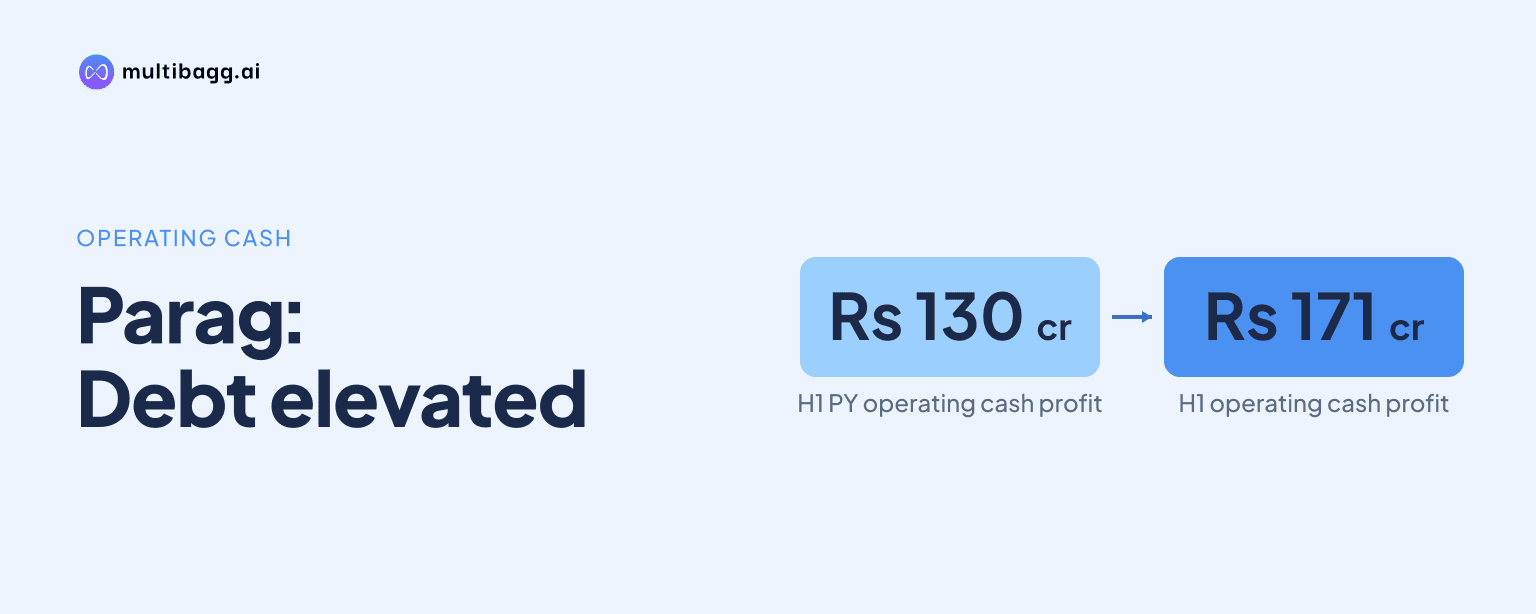
- Operating cash profit rose to Rs 171 crore in the first half from Rs 130 crore in the comparable prior-year half.
- Parag said September inventory quantities were only marginally different year on year, with inflation driving much of the working-capital increase.
- Paneer capacity is planned to rise from 20 metric tonnes to 80 metric tonnes, while cheese capacity is targeted to reach 120 metric tonnes by Q2 FY28.
powered by IRIS
On November 4, 2026, Parag Milk Foods Limited said debt may not fall materially by year-end because more than Rs 200 crore of announced investment and regular capital expenditure are expected to absorb funds released as seasonal inventory declines. Management said the debt profile could remain in a similar range or rise marginally.
Know Parag Milk Foods inside out
Results, valuation, peers and who's buying, in one view.
Why might Parag’s debt stay elevated?
Parag expects debt to remain broadly near its current range because capital investment will use funding released from working capital. Responding to an investor’s question on whether debt taken for inventory would reduce by year-end, Ankit Jain said the debt had largely been consumed in working capital but would not foreseeably decline substantially because Parag was moving towards investment.
Management cited an already announced exceptional investment of more than Rs 200 crore alongside other regular capital investments. Jain said capital expenditure takes time to build rather than occurring in one month, so spending would continue through the year. He added that debt should not increase materially unless capital expenditure is fast-tracked, although it could remain in a similar range and may increase marginally.
The call did not disclose an absolute net-debt balance, a gross-debt closing balance or a cash balance. An investor referred to Rs 200 crore of additional debt while asking whether it would unwind, but management did not confirm that amount as reported debt. The disclosed position is directional: a seasonal inventory reduction may release funds, but planned investment is expected to prevent a material fall in debt.
What caused Parag’s working-capital increase?
Parag attributed the rise in working capital mainly to inflation in inventory values and a deliberate festive-season stock build. Jain said that, on a comparable basis, inventory quantities in September were only marginally different from the September position a year earlier. This indicates that inflation, rather than a substantial increase in physical stock, drove much of the year-on-year working-capital movement.
Rakesh Kothari said Parag had consciously increased inventory for the festive season and amid inflationary pressure. He said inventory days were almost consistent with previous quarters and described the higher stock position as momentary, with stabilisation expected as the quarter progresses. The company’s explanation separates its seasonal stock decision from a permanent increase in inventory volumes.
Product mix also affects Parag’s inventory requirements. Kothari said cheese requires about 90 days of storage at the plant before it reaches the market. That aging period means comparisons of inventory days with peers can differ materially where those companies have a different dairy-product mix, particularly one with less cheese exposure.
Got a follow-up? Ask IRIS
Will inventory reduction improve Parag’s full-year cash flow?
Management said it expects the seasonal inventory position to come down by year-end and believes Parag should be in a positive zone for the full year despite inflation. Jain made the comment after an investor asked about negative first-half cash flow and whether the festive inventory buildup would unwind. Management did not provide a specific full-year cash-flow target.
Operating cash profit increased to Rs 171 crore in the first half from Rs 130 crore in the comparable prior-year half, an increase of Rs 41 crore. The increase shows that operating cash generation improved while inflation lifted the rupee value of working capital. It does not establish the cash remaining after inventory movements and capital expenditure.
Milk procurement costs remain relevant to cash conversion. Management said the average milk procurement price was Rs 45 per litre in the second quarter and Rs 46.5 per litre at the time of the November 4 call. Rahul Srivastava said Parag did not expect the usual third-quarter seasonal softening because deficient rains, drought conditions, feed-price inflation and green-fodder availability could keep procurement costs elevated.
Which expansion plans will use Parag’s funding?
Parag is investing ahead of demand in paneer and cheese capacity, a strategy management linked to its expectation that debt will not decline materially. Paneer capacity is planned to rise fourfold from 20 metric tonnes to 80 metric tonnes. Srivastava said management anticipated about 80% utilisation immediately after completion and placed the paneer capacity timeline at about June 2027.
Cheese capacity is being expanded in phases from 60 metric tonnes to 80 metric tonnes, then 100 metric tonnes and finally 120 metric tonnes. Akshali Shah said Parag had guided for 120 metric tonnes by the second quarter of financial year 2028. Management expected capacity to reach 80 metric tonnes within about one to one-and-a-half months of the November 4 call, while the wider phased programme was expected to take about 1.5 years.
The funding and working-capital effect of the cheese programme may extend beyond plant construction because cheese needs aging. Jain said the full effect of the expansion would be visible in the following year after the capacity programme is completed in the second half of the next year. He said 80% utilisation was a fair assumption for expanded capacity, but this was management’s assumption rather than a sales or profit forecast.
Conclusion
Parag’s financing position reflects two offsetting movements: management expects festive inventory to reduce by year-end, while more than Rs 200 crore of announced investment and other capital expenditure will absorb funding. Operating cash profit rose to Rs 171 crore from Rs 130 crore in the first half, but inflation in inventory values and investment ahead of demand mean that improved operating cash generation is not expected to translate into a substantial debt reduction.
The next developments to watch are the year-end inventory unwind, the resulting full-year cash-flow outcome and the pace of capital spending. Management’s disclosed milestones are paneer capacity increasing from 20 metric tonnes to 80 metric tonnes by about June 2027 and cheese capacity reaching 120 metric tonnes in the second quarter of financial year 2028, with cheese aging delaying the full benefit of that expansion.