










Parag Milk Foods sees paneer shift opportunity in HoReCa
Key highlights
- Parag Milk Foods said India consumes about 4 million kilograms of paneer per day.
- Parag Milk Foods estimates 70% to 80% of HoReCa and out-of-home paneer is analogue or unorganised.
- Avvatar and Pride of Cows grew 71% in both value and volume, according to management.
- Parag Milk Foods said gross margin per litre rose to Rs 17 from Rs 14 year on year.
powered by IRIS
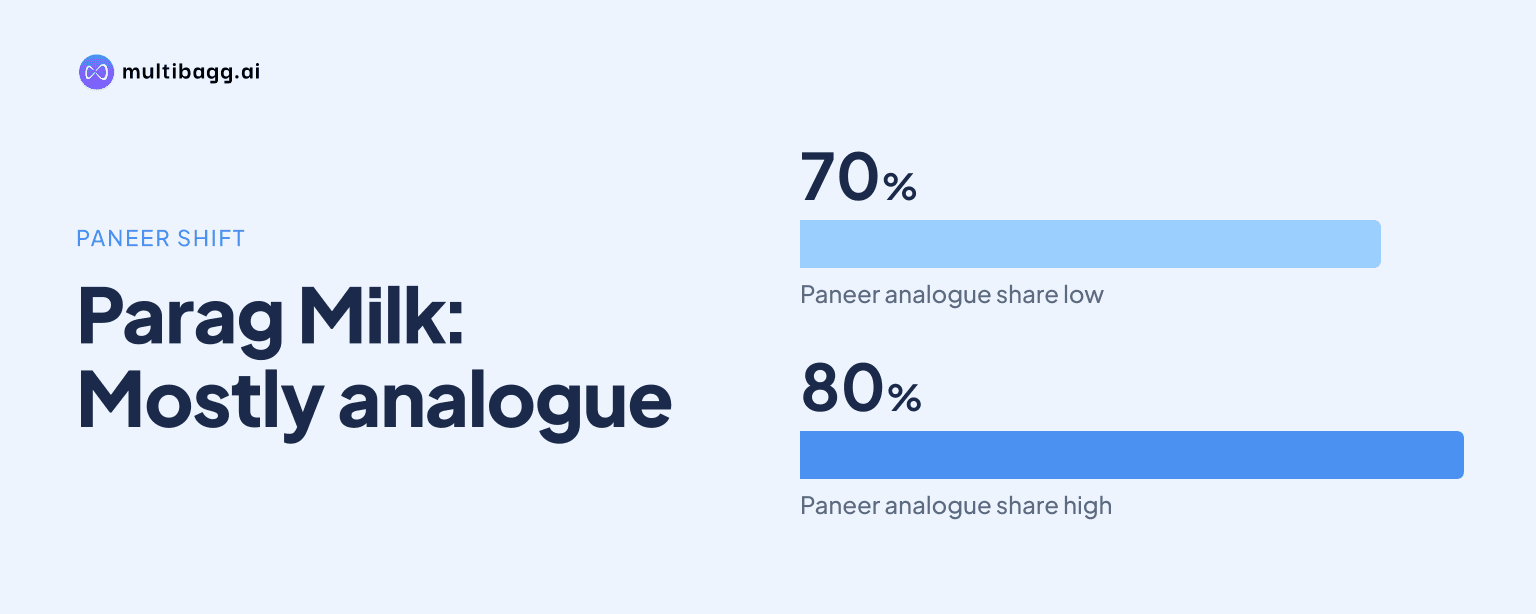
On November 4, 2026, Parag Milk Foods Limited said 70% to 80% of paneer consumed through hotel, restaurant and catering, or HoReCa, and out-of-home channels is analogue or unorganised, identifying a potential conversion market for branded real paneer.
Know Parag Milk Foods inside out
Results, valuation, peers and who's buying, in one view.
How large is Parag Milk Foods’ paneer conversion opportunity?
Parag Milk Foods said India consumes about 4 million kilograms of paneer a day, and that the majority is consumed through HoReCa and other out-of-home occasions. Within those channels, management estimated that 70% to 80% of paneer is analogue paneer or comes from the unorganised sector rather than branded real paneer.
Rahul Srivastava described the potential shift as large, but gradual. He said a 10% to 20% annual conversion of the analogue or unorganised portion would represent a substantial opportunity for branded paneer companies. This was management’s illustration of category potential, not a forecast for Parag Milk Foods’ paneer sales, market share or annual growth.
The 70% to 80% estimate applies to HoReCa and out-of-home consumption, not to all paneer sold in India. Parag Milk Foods did not disclose the share of the 4 million kilograms daily market represented by HoReCa, its own paneer production capacity, its paneer revenue, or its current share of branded paneer demand.
What could move demand from analogue to real paneer?
Parag Milk Foods said states are gradually incorporating provisions in their laws against using analogue paneer and in favour of real paneer. Srivastava said the process would take time because the industry needs sufficient production capacity, milk availability and pricing that supports the transition from cheaper substitutes.
Management linked the demand environment to product awareness as well as regulation. Akshali Shah said greater attention to adulteration, product traceability and the source of food had increased demand for branded products offering quality and consistency. She said the company had been competing with analogue paneer and analogue substitutes, but now faced cheaper substitutes more directly.
Parag Milk Foods did not identify states that had changed rules, give implementation dates, or quantify enforcement. It also did not separate the effect of legal changes from consumer awareness in its quarterly demand performance, so the pace of conversion from the estimated 70% to 80% analogue or unorganised channel share remains unresolved.
What else supported Parag Milk Foods’ demand and margins?
Parag Milk Foods said its New Age portfolio supported the quarter alongside the favourable environment for branded dairy. Shah said Avvatar and Pride of Cows grew 71% in both value and volume, and that these products helped gross margins because they carry higher margins than other parts of the portfolio.
The company also reported stable channel mix. Ankit Jain said business-to-consumer, or B2C, represented 70% of the overall business and business-to-business, or B2B, represented 30%. He said earnings improved in both segments, while B2B shifted away from skimmed-milk production toward milk protein concentrate and lactose.
Gross margin per litre rose to Rs 17 from Rs 14 year on year despite a Rs 7 per litre increase in milk prices, Jain said. In Flagship Categories, volume grew 7% while value grew 20%, creating a 13-percentage-point difference that management attributed to portfolio mix; this result covers more than paneer and includes other flagship products.
Got a follow-up? Ask IRIS
How is Parag Milk Foods preparing for additional dairy demand?
Parag Milk Foods said the paneer conversion possibility was one reason it was expanding strategically, but it did not provide a separate paneer-capacity target, spending commitment or completion date during the call. Srivastava said industry conversion requires capacity and milk supply, while Shah confirmed that the opportunity was among the reasons for the company’s expansion plans.
The specific capacity schedule disclosed was for cheese. Parag Milk Foods said cheese capacity would increase in stages from 60 metric tons to 80 metric tons, then 100 metric tons and finally 120 metric tons. Management guided to reach 120 metric tons by the second quarter of financial year 2028, with the initial move to 80 metric tons expected within about one to one-and-a-half months of the call.
Jain said cheese needs ageing, meaning the full benefit from expanded capacity would be visible in the financial year after the expansion is completed. Management said 80% utilisation was a fair assumption for capacity expansion and said that doubling cheese capacity also raises whey output, which should be assessed as part of the blended portfolio rather than as cheese alone.
Parag Milk Foods said blended gross margins of 26% to 27% would continue without dilution from the cheese capacity increase. The company also said it had kept annual advertising budgets in a range of Rs 130 crore to Rs 150 crore over the previous three years, while planning brand-level budgets for newer offerings and maintaining a tight overall spending approach.
Conclusion
Parag Milk Foods has identified a potentially significant structural shift in paneer: management estimates that 70% to 80% of supply in HoReCa and out-of-home channels is analogue or unorganised, against total Indian consumption of about 4 million kilograms a day. The company’s case rests on evolving state rules, demand for traceability and branded quality, and the ability of producers to provide real paneer at workable prices.
The next issue to watch is the pace of state-level change and whether capacity, milk availability and pricing permit conversion at the 10% to 20% annual rate management used as an illustration. Parag Milk Foods has not quantified paneer expansion, but it has scheduled phased cheese capacity growth from 60 metric tons to 120 metric tons by the second quarter of financial year 2028, with the full cheese benefit expected after ageing.