










Parag sees ₹46.50 milk costs holding through winter flush
Key highlights
- Parag expects Q3 procurement costs to hold at ₹46.50 per litre, versus a ₹45-per-litre Q2 average.
- Parag cited deficient rainfall, water constraints, cattle-feed inflation and green-fodder availability as reasons winter-flush prices may not soften.
- Southern India accounts for 20% to 25% of Parag's total milk procurement.
- Parag's New Age business rose sequentially from ₹118 crore to ₹154 crore and reached almost 12.5% of quarterly revenue.
powered by IRIS
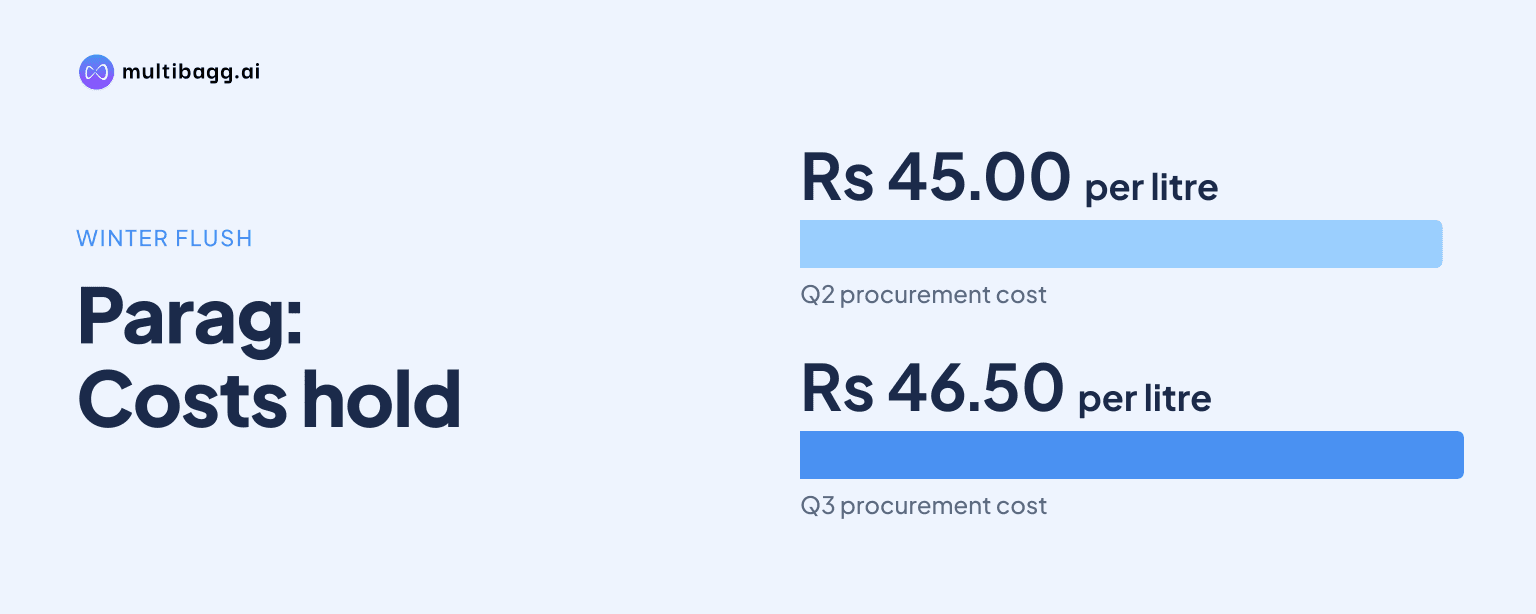
Parag Milk Foods Limited expects its milk procurement cost to stay at ₹46.50 per litre in the third quarter (Q3), rather than decline in the winter flush season, management said on November 4, 2026. The current rate is ₹1.50 per litre above the second quarter (Q2) average of ₹45, amid deficient rainfall, water constraints and fodder-cost inflation.
Know Parag Milk Foods inside out
Results, valuation, peers and who's buying, in one view.
Will Parag's procurement cost fall in Q3?
No. Parag said it anticipates that the current milk procurement price of ₹46.50 per litre will continue through Q3, rather than follow the usual post-October decline associated with the winter flush. Management said it expected a clearer view by December, but its stated working assumption was no price softening during the quarter.
The current rate is ₹1.50 per litre above Parag's Q2 average. Management said that, in a normal year, procurement prices soften after Diwali as winter milk production rises in natural production regions. This season, it does not expect that seasonal supply increase to reduce the Q3 cost base.
The outlook concerns the procurement cost rather than a disclosed change in milk volumes or a company-wide margin target. Parag did not give a forecast for procurement prices beyond Q3, and management specifically said its position could become clearer towards December as winter conditions and milk availability develop.
Why does Parag expect no winter milk-price relief?
Parag expects no customary winter relief because management cited very deficient rainfall and drought conditions. It said reduced water availability could restrict the normal seasonal increase in milk production, which is the mechanism that typically lowers procurement prices during the flush period.
Management also pointed to inflation in cattle-feed prices and the availability of green fodder. These factors affect farmers' input costs alongside water constraints, and Parag said the combined conditions could prevent procurement prices from easing even as the winter season begins. The company did not forecast a specific price increase for Q3.
The pressure described by management differs from the normal flush-season pattern, under which greater milk availability after October tends to soften prices across India. Parag's view was not that procurement prices would necessarily rise in Q3, but that the seasonal fall from the current ₹46.50-per-litre level may not occur.
Will Parag raise core-category prices again to offset costs?
Parag does not currently see another immediate price increase in its core categories. Management said it had already taken two price increases during the quarter and did not expect another increase anytime soon for core products, while forecasting high-single-digit volume growth in paneer and ghee in coming quarters.
The company separately said gross margins had been broadly stable over the last several quarters, apart from a few basis points, and expected stability in the coming quarter. Management attributed the margin position to inflation and portfolio mix, rather than promising further improvement from pricing. Its view is therefore that Q3 can absorb the current procurement environment without a stated additional core-category price action.
Parag reported 7% volume growth in Flagship Categories during the current quarter after management said Q1 had been affected by a business-to-business volume opportunity it chose not to pursue. Management said business-to-consumer sales grew in double digits in both the comparable prior-year quarter and the current quarter, while it expects high-single-digit core-category growth ahead.
Got a follow-up? Ask IRIS
How exposed is Parag to milk-price changes in southern India?
Parag said southern India accounts for 20% to 25% of its total milk procurement. Management said Karnataka Milk Federation, or KMF, had recently raised both selling and farmer procurement prices, but added that the development was not large for Parag because of the company's overall geographic procurement base.
Management said KMF's move occurred about two days before the November 4 call and reflected a government decision pattern in Karnataka, where pricing can be revised after intervals of three, four or five years. Parag said it was still assessing whether Tamil Nadu or Andhra Pradesh would react and whether it would need to respond in the field. It did not see a similar large increase in Maharashtra or nearby areas at that time.
The company did not quantify any procurement-cost effect from Karnataka's revision. Its stated uncertainty was whether other southern markets would follow KMF and whether field-level prices would require a response, while the 20% to 25% southern share sets the relevant exposure within Parag's total milk procurement.
How is Parag managing milk-cost pressure through product mix?
Parag said it has managed recent inflation by passing through cost pressure and improving gross margin on a per-litre basis, while treating profitability as a blended portfolio outcome. Management said milk is the common input for several outputs, including cheese and whey, as well as ghee and skimmed milk powder or milk protein concentrate, making separate category-level cost allocation less meaningful.
The New Age business is part of management's medium-term mix plan. It rose sequentially from ₹118 crore to ₹154 crore and represented almost 12.5% of quarterly revenue, compared with 10% earlier in the financial year. Management said a rising New Age mix should support the gross-margin profile over the medium term, although Q2 and Q3 are seasonally heavier for Flagship Categories and input inflation remains a parallel factor.
Management said the New Age business had exceeded ₹150 crore in the quarter and was above ₹600 crore on an annual recurring revenue basis. It has stated an aspiration for New Age to contribute about 25% when Parag reaches its ₹10,000 crore target, but it did not provide a dated forecast for achieving either measure.
Parag also said it expects to add paneer capacity from 20 tonnes to 80 metric tonnes, with the facility anticipated around June 2027. Management expects roughly 80% utilisation soon after commissioning, based on its existing distribution, but that expansion does not change its stated Q3 assumption that procurement costs will remain at ₹46.50 per litre.
Conclusion
Parag's disclosed outlook is that the winter flush may not bring its usual procurement-cost reduction in Q3. The ₹46.50-per-litre current rate, compared with a ₹45-per-litre Q2 average, reflects management's concern that deficient rain, limited water, feed inflation and green-fodder availability could keep raw-milk costs elevated despite seasonal production patterns.
The next point to watch is management's expected clarity by December on whether Q3 prices remain unchanged and whether southern market pricing requires a response. Investors can also track the New Age business mix, which reached ₹154 crore in the quarter, and the planned June 2027 paneer-capacity commissioning from 20 tonnes to 80 metric tonnes.