










Paramount Syntex half-year profit falls 15% to Rs 6.35 crore
Key highlights
- Paramount Syntex reported half-year profit after tax of Rs 6.35 crore, down from Rs 7.51 crore a year earlier.
- Revenue from operations declined 14.5% to Rs 51.04 crore in the half year ended 30 September 2026.
- Profit before tax was Rs 8.95 crore, compared with Rs 10.39 crore in the corresponding 2025 half year.
- Total expenses decreased to Rs 42.19 crore from Rs 49.56 crore year on year.
powered by IRIS
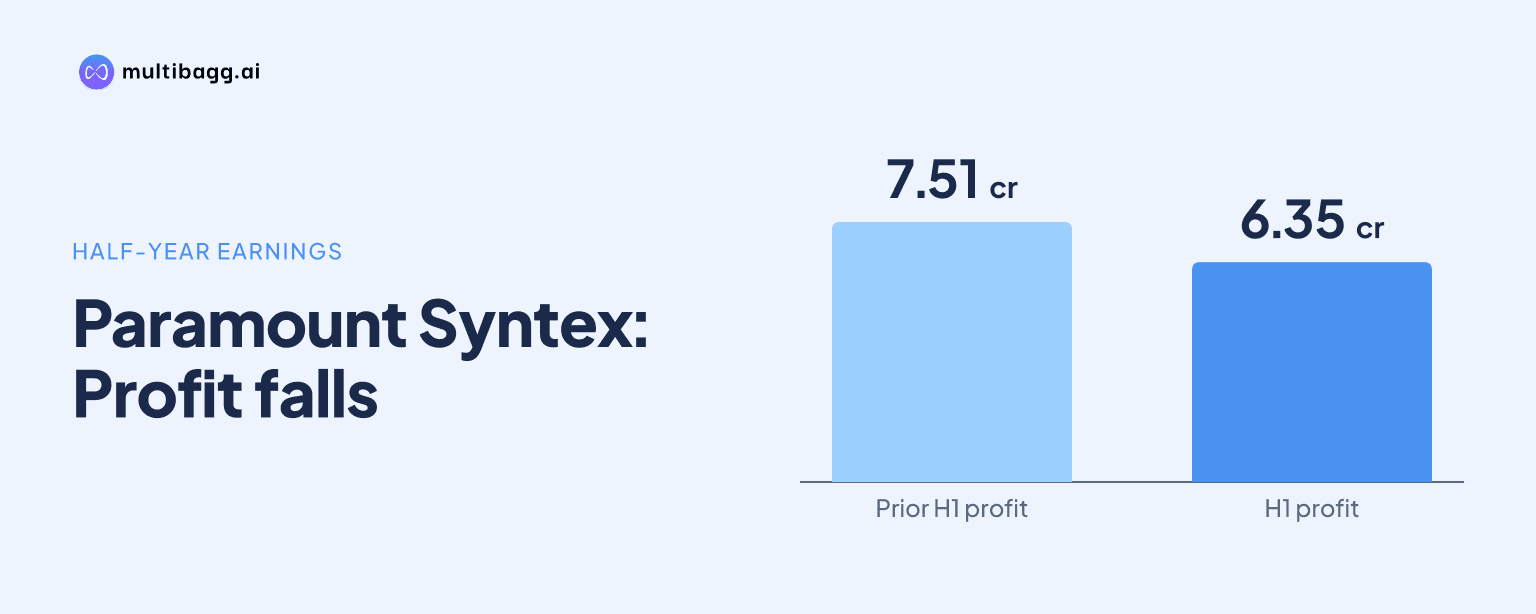
Paramount Syntex Limited reported profit after tax of Rs 6.35 crore for the half year ended 30 September 2026, down 15% from Rs 7.51 crore a year earlier, alongside a 14.5% decline in revenue from operations to Rs 51.04 crore. Profit before tax fell to Rs 8.95 crore, although the calculated pre-tax margin increased modestly.
Know Paramount Syntex inside out
Results, valuation, peers and who's buying, in one view.
What were Paramount Syntex’s half-year results?
Paramount Syntex reported total revenue of Rs 51.14 crore for the half year ended 30 September 2026, compared with Rs 59.96 crore in the corresponding six months of 2025. Revenue from operations was Rs 51.04 crore, while other income was Rs 9.71 lakh. The company classified the September 2026 half-year statement as unaudited.
Paramount Syntex’s profit before tax was Rs 8.95 crore, compared with Rs 10.39 crore in the half year ended 30 September 2025. Total tax expense declined to Rs 2.60 crore from Rs 2.88 crore. Basic and diluted earnings per equity share, both non-annualised, were Rs 5 for the latest half year against Rs 6.28 a year earlier.
The filing also provides a sequential comparison with the half year ended 31 March 2026, when revenue from operations was Rs 62.37 crore and profit after tax was Rs 6.36 crore. Revenue from operations therefore declined by Rs 11.33 crore between the March and September 2026 half years, while reported profit after tax was broadly unchanged.
Why did Paramount Syntex’s half-year profit decline?
Paramount Syntex’s filing does not identify a specific cause for the lower profit, but it reports lower revenue and lower profit before tax for the six months ended 30 September 2026. Revenue from operations decreased by Rs 8.62 crore year on year, while other income declined to Rs 9.71 lakh from Rs 29.11 lakh in the corresponding 2025 period.
Total revenue declined by Rs 8.82 crore to Rs 51.14 crore, and profit before tax decreased by Rs 1.44 crore to Rs 8.95 crore. The pre-tax decline was smaller in percentage terms than the revenue decline because total expenses reduced by Rs 7.38 crore over the same comparison.
The tax charge was Rs 28.22 lakh lower than the Rs 2.88 crore reported in the year-earlier half year. That reduction partly moderated the post-tax movement, but profit after tax still fell by Rs 1.16 crore, from Rs 7.51 crore to Rs 6.35 crore.
Got a follow-up? Ask IRIS
How did Paramount Syntex’s costs and margins change?
Paramount Syntex reduced total expenses to Rs 42.19 crore in the half year ended 30 September 2026 from Rs 49.56 crore a year earlier, a decline of about 14.8%. Purchases of stock in trade and raw material were Rs 39.89 crore, compared with Rs 40.53 crore in the prior-year period.
Changes in inventories represented a reduction of Rs 7.02 crore, compared with a reduction of Rs 1.30 crore in the September 2025 half year. Manufacturing expenses increased to Rs 4.97 crore from Rs 4.92 crore, while employee-benefit expense decreased to Rs 1.40 crore from Rs 1.44 crore.
Finance costs declined to Rs 1.25 crore from Rs 1.58 crore, depreciation and amortisation expense increased to Rs 95.37 lakh from Rs 81.26 lakh, and other expenses fell to Rs 73.88 lakh from Rs 1.58 crore. These line-item movements, together with the larger inventory reduction, resulted in expenses falling slightly faster than total revenue.
Paramount Syntex’s calculated profit-before-tax margin was about 17.5% in the September 2026 half year, compared with about 17.3% in the corresponding 2025 period. The increase of about 0.2 percentage points was calculated by dividing profit before tax of Rs 8.95 crore by total revenue of Rs 51.14 crore, versus Rs 10.39 crore and Rs 59.96 crore a year earlier.
What did Paramount Syntex’s auditor say about the results?
Paramount Syntex’s independent auditor, Aggarwal Pawan & Associates, stated on 14 November 2026 that nothing had come to its attention indicating that the unaudited standalone results for the period ended 30 September 2026 contained a material misstatement. The review was conducted under Standard on Review Engagements 2410, which provides less assurance than an audit.
The auditor drew attention to procedures it had not performed as at 30 September 2026. It did not conduct physical verification of inventories, obtain direct independent balance confirmations, or carry out external verification of trade receivables and trade payables.
Aggarwal Pawan & Associates said it relied on inventory verification represented by those charged with governance and on balances certified and furnished by management from its books and records. The auditor said its review conclusion was not modified in respect of these matters.
Paramount Syntex submitted a revised filing to BSE Limited on 19 November 2026 because the limited-review report was inadvertently omitted from its 14 November 2026 filing. The company said all other contents of the earlier letter remained unchanged, including the reported Rs 6.35 crore half-year profit.
Conclusion
Paramount Syntex reported a lower half-year result as revenue from operations fell 14.5% to Rs 51.04 crore and profit after tax declined 15% to Rs 6.35 crore for the period ended 30 September 2026. Total expenses fell 14.8% to Rs 42.19 crore, supporting a small increase in calculated pre-tax margin even as profit before tax decreased by Rs 1.44 crore.
What to watch next is whether a later company disclosure provides further information on inventory, trade receivable and trade payable balances that were not independently verified in the limited review at 30 September 2026. The filing does not disclose a revenue target, operating plan or scheduled business initiative, leaving subsequent reported revenue, expense and working-capital figures as the next measurable update.