










Paramount Syntex Limited Revenue Rises 29% as Profit Falls
Key highlights
- Paramount Syntex reported H1 FY27 revenue of ₹51.04 crore, up about 28.7% from ₹39.66 crore a year earlier.
- Profit after tax fell about 15% to ₹6.35 crore from ₹7.51 crore in H1 FY26.
- Operating cash flow was negative ₹10.35 crore as trade receivables rose to ₹58.39 crore.
- Total borrowings increased by ₹13.75 crore to ₹47 crore from ₹33.25 crore at March 31, 2026.
powered by IRIS
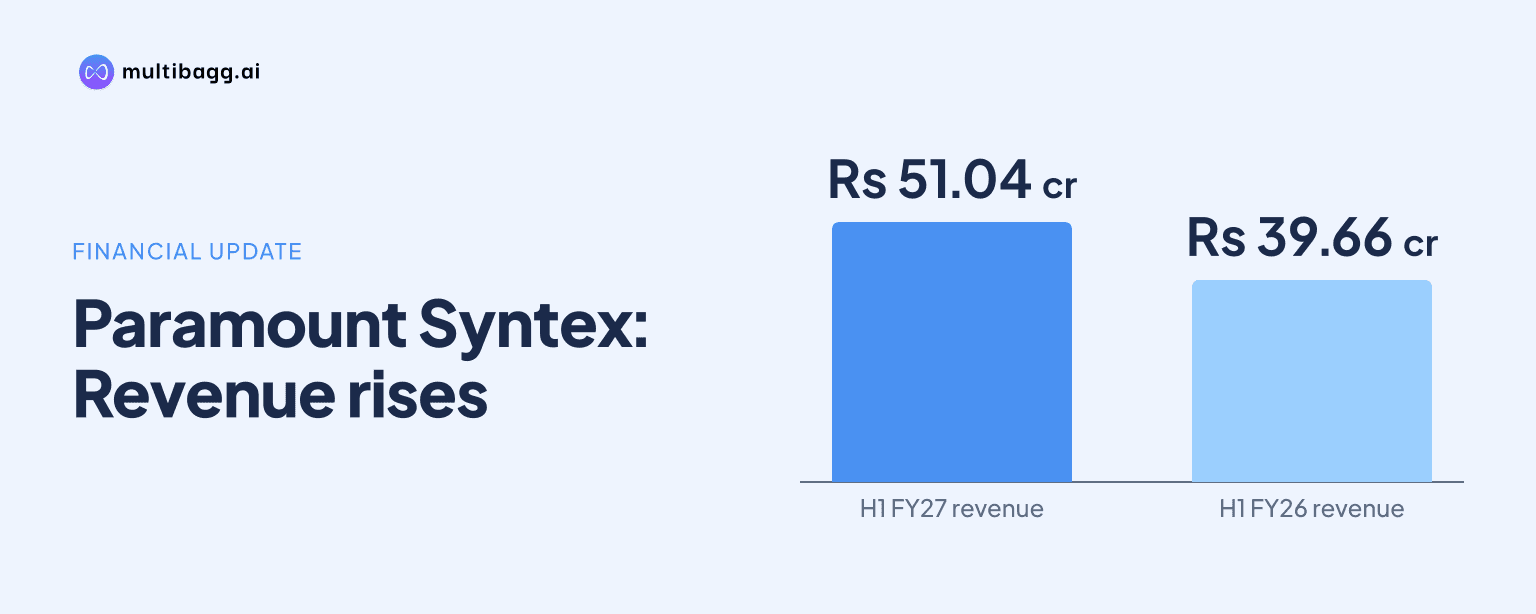
Paramount Syntex Limited reported H1 FY27 revenue of ₹51.04 crore, up 29% year on year, but profit after tax fell 15% to ₹6.35 crore and operating cash flow was negative ₹10.35 crore. The results show that higher sales were accompanied by a substantial build-up in receivables, inventories and borrowings.
Know Paramount Syntex inside out
Results, valuation, peers and who's buying, in one view.
What did Paramount Syntex report for H1 FY27?
Paramount Syntex reported revenue from operations of ₹51.04 crore for the half year ended September 30, 2026, compared with ₹39.66 crore in the corresponding period a year earlier. This represents year-on-year growth of about 28.7%.
However, profit before tax declined to ₹8.95 crore from ₹10.39 crore in the prior-year period. Profit after tax fell to ₹6.35 crore from ₹7.51 crore, a decline of about 15%. Basic and diluted earnings per share were ₹5.31 for the half year and were stated as non-annualised.
The board approved the unaudited financial results on November 14, 2026. The results covered the six months ended September 30, 2026, following the board-meeting intimation made to BSE earlier in November.
Why did cash flow turn negative despite higher revenue?
Operating cash flow turned negative ₹10.35 crore during H1 FY27 as working-capital requirements increased. The main factor identified in the financial data was a sharp expansion in trade receivables, which more than doubled to ₹58.39 crore.
Receivables increased by about ₹33 crore, indicating that a larger portion of reported sales remained to be collected at the reporting date. Inventories also rose, adding to the amount of cash tied up in day-to-day operations. Revenue and accounting profit therefore did not translate into positive operating cash generation during the period.
For investors, the distinction is significant. Revenue measures sales booked, while operating cash flow measures cash generated from core business operations after changes in working capital. A rise in receivables and inventory can reduce cash availability even when reported revenue expands.
How much did Paramount Syntex's borrowing increase?
Paramount Syntex's total borrowings rose to ₹47 crore at September 30, 2026, from ₹33.25 crore at March 31, 2026. The increase of ₹13.75 crore was used to support the higher working-capital requirement reflected in receivables and inventories.
The higher borrowing level came alongside negative operating cash flow, making the company’s cash conversion and collection cycle important points for shareholders to monitor. The available data does not specify the composition, maturity profile or interest cost of the additional borrowings.
The company reported total assets of ₹131.09 crore and total liabilities of ₹82.51 crore at the half-year end. These balance-sheet figures provide context for the increase in working capital and debt, although the disclosed results do not provide a detailed explanation of individual asset and liability movements.
Got a follow-up? Ask IRIS
How does the latest half year compare with the previous period?
Paramount Syntex reported revenue of ₹62.37 crore for the half year ended March 31, 2026. Revenue of ₹51.04 crore in the September 2026 half year was therefore ₹11.32 crore lower than the immediately preceding six-month period.
This sequential comparison should be read separately from the year-on-year increase. The H1 FY27 result compares with the six months ended September 2025, while the March 2026 figure relates to the following half year. The disclosed data establishes that sales improved from the comparable prior-year half but were lower than the previous reported six-month period.
The wider annual trend showed revenue from operations of ₹122.03 crore in FY26, against ₹112.42 crore in FY25 and ₹92.78 crore in FY24. The half-year results, however, show that growth in sales has recently been accompanied by lower profit and weaker operating cash conversion.
What does the result mean for shareholders?
The result matters because the company recorded strong year-on-year revenue growth without a corresponding increase in profit or cash generation. PAT fell despite the increase in sales, while the build-up in receivables and inventories required additional debt funding.
For shareholders, the reported indicators to assess are the pace of receivable collections, inventory levels, borrowings and future operating cash flow. These measures will indicate whether the higher working capital is temporary or remains a continuing requirement for supporting operations.
The data does not include a management forecast, a stated debt-reduction target or an explanation for the increase in receivables. As a result, the results provide evidence of greater working-capital intensity but do not establish how quickly cash conversion may improve.
Conclusion
Paramount Syntex delivered H1 FY27 revenue growth of nearly 29%, but its financial outcome was weaker on profit and cash-flow measures. PAT declined to ₹6.35 crore, operating cash flow was negative ₹10.35 crore, and receivables and borrowings increased materially during the period.
The next disclosed financial results will be important for assessing whether collections improve and whether working-capital funding needs moderate. Investors can also track changes in total borrowings from the ₹47 crore reported at September 30, 2026, along with revenue, profit and cash-flow trends in subsequent filings.