










Insolation Energy Ltd Revenue Doubles as Margins Contract
Key highlights
- INA reported H1 FY27 revenue of ₹1,582 crore, up 100.6% year on year.
- H1 FY27 EBITDA margin declined to 8.87% from 14.43% a year earlier.
- Q2 FY27 net profit fell 32.2% year on year to ₹25.1 crore.
- INA reported a 2.2 GW order book, with about 1.3 GW deliverable by March 2027.
powered by IRIS
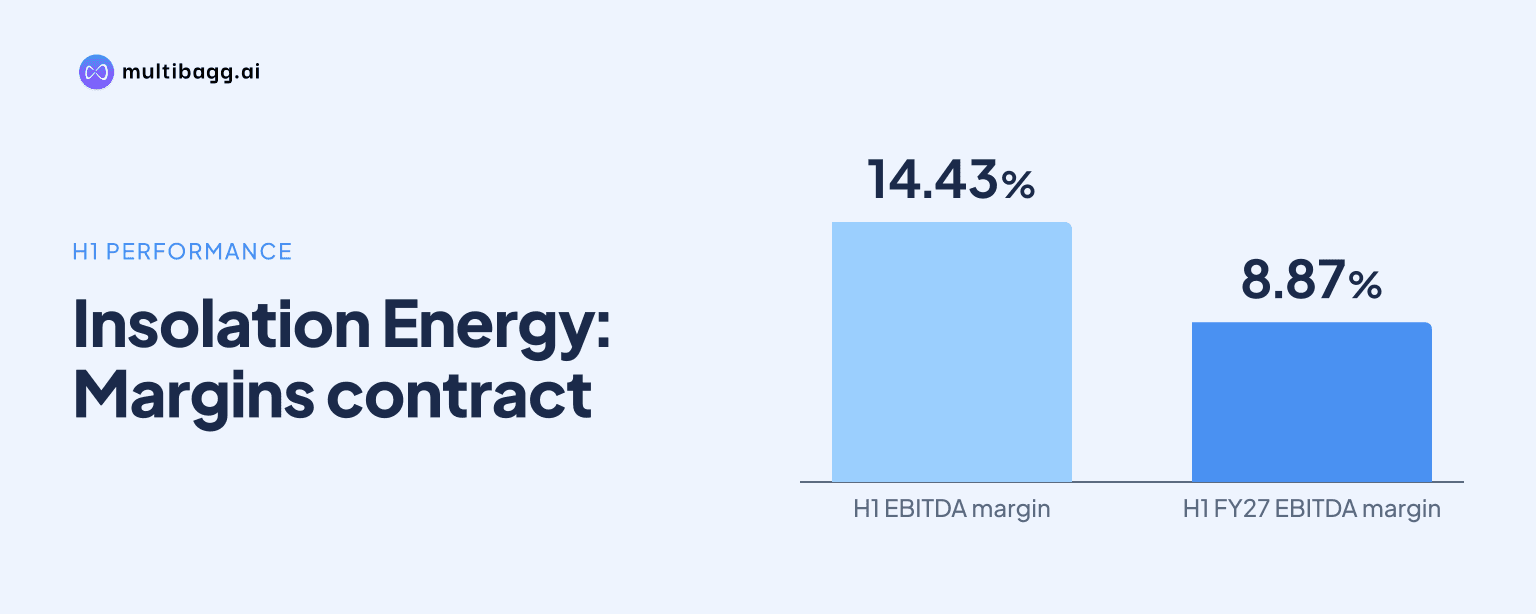
Insolation Energy Ltd's H1 FY27 revenue doubled 100.6% year on year to ₹1,582 crore, while its EBITDA margin contracted to 8.87% from 14.43%. The company delivered strong sales growth in the six months ended September 2026, but lower profitability and an unquantified management outlook for H2 put the focus on execution and margins.
Know Insolation Energy inside out
Results, valuation, peers and who's buying, in one view.
What did INA report for Q2 and H1 FY27?
INA reported revenue from operations of ₹836.5 crore for Q2 FY27, up 101.6% year on year, and ₹1,582 crore for H1 FY27, up 100.6%. The quarterly revenue figure was also presented in rounded form as ₹837 crore in the company's investor presentation and earnings-call summaries.
Profit growth did not keep pace with revenue. Q2 net profit declined 32.2% year on year to ₹25.1 crore. For H1 FY27, profit after tax fell 21% to ₹63.08 crore from ₹80.07 crore in the corresponding prior-year period, despite the sharp expansion in the revenue base.
EBITDA for H1 FY27 was ₹140 crore, an increase of 23.3% year on year. However, EBITDA margin declined to 8.87% from 14.43% a year earlier. The Q2 EBITDA margin was reported at 7.6%, showing that the pressure on profitability continued during the September quarter.
Why did INA's profitability lag its revenue growth?
INA's profitability lagged revenue growth because EBITDA expanded by 23.3% in H1 FY27 while revenue grew 100.6%, resulting in a lower margin. The company did not quantify on the call the respective effects of product realisations and costs on the margin movement.
Management acknowledged that achieving a 14% EBITDA margin in FY27 was very unlikely. This is important because the H1 margin of 8.87% was already materially below the 14.43% reported in the prior-year half, while Q2 margin was lower still at 7.6%.
The available call summary said management expected H2 profitability to improve over H1, but did not provide a numerical margin target. It indicated that a potential recovery was linked to easing commodity prices and the ramp-up of new facilities. More specific guidance was deferred until the Q3 FY27 discussion.
What did management say about the H2 FY27 outlook?
INA said H2 FY27 should be better than H1 FY27 on margins, but it did not quantify the expected improvement. Management stated that FY27 EBITDA margin would likely close somewhere between the current level and its earlier expectations, while describing a 14% margin for the full year as very unlikely.
The company held its Q2 and H1 FY27 earnings call on 16 November 2026, following the release of results on 13 November. The call lasted 63 minutes and was attended by Chairman Manish Gupta, Managing Director Vikas Jain, Chief Financial Officer Ravi Dusad, and Head of Strategy Sumit Jain, among other participants.
INA has made the audio recording of the call available on its website under its Regulation 30 disclosure. The transcript was not filed immediately after the call on one of the call-tracking platforms, which noted that companies generally file it within a week. The disclosed call summaries nevertheless highlighted the margin outlook and the operational pipeline discussed by management.
Got a follow-up? Ask IRIS
How much demand visibility does INA have?
INA reported an order book of 2.2 GW, of which about 1.3 GW was stated to be deliverable by March 2027. This provides a disclosed volume indicator for near-term operations, although the figures do not state the revenue value or profitability of the orders.
Management also referred to an approximately 2.5 GW pipeline under evaluation. That pipeline remains unconfirmed and should not be treated as an order book. The distinction matters because the 2.2 GW order book represents existing demand visibility, while projects under evaluation may not convert into firm business.
For investors, the order data should be viewed alongside the margin trend. A large revenue base and reported delivery schedule can support operating activity, but the H1 results show that revenue expansion alone did not translate into higher profit after tax.
How is INA expanding its manufacturing operations?
INA is pursuing backward integration into 4.5 GW cell capacity and aluminium frames, according to its investor presentation. The stated strategy broadens the company beyond its existing operations and is part of its plan to build integrated manufacturing capabilities.
The timing of the cell initiative has changed. The company indicated on the call that cell timing had moved from Q3 FY27 to Q4 FY27. This leaves the ramp-up schedule as a key disclosed execution item for the remainder of the financial year.
Management linked its confidence in a later margin improvement partly to new facilities ramping up. However, it did not provide a quantified estimate of the margin benefit, nor did it specify the relative contribution expected from the facilities, commodity prices, or realisations.
Conclusion
INA's H1 FY27 results show a clear divergence between revenue growth and earnings conversion. Revenue rose 100.6% to ₹1,582 crore, but EBITDA margin fell to 8.87% and profit after tax declined 21%, making profitability the central issue in assessing the half-year performance.
The next disclosures to watch are the Q3 FY27 margin commentary, management's promised clearer guidance, progress on the cell project now expected in Q4 FY27, and execution against the 1.3 GW scheduled for delivery by March 2027.