










INA Solar expects Rs 180-200 crore annual IPP revenue
Key highlights
- INA Solar expects Rs 180-200 crore of annual revenue after its 300 MW IPP projects become operational.
- Management said the 300 MW IPP portfolio requires Rs 800-900 crore of project investment, which will not be booked as revenue.
- INA Solar estimated Rs 200-225 crore of panel billing associated with the IPP projects.
- INA Solar executed about 70 MW of solar projects during H1 FY27 and is targeting an IPP portfolio of more than 400 MW by FY27.
powered by IRIS
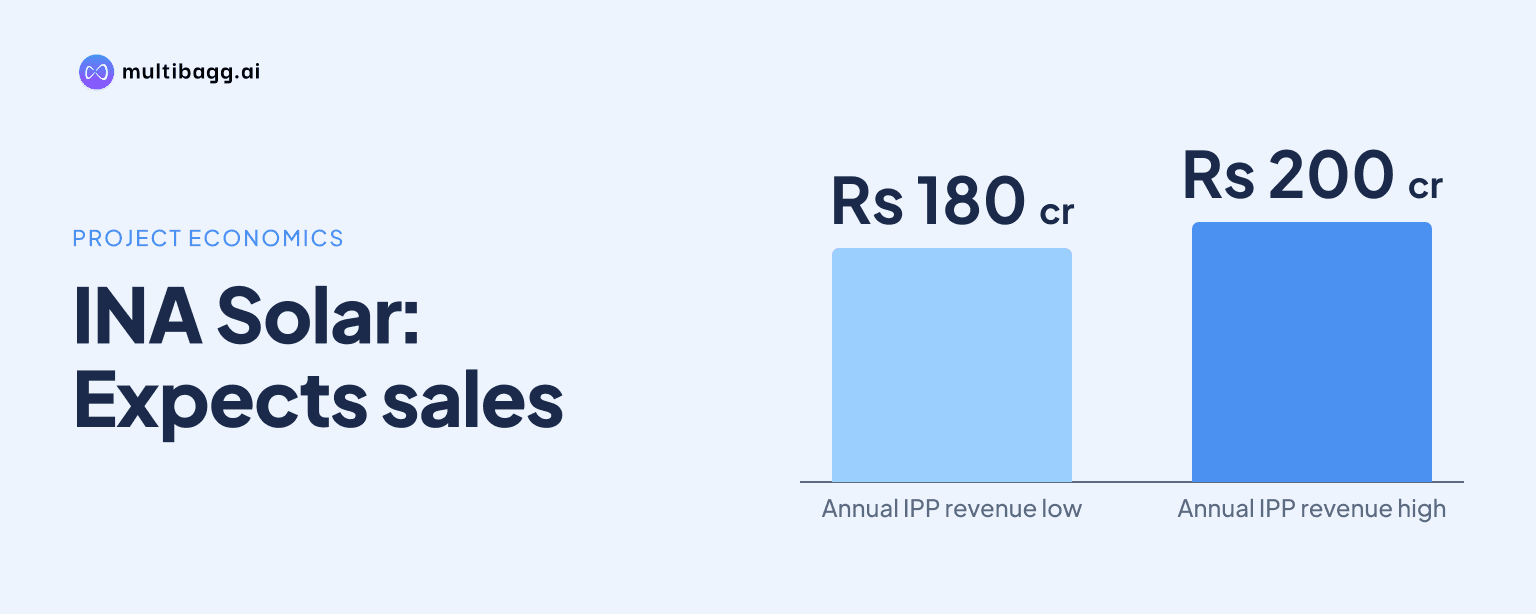
Insolation Energy Limited, referred to as INA Solar, expects its fully developed 300 megawatt independent power producer portfolio to generate Rs 180 crore to Rs 200 crore of annual revenue after the projects become operational, following an estimated Rs 800 crore to Rs 900 crore project investment by March 2027. Management said the construction cost will not be recognised as revenue.
Know Insolation Energy inside out
Results, valuation, peers and who's buying, in one view.
How much IPP revenue does INA Solar expect after commissioning?
INA Solar expects Rs 180 crore to Rs 200 crore of yearly revenue from 300 MW of independent power producer, or IPP, projects once the portfolio is operational. Chairman Manish Gupta gave the estimate during the November 16, 2026 earnings call and said the annual receipts would come from the government under a power purchase agreement, or PPA, with the Rajasthan government.
The estimate is for recurring electricity-generation revenue, rather than the value of constructing solar assets. Management said revenue would start being booked “from next year” when the projects are fully operational, but did not disclose a quarterly commissioning schedule, tariff, PPA duration, generation assumptions or the financial year in which the full annualised range would be recorded.
Is Rs 800-900 crore IPP revenue for INA Solar?
No. INA Solar said Rs 800 crore to Rs 900 crore is the cost of creating the 300 MW projects, including engineering, procurement and construction, or EPC, work, rather than revenue to be booked by the company. Gupta directly clarified that revenue would not be booked against the project-build amount.
INA Solar separately expects to bill about Rs 200 crore to Rs 225 crore for panels supplied to the projects. The full project cost therefore describes the asset-development requirement, while panel billing is a manufacturing-related component and the Rs 180 crore to Rs 200 crore range represents recurring revenue from operating the completed assets.
INA Solar said it had executed about 70 MW of solar projects during H1 FY27. It also stated that its broader IPP portfolio was targeting more than 400 MW by FY27, whereas the annual-revenue discussion specifically concerned 300 MW of projects expected to be fully invested in by March 2027. The call did not explain how capacity beyond 300 MW would affect annual IPP revenue.
When will INA Solar's IPP portfolio begin generating revenue?
INA Solar said IPP revenue will begin after the 300 MW projects are fully operational, which management described as occurring after the March 2027 investment completion and from the following year. The company did not say that the Rs 180 crore to Rs 200 crore annual figure would be recognised in FY27, and it explicitly rejected the suggestion that the Rs 800 crore to Rs 900 crore project value would become FY27 revenue.
This creates a timing difference between capital deployment and operating income. Management expects the investment in the 300 MW projects to be completed by March 2027, while recurring generation revenue would begin after commissioning. The call did not disclose individual-site construction milestones, commercial-operation dates or whether all 300 MW would commence generation at the same time.
INA Solar is developing the IPP portfolio alongside manufacturing expansion. Management said its 4.5 gigawatt TOPCon solar-cell facility at Narmadapuram was targeted for first commercial operations in Q4 FY27, while its 18,000 metric tonnes per annum aluminium-frame plant was targeted to begin commercial operations in Q3 FY27. Those targets apply to manufacturing facilities, not to the IPP portfolio’s operating dates.
Got a follow-up? Ask IRIS
How does the IPP plan fit INA Solar's FY27 performance?
INA Solar's IPP programme would add a prospective recurring-revenue stream while reported FY27 revenue remained driven by ongoing operations and project activity. In H1 FY27, revenue from operations rose 100.56% year on year to Rs 1,582.09 crore, while earnings before interest, tax, depreciation and amortisation, or EBITDA, increased 23.3% to Rs 140.31 crore.
Profitability did not rise at the same pace as revenue. H1 FY27 EBITDA margin was 8.87%, compared with 14.43% in the corresponding prior-year period, while net profit declined to Rs 63.08 crore from Rs 80.07 crore. Management attributed the margin change to industry pricing dynamics and higher input costs, and said increased depreciation and finance costs affected profit after tax, or PAT.
Management described prospective IPP EBITDA as “good” but did not provide an EBITDA margin, operating-cost estimate, debt structure or cash-flow projection for the 300 MW portfolio. The disclosed Rs 180 crore to Rs 200 crore annual revenue range therefore cannot be converted into a profit contribution or return calculation from the earnings call alone.
What must INA Solar complete before IPP revenue scales?
INA Solar must complete the 300 MW projects by March 2027 and bring them into operation before the stated annual revenue can be generated. The company said it executed about 70 MW of solar projects during H1 FY27, providing a measure of first-half execution, but it did not give a remaining construction schedule for the 300 MW portfolio.
The IPP funding framework is only partly disclosed. In response to a capital-allocation question, management said manufacturing-expansion funding lines had already been secured and that it had security on certain limits for IPP projects. It did not disclose the amount of those IPP limits, interest costs, equity contribution, project-level borrowing or whether the limits cover the full Rs 800 crore to Rs 900 crore investment.
INA Solar's order book offers separate manufacturing visibility rather than direct IPP revenue visibility. The company reported an order book of about 2.2 gigawatt, with 1.3 gigawatt scheduled for delivery by March 2027, and said supplies to customers including NTPC, MEIL and Rays Power supported utilisation above 60%. Those supplies should not be treated as the Rajasthan IPP generation revenue discussed by management.
Conclusion
INA Solar distinguishes the Rs 800 crore to Rs 900 crore required to create 300 MW of IPP projects from future operating income. Management expects Rs 180 crore to Rs 200 crore of annual generation revenue after the assets are operational, alongside separately stated panel billing of Rs 200 crore to Rs 225 crore and the existing manufacturing business.
The next disclosed milestones are completion of the 300 MW investment by March 2027 and the start of revenue once the projects become operational. Management's broader IPP target is more than 400 MW by FY27, while the 4.5 gigawatt TOPCon cell facility is targeted for first commercial operations in Q4 FY27.