










Insolation Energy sees 20% EBITDA margin in DCR projects
Key highlights
- Insolation said captive cells in DCR modules could lift EBITDA margin to about 20% once its 4.5-gigawatt cell plant is fully operational.
- Insolation reported Q2 FY27 revenue of Rs 836.69 crore, up 96.45% year on year, with EBITDA margin of 7.58%.
- Insolation targets first commercial operations at its 4.5-gigawatt TOPCon cell facility in Q4 FY27.
- Insolation expects its 18,000-metric-tonnes-per-year aluminium-frame plant to save Rs 50 to Rs 60 per frame set.
powered by IRIS
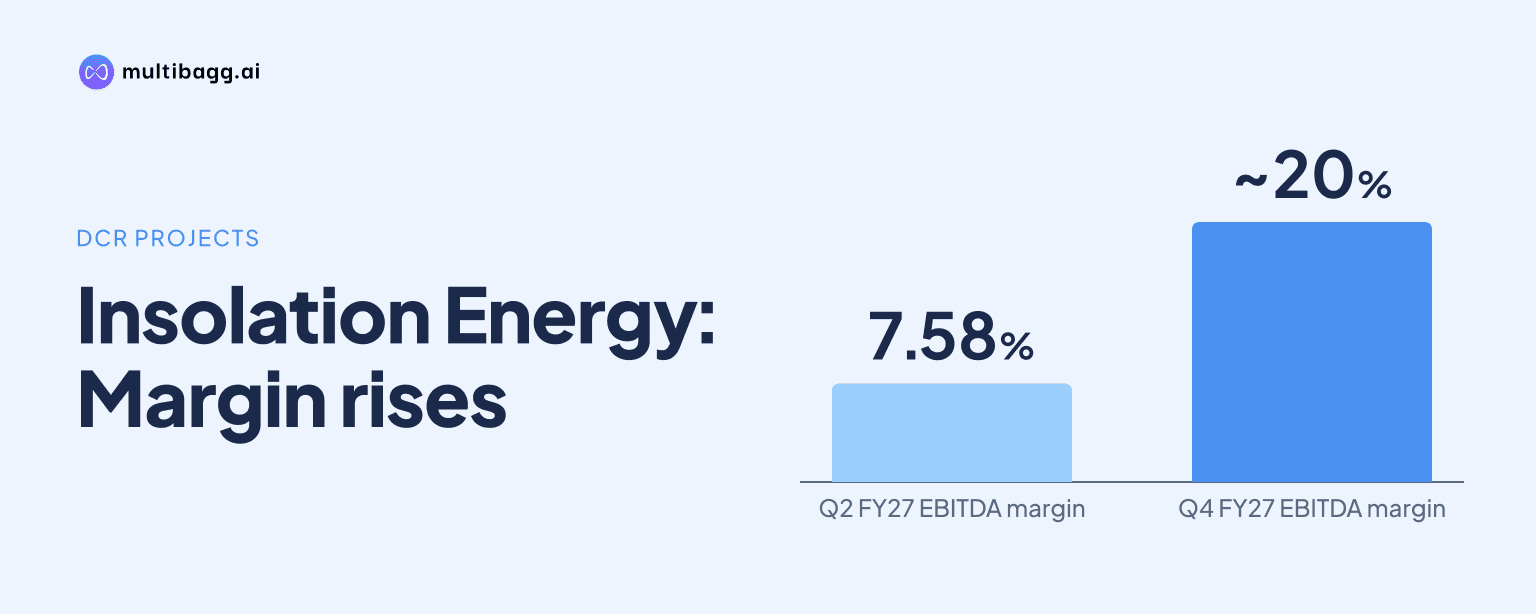
Insolation Energy said on November 16, 2026 that EBITDA margin could reach about 20% when its 4.5-gigawatt solar-cell plant is fully operational and its own cells are used in domestic-content requirement (DCR) modules. The company reported EBITDA margin of 7.58% in Q2 FY27 and 8.87% in H1 FY27.
Know Insolation Energy inside out
Results, valuation, peers and who's buying, in one view.
How could Insolation reach a 20% EBITDA margin?
Insolation said its route to about 20% EBITDA margin is to make solar cells internally and use them in DCR modules. Management made the estimate conditional on the 4.5-gigawatt TOPCon, or tunnel oxide passivated contact, cell facility at Narmadapuram becoming fully operational. It did not give a time-bound, company-wide EBITDA-margin target.
The current reported margin is below that conditional outcome. Revenue from operations rose 96.45% year on year to Rs 836.69 crore in Q2 FY27, while EBITDA rose 13.32% to Rs 63.44 crore. That difference left quarterly EBITDA margin at 7.58%, compared with H1 FY27 EBITDA margin of 8.87% on revenue of Rs 1,582 crore.
Management said it expected H2 FY27 margins to be better than H1 FY27, but did not expect to match the 14% EBITDA margin cited for FY26. It said a more specific margin view would follow Q3 FY27 results, after developments in dollar pricing, input prices and international freight become clearer.
Why do captive cells matter for DCR modules?
Captive cells matter because DCR tenders require both solar cells and solar panels made in India, according to management. Insolation said using its own Indian-made cells in its panels would increase EBITDA margin and overall margin, making the expected benefit specific to qualifying DCR production rather than all module sales.
Management contrasted DCR demand with non-DCR applications, where externally sourced cells can still be used in FY27 and FY28. It cited current cell prices of about Rs 13.25 to Rs 13.75 per watt, DCR module prices of Rs 21 to Rs 23 per watt, and non-DCR module prices of Rs 12.25 to Rs 12.75 per watt. Those cited prices show differing product categories, but do not establish realised margins.
Insolation has about 2.5 gigawatts of proposed cell demand under strategic memoranda of understanding, partnerships and direct supply orders under evaluation. Management expects the pipeline to expand after the cell line begins operating, but did not disclose how much is DCR, binding, or intended for direct cell sales rather than internal module consumption.
Management said the overall margin would be the same whether cells were sold directly or used internally in modules, because the value would be recorded in different product lines. Insolation did not disclose cell production cost, module conversion cost, DCR volumes or the proportion of sales expected to use captive cells, leaving the 20% figure an operational estimate rather than reported performance.
Got a follow-up? Ask IRIS
When will Insolation's cell plant begin contributing?
Insolation targets first commercial operations at the 4.5-gigawatt cell facility in Q4 FY27. At the November 16 call, management said main civil work and pre-engineered building erection were complete, major utilities had been ordered and machinery installation was under way at the Narmadapuram site.
The plant is expected to ramp up quarter by quarter, with fuller utilisation expected in FY28. Management said full-year utilisation could be around 60% to 65%, while also noting that the actual ramp would need to be assessed after operations begin. This means any margin uplift depends on commissioning, production stability and DCR demand, not capacity alone.
Insolation said it had secured power availability and sanctioned bulk industrial water supply, and had appointed a turnkey provider, technical consultants and owner engineers. It also said machines for the facility were in dispatch position, with more than 60% to 70% constructed and a factory acceptance test team in China.
Management said the equipment orders and advance payments predated the policy announcement about Chinese solar manufacturing technology discussed during the call. It said it did not foresee a risk to the ordered machines and expected dispatch to start during November 2026, but that view does not guarantee the Q4 FY27 commercial-operation target.
What other cost benefits does Insolation expect from integration?
Insolation expects its 18,000-metric-tonnes-per-year aluminium-frame facility to save about Rs 50 to Rs 60 per frame set. Management said the plant was expected to become operational before December 31, 2026; civil work was complete, machinery was installed and trial runs were under way.
The frame plant is a separate cost lever from captive cell production. Frames are module components, while management explicitly linked the potential 20% EBITDA margin to using in-house Indian-made cells in DCR panels. Insolation did not say whether the Rs 50 to Rs 60 per-set frame saving is included in the indicated 20% outcome.
Existing module operations were supporting utilisation above 60% through supplies to customers including NTPC, MEIL and Rays Power, management said. On November 4, 2026, Insolation recorded its highest single-day module dispatch of about 16 megawatts, involving 26,660 modules carried on 40 trailers.
The company also reported H1 FY27 net profit of Rs 63.08 crore, down from Rs 80.07 crore in H1 FY26, despite EBITDA increasing 23% to Rs 140 crore. Management attributed the lower profit margin to higher depreciation and finance costs, with the chief financial officer describing their combined effect as close to 3%.
Conclusion
Insolation's margin case rests on a specific production mix: its own cells used in DCR modules once the 4.5-gigawatt facility is operating at scale. Reported EBITDA margin of 8.87% in H1 FY27 and 7.58% in Q2 FY27 remains well below management's indicated level, while the aluminium-frame project offers a separately disclosed saving of Rs 50 to Rs 60 per set.
The next disclosed milestones are the frame plant's planned start before December 31, 2026, first commercial cell operations in Q4 FY27, and management's intended margin guidance after Q3 FY27 results. Investors will also watch conversion of the roughly 2.5-gigawatt cell pipeline, the pace toward 60% to 65% utilisation, and the proportion of demand that qualifies as DCR.