










Insolation Energy Limited sees Rs 50-60 frame savings
Key highlights
- INA Solar targets commercial operations before December 31, 2026 for its 18,000-metric-tonne annual aluminium-frame plant.
- Management estimates internal aluminium-frame production can save Rs 50 to Rs 60 per frame set.
- INA Solar's H1 FY27 EBITDA margin was 8.87%, compared with 14.43% in H1 FY26.
- INA Solar targets first commercial operations at its 4.5-gigawatt TOPCon cell plant in Q4 FY27.
powered by IRIS
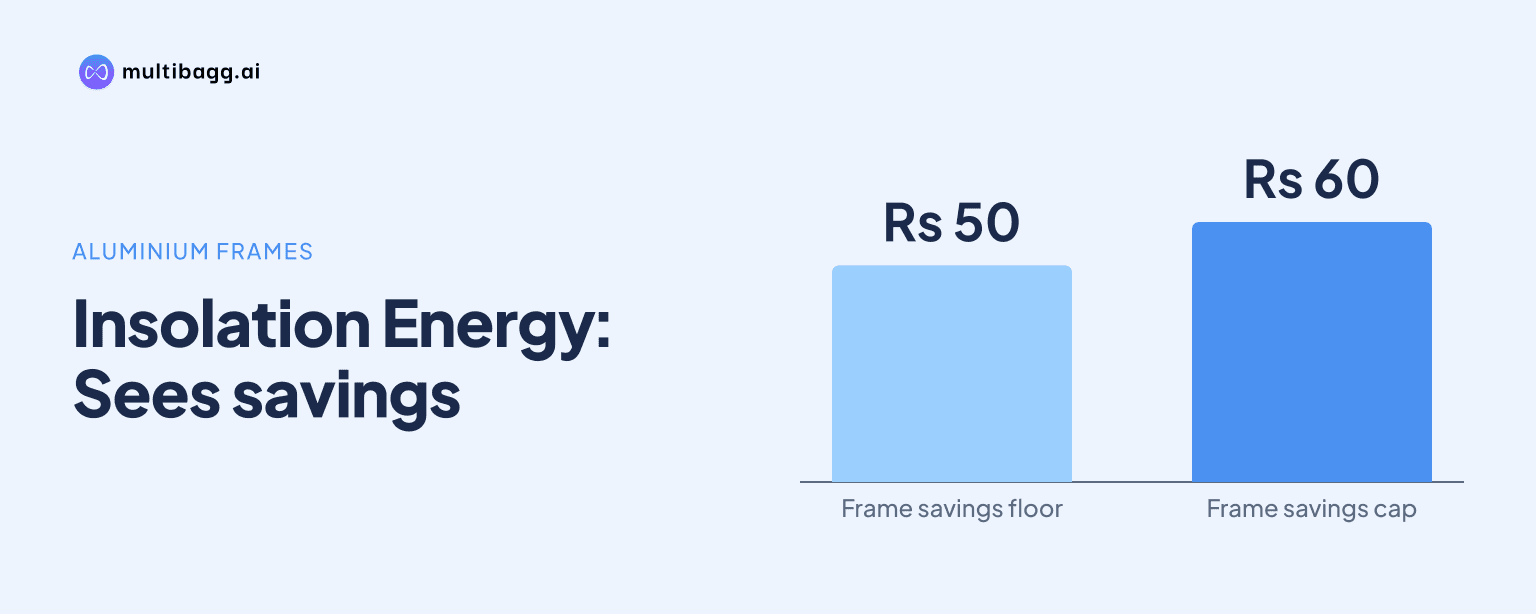
Insolation Energy Limited said on November 16, 2026 that its 18,000-metric-tonne-a-year aluminium-frame plant is targeted to start commercial operations before December 31, 2026, with estimated savings of Rs 50 to Rs 60 per frame set. Machine installation is complete and trial runs are under way.
Know Insolation Energy inside out
Results, valuation, peers and who's buying, in one view.
When will INA Solar's aluminium-frame plant begin commercial operations?
INA Solar targets commercial operations at its aluminium-frame plant before December 31, 2026. Management had previously identified Q3 FY27 as the commercial-operation target, then gave the more specific before-December-31 timing in response to an analyst question during the November 16 earnings call.
The project has capacity of 18,000 metric tonnes per annum. Civil work and pre-engineered building construction have been completed, machinery has been installed, and trial runs are under way, according to management. Those milestones indicate that the plant remains in pre-commercial commissioning rather than already producing commercial frame volumes.
The facility forms part of INA Solar's backward-integration programme, which also includes a 4.5-gigawatt tunnel oxide passivated contact, or TOPCon, solar-cell plant at Narmadapuram, Madhya Pradesh. The cell project has completed its main civil work and pre-engineered building erection, but its first commercial operations are targeted for Q4 FY27, later than the frame plant's Q3 FY27 target.
How much could INA Solar save by making frames internally?
INA Solar estimates savings of around Rs 50 to Rs 60 per frame set from internal aluminium-frame production. Management provided the estimate directly in answer to a question about the plant's contribution to manufacturing-cost reduction, but did not disclose the current external purchase cost per set or an annual rupee saving.
The saving is a per-unit estimate, not EBITDA-margin guidance. Its eventual income-statement effect will depend on commercial production and how many module frame sets the plant supplies. Management said the aim of the 18,000-metric-tonne project is to control key inputs, improve manufacturing efficiency and reduce dependence on external sourcing.
The cost initiative arrives after margin declined despite higher sales. In Q2 FY27, revenue from operations rose 96.45% year on year to Rs 836.69 crore from Rs 425.90 crore, while EBITDA, or earnings before interest, tax, depreciation and amortisation, increased 13.32% to Rs 63.44 crore from Rs 55.99 crore. EBITDA margin was 7.58% in Q2 FY27.
Management attributed the H1 FY27 margin movement to industry pricing dynamics and elevated input costs. It said global supply-chain disruption was gradually easing and input prices were correcting, and it expects margins to improve over the next two quarters. The frame plant's estimated Rs 50 to Rs 60 saving is one disclosed cost mechanism, although INA Solar did not assign a specific EBITDA-margin benefit to it.
How did INA Solar's profitability change in H1 FY27?
INA Solar's H1 FY27 EBITDA margin fell to 8.87% from 14.43% in the corresponding prior-year half, even as revenue from operations increased 100.56% to Rs 1,582.09 crore. EBITDA grew 23.3% to Rs 140.31 crore, showing that operating profit increased substantially more slowly than revenue.
Net profit fell to Rs 63.08 crore in H1 FY27 from Rs 80.07 crore in H1 FY26, while profit-after-tax margin was 4%. Chief Financial Officer Ravi Dusad said higher depreciation and finance costs affected the result; when asked about the margin impact, he said it was close to 3%.
Chairman Manish Gupta said H2 FY27 would be better than H1 FY27, but did not commit to a numerical full-year EBITDA-margin target. He said management would be better placed to provide guidance after Q3 FY27 results, citing movements in dollar pricing, freight and ferrous and non-ferrous material prices, including copper and aluminium.
Got a follow-up? Ask IRIS
How will INA Solar use its planned cell capacity?
INA Solar said it can either sell cells directly or use them in modules, with management expecting the overall margin to remain the same between those routes. The company has approximately 2.5 gigawatts of proposed demand across strategic memoranda of understanding, partnerships and direct supply orders under internal evaluation as its 4.5-gigawatt cell line nears commissioning.
Management explained that a direct sale would record profit in the cell business, whereas using internally manufactured cells in a module would record it in the module business. It did not give an external cell-sales commitment or specify what portion of the approximately 2.5-gigawatt pipeline would be sold as cells rather than used internally.
The cell plant is primarily intended to serve domestic-content-requirement, or DCR, demand, according to management. DCR projects require both India-made cells and India-made panels under management's explanation. Management said using INA Solar's own cells in DCR modules would increase EBITDA and overall margin, and that fully operational cell manufacturing could take EBITDA margin to around 20%.
That approximately 20% figure relates to the integrated cell operation, not the aluminium-frame plant alone. Management also said non-DCR applications can use cells sourced outside India in FY27 and FY28, making their economics different from DCR module production. Current cell prices were quoted at Rs 13.25 to Rs 13.75 per watt, compared with Rs 21 to Rs 23 per watt for DCR modules and Rs 12.25 to Rs 12.75 per watt for non-DCR modules.
What are INA Solar's next manufacturing milestones?
INA Solar targets the aluminium-frame plant's commercial start before December 31, 2026, followed by first commercial operations at its 4.5-gigawatt TOPCon cell facility in Q4 FY27. Management said the cell line would start in one phase rather than in separate capacity tranches.
The cell facility is expected to ramp quarter by quarter after its FY27 start. Management indicated full-year utilisation of around 60% to 65% in FY28, while saying actual utilisation would depend on the ramp-up. Existing module supplies to customers including NTPC, MEIL and Rays Power were supporting capacity utilisation of more than 60% at the time of the call.
INA Solar also reported an order book of approximately 2.2 gigawatts, with 1.3 gigawatts scheduled for delivery by March 2027 and production slots already allocated. Separately, the company recorded a highest-ever one-day module dispatch of about 16 megawatts on November 4, 2026, comprising 26,660 modules carried on 40 trailers.
Conclusion
INA Solar has set out a defined operating date and unit-cost estimate for its aluminium-frame integration: commercial operations before December 31, 2026 and savings of Rs 50 to Rs 60 per frame set. The plant is nearer commercial readiness than the 4.5-gigawatt cell project, and its cost-control rationale comes as H1 FY27 EBITDA margin declined to 8.87% from 14.43% despite revenue more than doubling.
The next items to watch are the frame plant's Q3 FY27 commercial start, the cell plant's Q4 FY27 first operations and management's planned margin guidance after Q3 FY27 results. Management has said H2 FY27 should improve on H1 FY27, while identifying input prices, freight and international market conditions as factors relevant to a more precise outlook.