










INA sees FY27 margin recovery but below FY26's 14% level
Key highlights
- INA said H2 FY27 EBITDA margin will exceed H1's 8.87%, but FY26's roughly 14% level will not be reached.
- H1 FY27 revenue rose 100.56% to Rs 1,582.09 crore, while EBITDA increased 23.3% to Rs 140.31 crore.
- Q2 FY27 EBITDA margin was 7.58%, while net profit fell to Rs 25.06 crore from Rs 36.95 crore a year earlier.
- INA targets first commercial operations at its 4.5-gigawatt cell facility in Q4 FY27.
powered by IRIS
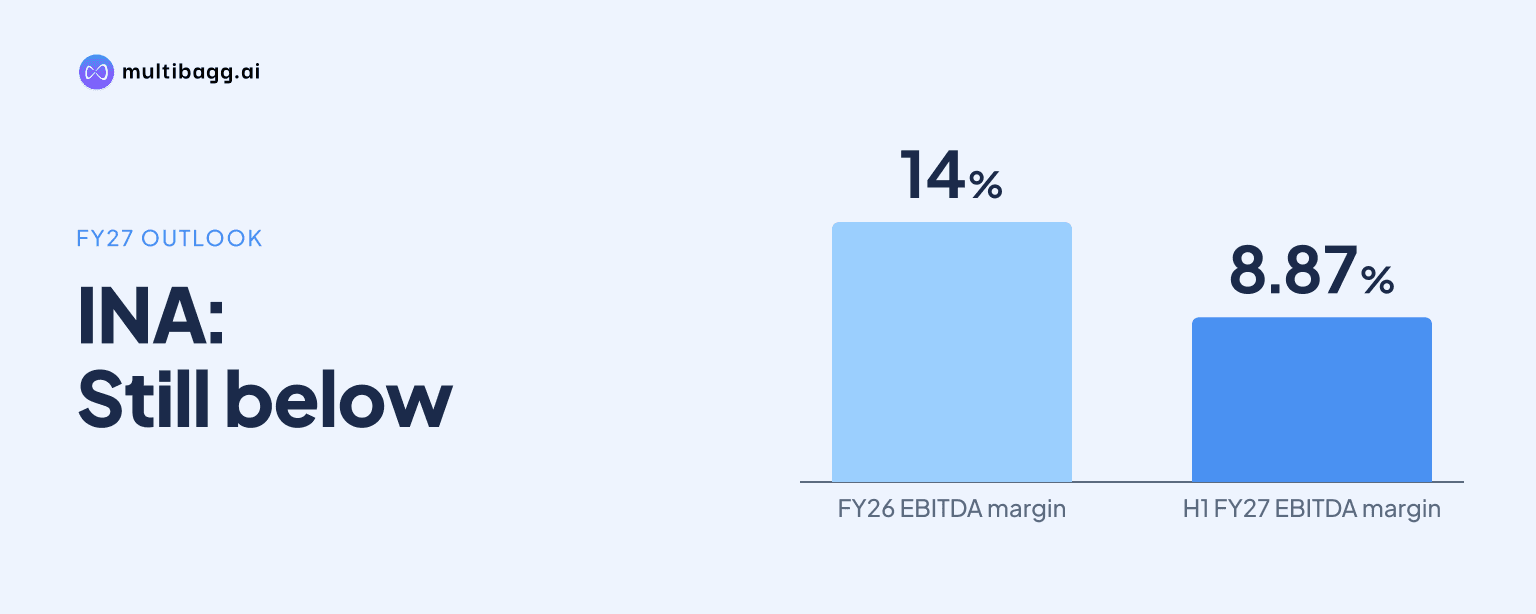
Insolation Energy Limited said on November 16, 2026 that its second-half, or H2, FY27 earnings before interest, tax, depreciation and amortisation (EBITDA) margin should improve from 8.87% in the first half, or H1, but will not return to the roughly 14% level recorded in FY26. Management cited easing freight and material costs as the basis for improvement.
Know Insolation Energy inside out
Results, valuation, peers and who's buying, in one view.
What did INA say about FY27 EBITDA margins?
INA said H2 FY27 EBITDA margin will exceed the 8.87% reported in H1 FY27, but it does not expect to reach FY26's roughly 14% level. Chairman Manish Gupta gave that assessment during the November 16 earnings call, stating that 14% would not be achieved in the current financial year despite an expected improvement.
Management did not provide a numerical full-year FY27 margin target. Gupta said INA would be better placed to offer a figure after Q3 FY27 results, when the company expects a clearer view of market conditions by December. The disclosed outlook is therefore for improvement from current levels, rather than restoration of the prior-year benchmark.
INA's prepared remarks had said EBITDA margins would recover over the next two quarters and that full-year FY27 EBITDA and margin were expected to return to FY26 levels. The later question-and-answer response was more specific: management said FY27 would close somewhere between the H1 FY27 level and FY26's roughly 14% margin.
Why did INA's profit growth trail revenue in H1 FY27?
INA's revenue doubled in H1 FY27, but operating margin declined because of industry pricing dynamics and elevated input costs. Revenue from operations rose 100.56% year on year to Rs 1,582.09 crore, while EBITDA increased 23.3% to Rs 140.31 crore, resulting in an EBITDA margin of 8.87% against 14.43% in H1 FY26.
The second quarter showed a similar gap between sales and profit growth. Q2 FY27 revenue increased 96.45% to Rs 836.69 crore, whereas EBITDA rose 13.32% to Rs 63.44 crore and EBITDA margin was 7.58%. Net profit fell to Rs 25.06 crore from Rs 36.95 crore, with profit after tax (PAT) margin reported at 3%.
For H1 FY27, net profit declined to Rs 63.08 crore from Rs 80.07 crore despite the increase in revenue. Chief Financial Officer Ravi Dusad attributed the lower PAT margin of 4% to higher depreciation and finance costs, and agreed with an analyst that their combined impact was close to 3%.
Got a follow-up? Ask IRIS
Which costs could improve INA's H2 FY27 margin?
INA expects lower international freight, softer copper and aluminium prices, and easing dollar-related pressure to support H2 FY27 margins. Gupta said freight had started to ease compared with the preceding period, while lower ferrous and non-ferrous material prices should be reflected in margins if those conditions continue.
That recovery depends on external market movements rather than a fixed cost target. Management described FY27 conditions as affected by international disruption in dollar prices, metals and freight, and said December should provide a clearer assessment of whether those pressures have eased sufficiently to support a more accurate Q3 FY27 margin outlook.
INA also disclosed a separate incentive for its Sawarda facility. The company received an entitlement certificate under RIPS 2022 for a Phase 1 investment of Rs 179.12 crore, providing a 1.98% turnover-linked benefit of about Rs 224 crore over nine years and a 100% electricity-duty exemption expected to save more than Rs 1 crore annually at current consumption.
The incentive and the H2 cost outlook operate through different mechanisms. The certificate applies over nine years at the Sawarda facility, while management's immediate margin expectation is linked mainly to input, currency and logistics conditions during the remaining two quarters of FY27.
What operational milestones could affect INA's margin outlook?
INA is targeting first commercial operations at its 4.5-gigawatt TOPCon solar-cell facility in Q4 FY27 and commercial operations at its 18,000-metric-tonnes-per-annum aluminium-frame plant in Q3 FY27. Management said the cell facility's main civil work and pre-engineered building erection were complete, while machinery installation was under way.
The cell project at Narmadapuram is part of INA's backward-integration plan, intended to improve manufacturing efficiency and reduce external sourcing dependence. Management said full utilisation would come in FY28 rather than FY27 because the 4.5-gigawatt facility is due to start near the end of the current financial year.
For the aluminium plant, INA said civil work and building construction were complete, machinery installation was in place and trial runs had begun. Gupta subsequently said the plant should be operational before December 31, 2026, and estimated a saving of Rs 50 to Rs 60 per frame set, without quantifying the resulting FY27 EBITDA-margin effect.
Order execution remains another near-term factor. INA reported an approximately 2.2-gigawatt order book, including 1.3 gigawatts scheduled for delivery by March 2027, with production slots allocated. Supplies to NTPC, MEIL and Rays Power were supporting capacity utilisation above 60%, and INA executed about 70 megawatts of solar projects in H1 FY27.
Conclusion
INA's stated position is that H2 FY27 profitability should improve after EBITDA margin fell to 8.87% in H1 FY27, even as revenue reached Rs 1,582.09 crore. However, management's later call commentary explicitly places FY27 below the roughly 14% EBITDA margin achieved in FY26, reflecting the effect of pricing, input costs, freight and currency conditions.
The next disclosed checkpoint is Q3 FY27 results, when management said it could provide more accurate margin guidance. Investors can also watch whether the aluminium-frame plant begins operations before December 31, 2026, whether the 4.5-gigawatt cell facility starts commercial operations in Q4 FY27, and whether lower freight and material costs translate into the projected H2 improvement.