










Insolation Energy Limited targets FY28 cell utilisation
Key highlights
- INA targets Q4 FY27 first commercial operations for its 4.5-gigawatt TOPCon cell facility.
- Management expects the cell line to reach about 60%-65% full-year utilisation in FY28.
- INA reported approximately 2.5 gigawatts of proposed cell opportunities under internal evaluation.
- H1 FY27 revenue rose 100.56% year on year to Rs 1,582.09 crore, while EBITDA margin was 8.87%.
powered by IRIS
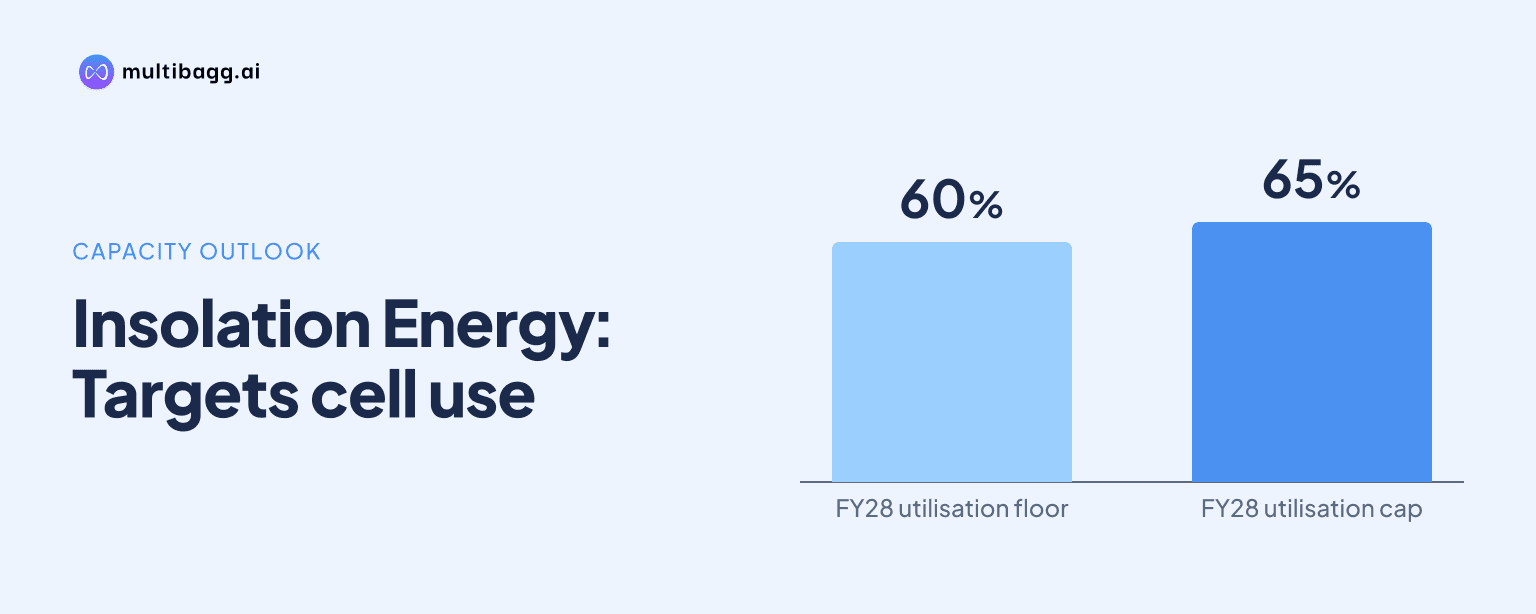
Insolation Energy Limited targets first commercial operations at its 4.5-gigawatt TOPCon solar-cell facility in Q4 FY27, with management expecting a quarter-by-quarter ramp to 60%-65% full-year utilisation in FY28. The company said the plant would not start in November 2026, while civil work was complete and machinery installation was under way.
Know Insolation Energy inside out
Results, valuation, peers and who's buying, in one view.
When will INA’s 4.5-gigawatt cell plant start?
INA targets first commercial operations at its 4.5-gigawatt tunnel oxide passivated contact, or TOPCon, solar-cell facility in Narmadapuram, Madhya Pradesh, during Q4 FY27. On the November 16, 2026 earnings call, management rejected an investor’s assumption that the plant would commence by that month-end, saying the full 4.5-gigawatt capacity would be commissioned in one go but “not this month.”
The project had completed its main civil work and pre-engineered building, or PEB, erection by the call date. INA said major utilities had been ordered, machinery installation was in progress, and it had secured power availability and bulk industrial-water supply. The company has also engaged a turnkey provider, technical consultants and owner engineers, while adding senior personnel and functional teams for the project.
The disclosed timeline means the plant is not expected to make a material operating contribution through most of FY27. Management said the line would start at the end of FY27, with fuller utilisation occurring in FY28, contrasting with the November 2026 start contemplated in the investor question.
What utilisation does INA expect from the cell line?
INA management expects the 4.5-gigawatt cell line to reach about 60%-65% utilisation on a full-year basis in FY28. It did not provide an FY27 utilisation target, saying instead that the facility would begin by the end of that financial year and ramp quarter by quarter in its first year.
This is a ramp-up expectation rather than an indication that the line will operate at 60%-65% immediately after commissioning. Management said utilisation would increase each quarter, but did not define whether the measure referred to production output, sales volume or another operational metric.
INA reported approximately 2.5 gigawatts of proposed opportunities under internal evaluation across strategic memorandums of understanding, partnerships and direct supply orders. Management expects this pipeline to expand after the cell line becomes operational, but it did not disclose a conversion rate into firm orders.
That prospective cell pipeline is separate from INA’s approximately 2.2-gigawatt total order book, of which 1.3 gigawatts were scheduled for delivery by March 2027. Existing supplies to customers including NTPC, MEIL and Rays Power were supporting capacity utilisation of more than 60%, management said, but that figure relates to current operations rather than the Narmadapuram cell factory.
Got a follow-up? Ask IRIS
How could INA’s cell plant affect margins and product mix?
INA said using its own domestically made cells in domestically made modules for domestic-content-requirement, or DCR, applications should increase earnings before interest, tax, depreciation and amortisation, or EBITDA, and overall margin. Management described backward integration into cells principally as a means to serve DCR tenders and requirements, where cells and panels are manufactured in India.
Management said EBITDA could reach “somewhere around 20%” when the plant is fully operational. This was an expectation given in response to an analyst question, not formal guidance for a specified year. INA also said that selling cells directly or incorporating them into modules should produce the same overall margin, although revenue would be recorded in direct cell sales or module sales respectively.
The company cited prevailing cell prices of Rs 13.25 to Rs 13.75 per watt, DCR module prices of Rs 21 to Rs 23 per watt, and non-DCR module prices of Rs 12.25 to Rs 12.75 per watt. INA did not disclose the new plant’s unit costs, expected cell gross margin or committed sales volume.
The cell investment is being developed alongside an aluminium-frame project rated at 18,000 metric tonnes per annum. INA said the aluminium plant was targeted to start commercial operations before December 31, 2026, ahead of the Q4 FY27 cell-facility target, and management estimated savings of Rs 50 to Rs 60 per frame set.
What are INA’s financial results before the cell plant starts?
INA reported H1 FY27 revenue from operations of Rs 1,582.09 crore, up 100.56% year on year from Rs 788 crore in H1 FY26. EBITDA rose 23.3% to Rs 140.31 crore from Rs 113.80 crore, but EBITDA margin moderated to 8.87% from 14.43% in the corresponding prior-year period, which management attributed to industry pricing dynamics and elevated input costs.
The comparison shows revenue expanded faster than EBITDA in H1 FY27. In Q2 FY27, revenue increased 96.45% year on year to Rs 836.69 crore, while EBITDA rose 13.32% to Rs 63.44 crore from Rs 55.99 crore. Quarterly EBITDA margin was 7.58%, below the H1 FY27 margin of 8.87%.
Profit after tax, or PAT, was Rs 63.08 crore in H1 FY27, compared with Rs 80.07 crore in H1 FY26, with a 4% PAT margin. Q2 FY27 PAT was Rs 25.06 crore versus Rs 36.95 crore a year earlier, and the chief financial officer said higher depreciation and finance costs had an impact close to 3%.
Management expects EBITDA margins to improve over the next two quarters, but the chairman said FY27 may not return to the 14% level cited for FY26. He said H2 FY27 should be better than H1 FY27 and that more precise guidance could be provided after Q3 results, citing easing freight and certain input-cost pressures.
Conclusion
INA’s timetable places the 4.5-gigawatt TOPCon facility at the transition between FY27 and FY28: commercial operations are targeted for Q4 FY27, while management expects 60%-65% full-year utilisation only in FY28. The facility is therefore presented as a future source of DCR capability and potential margin improvement rather than a major FY27 production driver.
The next disclosed checkpoints are equipment dispatch, which management expected to begin by the end of November 2026 after saying more than 60%-70% of the machinery had been constructed, and the Q4 FY27 commercial-operations target. Investors can also watch for the aluminium plant’s planned start before December 31, 2026, conversion of the 2.5-gigawatt opportunity pipeline, and management’s post-Q3 FY27 margin update.