










Pasari Spinning Mills appoints Prem Bharath Bist as chair
Key highlights
- Prem Bharath Bist became Pasari Spinning Mills’ chairperson on October 30, 2026, replacing Kolagunda Kumar Siddappa.
- Members must approve Bist’s directorship within 3 months of his October 30, 2026 appointment through a remote e-voting postal ballot.
- Pasari Spinning Mills reported no operating revenue and a net loss of Rs 6.46 lakh for the six months ended September 30, 2026.
- The company disclosed Rs 6.3923 crore as a contingent liability in its dispute with Cotton Corporation of India, while Rs 63.90 lakh in related security deposits was fully provided for.
powered by IRIS
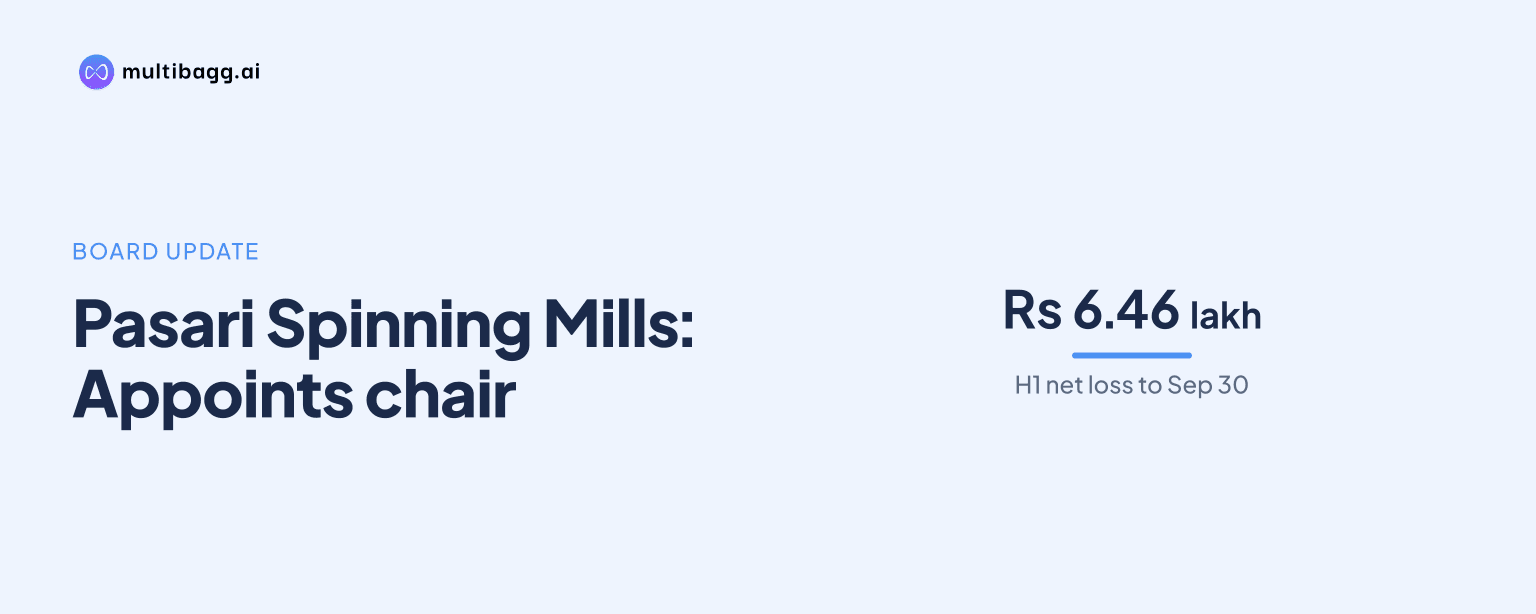
Pasari Spinning Mills Limited appointed Prem Bharath Bist as chairperson on October 30, 2026, after chairman Kolagunda Kumar Siddappa resigned for personal reasons. The board also accepted independent director Sheela Arvind’s resignation, reconstituted three committees she chaired, and approved a postal ballot for director appointments.
Know Pasari Spinning Mills inside out
Results, valuation, peers and who's buying, in one view.
Why did Pasari Spinning Mills change its board chair?
Pasari Spinning Mills changed its board chair because Kolagunda Kumar Siddappa resigned as non-executive non-independent director and chairman at the conclusion of the October 30, 2026 board meeting. Siddappa cited personal reasons and confirmed there was no other material reason for his resignation, according to the company’s disclosure.
The board elected Prem Bharath Bist, a non-executive non-independent director, as chairperson from the conclusion of the same meeting. The meeting at Pasari Spinning Mills’ Bengaluru registered office started at 3:00 PM and ended at 6:35 PM on October 30, 2026.
Bist’s appointment as an additional director followed a recommendation from the Nomination and Remuneration Committee. He is liable to retire by rotation and will hold office until the next annual general meeting, subject to the members’ approval within three months of his October 30, 2026 appointment.
When must Pasari Spinning Mills members approve Bist?
Pasari Spinning Mills must obtain member approval of Bist’s directorship within three months of October 30, 2026 under Regulation 17(1C) of the Securities and Exchange Board of India, or SEBI, Listing Obligations and Disclosure Requirements Regulations. The board said Bist was not debarred from holding a directorship by any SEBI or other authority order.
The company approved a postal ballot notice to seek approval through remote e-voting only. Members will consider Bist’s appointment as a non-executive non-independent director, liable to retire by rotation, through an ordinary resolution; the filing does not state the e-voting dates.
The October 30 meeting also noted Bhavna Agrawal’s appointment by a resolution passed through circulation on October 29, 2026. Agrawal was appointed as an additional non-executive independent director for a proposed five consecutive years, from October 29, 2026 to October 28, 2031, subject to approval through a special resolution.
The two incoming directors therefore face different member-approval routes in the planned postal ballot. Pasari Spinning Mills said it would submit the postal ballot notice to BSE after dispatching it to members, but the supplied pages do not include Bist’s profile that the company said was contained in Annexure B.
What changed in Pasari Spinning Mills’ board committees?
Pasari Spinning Mills reconstituted its Audit Committee, Nomination and Remuneration Committee, and Stakeholders’ Relationship Committee after Sheela Arvind resigned on October 30, 2026. Arvind’s resignation as an independent director also ended her roles as chairperson of all three committees at the close of that meeting.
Arvind said other professional commitments meant she could not devote sufficient time to the board. The company said she confirmed there was no material reason for leaving beyond that explanation, as required under Para 7B of Part A of Schedule III to the SEBI listing regulations.
The revised composition of the three committees took effect from the conclusion of the October 30 meeting. However, Pasari Spinning Mills identified Annexure E as containing the new composition, and that annexure is not included in the supplied filing pages; the available disclosure does not identify the new committee chairs or members.
The committee changes coincided with two board additions over October 29 and 30, 2026. Agrawal joined in the independent category, while Bist joined in the non-independent category and then became chairperson, replacing Siddappa after his resignation became effective.
Got a follow-up? Ask IRIS
What financial matters accompanied the Pasari Spinning Mills changes?
Pasari Spinning Mills approved unaudited standalone results for the quarter and half year ended September 30, 2026 at the October 30 meeting. Its statutory auditor said the company earned no revenue from operations in either period and reported a net loss of Rs 6.46 lakh for the six months.
At September 30, 2026, reserves and surplus were negative Rs 13.5309 crore, against paid-up equity share capital of Rs 13.80 crore, leaving net worth of Rs 26.91 lakh. Borrowings were Rs 1.3464 crore, and the auditor said Pasari Spinning Mills depended on funding from related parties.
The auditor identified those conditions as a material uncertainty that may cast significant doubt on Pasari Spinning Mills’ ability to continue as a going concern. The financial statements were prepared on a going-concern basis, and the auditor’s review conclusion was not modified in respect of the matter.
The factory building, previously let out, had remained vacant since February 2026, so no rental income was earned or recognised in the quarter ended September 30, 2026. In contrast, the six-month period included Rs 1.38 lakh recognised in the June 2026 quarter from adjusting repair and maintenance expenses against a tenant’s security deposit.
What is the status of the Pasari Spinning Mills cotton dispute?
Pasari Spinning Mills remains involved in a dispute with Cotton Corporation of India Limited over cotton purchases and related claims. Arbitration-related proceedings and subsequent appeals were pending before the High Court of Karnataka when the auditor issued its October 30, 2026 review report.
Execution proceedings before the Commercial Court in Mysuru included alleged dues of Rs 7.0312 crore and a sale proclamation concerning certain company immovable properties. The High Court of Karnataka granted an interim stay on the execution proceedings on January 6, 2026, and the matter remained pending adjudication.
Pasari Spinning Mills had fully provided for Rs 63.90 lakh in security deposits given to Cotton Corporation of India. The remaining disputed amount of Rs 6.3923 crore was disclosed as a contingent liability pending the outcome of legal proceedings.
The auditor also observed that the chief financial officer had not signed the September 2026 financial statement, despite the signing requirement described under Section 134 of the Companies Act, 2013. The auditor stated that its review conclusion was not modified in respect of that observation or the vacant factory building.
Conclusion
Pasari Spinning Mills completed a concentrated board transition on October 30, 2026, replacing its chairman, accepting the resignation of the independent director who chaired three committees, adding Bist and Agrawal, and reconstituting the committees. The filing confirms the effective date of these actions but the supplied pages do not disclose the revised committee memberships or chairpersons.
Next, Pasari Spinning Mills plans to dispatch a postal ballot notice seeking member approval for Bist and Agrawal, with Bist’s approval required within three months of October 30, 2026. The company also has unresolved matters to monitor, including the pending Cotton Corporation of India litigation and the conditions underlying the auditor’s going-concern uncertainty.