










Patel Engineering H1 attributable profit rises 15.9% on 2% revenue
Key highlights
- Patel Engineering’s H1-FY27 attributable profit rose 15.9% to Rs 176.7 crore.
- Patel Engineering’s H1-FY27 revenue from operations increased 2.0% to Rs 2,491.4 crore.
- Patel Engineering’s H1-FY27 operating EBITDA margin was 13.24%, down 3 basis points year on year.
- Patel Engineering reported an H1-FY27 order backlog of Rs 13,546.4 crore across 52 projects.
powered by IRIS
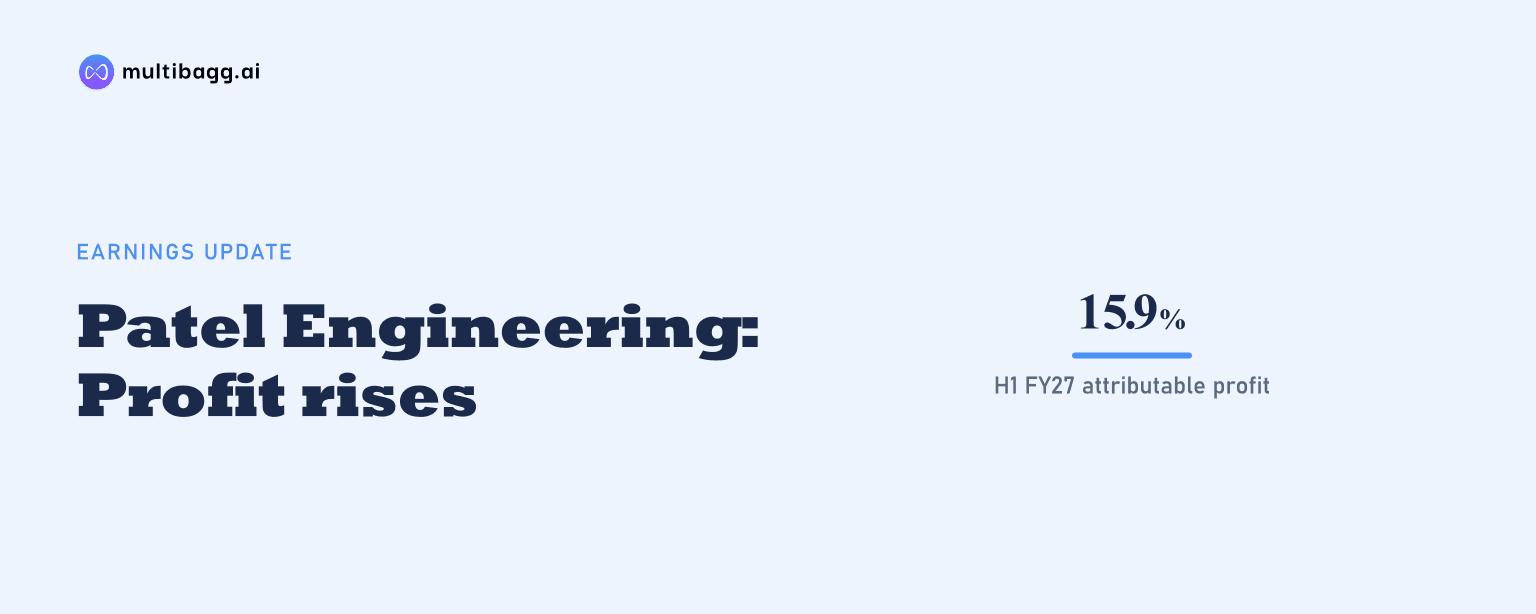
Patel Engineering Limited reported H1-FY27 net profit attributable to owners of the parent of Rs 176.7 crore, up 15.9% year on year, while revenue from operations rose 2.0% to Rs 2,491.4 crore. Finance costs fell 14.3%, and the prior-year period carried an exceptional item of Rs 30.9 crore that was absent in H1-FY27.
Know Patel Engineering inside out
Results, valuation, peers and who's buying, in one view.
How did Patel Engineering’s H1-FY27 profit change?
Patel Engineering’s net profit attributable to owners of the parent rose to Rs 176.7 crore in H1-FY27 from Rs 152.4 crore in H1-FY26, an increase of 15.9%. The presentation defines this measure as profit including other comprehensive income and adjusted for non-controlling interest. Diluted earnings per share increased 4.8% to Rs 1.75 from Rs 1.67.
Profit after tax, before the share of associates, other comprehensive income and non-controlling interest, increased 23.8% to Rs 179.2 crore from Rs 144.8 crore. Profit before tax rose 15.4% to Rs 224 crore from Rs 194.1 crore, while the attributable profit margin increased by 85 basis points to 7.09% from 6.24%.
Why did Patel Engineering’s profit grow faster than revenue?
Patel Engineering’s H1 profit grew faster than revenue because finance costs declined, tax expense fell and H1-FY26 included an exceptional item. Finance costs decreased by Rs 21.3 crore, or 14.3%, to Rs 127.8 crore from Rs 149.1 crore. Tax expense declined 9.1% to Rs 44.8 crore from Rs 49.3 crore, although profit before tax rose.
The operating performance moved broadly with the top line. Operating earnings before interest, tax, depreciation and amortisation, or EBITDA, increased 1.8% to Rs 329.9 crore, compared with 2.0% revenue growth. Operating EBITDA margin was 13.24%, down 3 basis points from 13.27%, showing that the increase in attributable profit did not stem from a material expansion in operating margin.
Other income declined 28.1% to Rs 73.1 crore from Rs 101.7 crore, while the share in profit of associates fell 32.6% to Rs 6.2 crore from Rs 9.2 crore. The prior-year exceptional item was Rs 30.9 crore, whereas no exceptional item was reported in H1-FY27. PAT margin increased 126 basis points to 7.19% from 5.93%.
What changed for Patel Engineering in Q2-FY27?
Patel Engineering reported Q2-FY27 revenue of Rs 1,210.7 crore, up 0.2% from Rs 1,208.5 crore in Q2-FY26, while net profit attributable to owners increased 7.8% to Rs 83.3 crore. Q2 operating EBITDA fell 5.3% to Rs 150.3 crore from Rs 158.7 crore, and operating EBITDA margin declined 72 basis points to 12.41%.
Sequentially, Q2 revenue was 5.5% below Q1-FY27 revenue of Rs 1,280.7 crore, while operating EBITDA was 16.3% lower than Rs 179.6 crore in Q1. Net profit for owners declined 10.9% from Rs 93.5 crore in Q1, and diluted earnings per share fell to Rs 0.82 from Rs 0.94.
The year-on-year quarterly comparison also reflects the absence of the Rs 30.9 crore exceptional item recorded in Q2-FY26. Q2-FY27 profit before tax was Rs 107.2 crore, up 20.9% from Rs 88.7 crore. Finance costs were Rs 66 crore, 13.2% below Rs 76 crore a year earlier but 6.8% above Rs 61.8 crore in Q1-FY27.
Got a follow-up? Ask IRIS
What execution work and order book does Patel Engineering report?
Patel Engineering reported an H1-FY27 order backlog of Rs 13,546.4 crore across 52 projects, down from Rs 15,119.3 crore at FY26. Hydroelectric projects accounted for Rs 8,620.4 crore, or 63.64%, across 18 projects. Irrigation represented Rs 1,962 crore across 20 projects, while urban infrastructure and other work represented Rs 2,262.1 crore across five projects.
New order intake was Rs 64.5 crore in H1-FY27, entirely in irrigation. This compares with Rs 4,400.9 crore in FY26 and Rs 111.2 crore in FY25, which are full-year periods rather than half-year periods. The presentation reported a book-to-bill ratio of 2.72 for Q2/H1-FY27.
Central government and public-sector undertaking clients made up 62.40% of the order book, or Rs 8,453.1 crore, while state-government clients accounted for Rs 3,901.4 crore. Projects below 10% completion represented Rs 5,574.1 crore, or 41.15% of backlog, across eight projects; projects at 70% to 90% completion represented Rs 2,147.2 crore across 18 projects.
Operationally, the Subansiri Lower Hydropower Project reached 1,250 megawatts of operational capacity after Unit 5, a 250-megawatt unit, entered wet commissioning activity in July 2026. At Kiru, dam concreting reached 12 lakh cubic metres against a 12.50 lakh cubic metre target. Kwar recorded 4 lakh cubic metres against a 7.50 lakh cubic metre target, and the Sleemanabad Carrier Canal Project completed a breakthrough of an approximately 12-kilometre irrigation tunnel using a 10-metre-diameter tunnel-boring machine.
How has Patel Engineering’s debt and working capital changed?
Patel Engineering reported total debt of Rs 1,312.1 crore at H1-FY27, compared with Rs 1,187 crore at FY26 and Rs 1,602.5 crore at FY25. The increase of Rs 125.1 crore from FY26 reflected working-capital debt rising to Rs 962.3 crore from Rs 846.9 crore, while term debt increased to Rs 349.8 crore from Rs 340.1 crore.
Total debt plus contractee advances was Rs 1,921.2 crore at H1-FY27, versus Rs 1,809.2 crore at FY26. Contractee advances fell to Rs 609.1 crore from Rs 622.2 crore. Net working capital increased to 136 days from 120 days, while adjusted net working capital rose to 125 days from 106 days.
The presentation defines adjusted net working capital as excluding borrowings, arbitration claims, current investments, cash and bank balances, and stock of land. Management’s stated strategy includes improving the balance sheet and optimising the cost of capital, alongside selective project selection based on scale, complexity and profitability.
Conclusion
Patel Engineering’s H1-FY27 results show profit attributable to owners increasing faster than revenue, with a 15.9% rise in attributable profit against 2.0% revenue growth. Operating EBITDA grew 1.8% and its margin was nearly unchanged, while lower finance costs, lower tax expense and no exceptional item supported the change in reported profit.
The next disclosures to watch are fresh order intake after Rs 64.5 crore in H1-FY27, backlog conversion from the Rs 13,546.4 crore order book, and working-capital movement after net working capital reached 136 days. Management has also outlined a plan to focus on hydropower, pumped storage, tunnelling and selected adjacent infrastructure projects while improving its balance sheet and cost of capital.