










Patel Engineering first-half profit rises to Rs 179.24 crore
Key highlights
- Patel Engineering’s first-half profit rose to Rs 179.24 crore from Rs 144.76 crore.
- Revenue from operations increased to Rs 249.14 crore from Rs 244.19 crore.
- Net operating cash flow fell to Rs 87.16 crore from Rs 380.12 crore.
- Trade and other receivables used Rs 505.16 crore of cash in the first half.
powered by IRIS
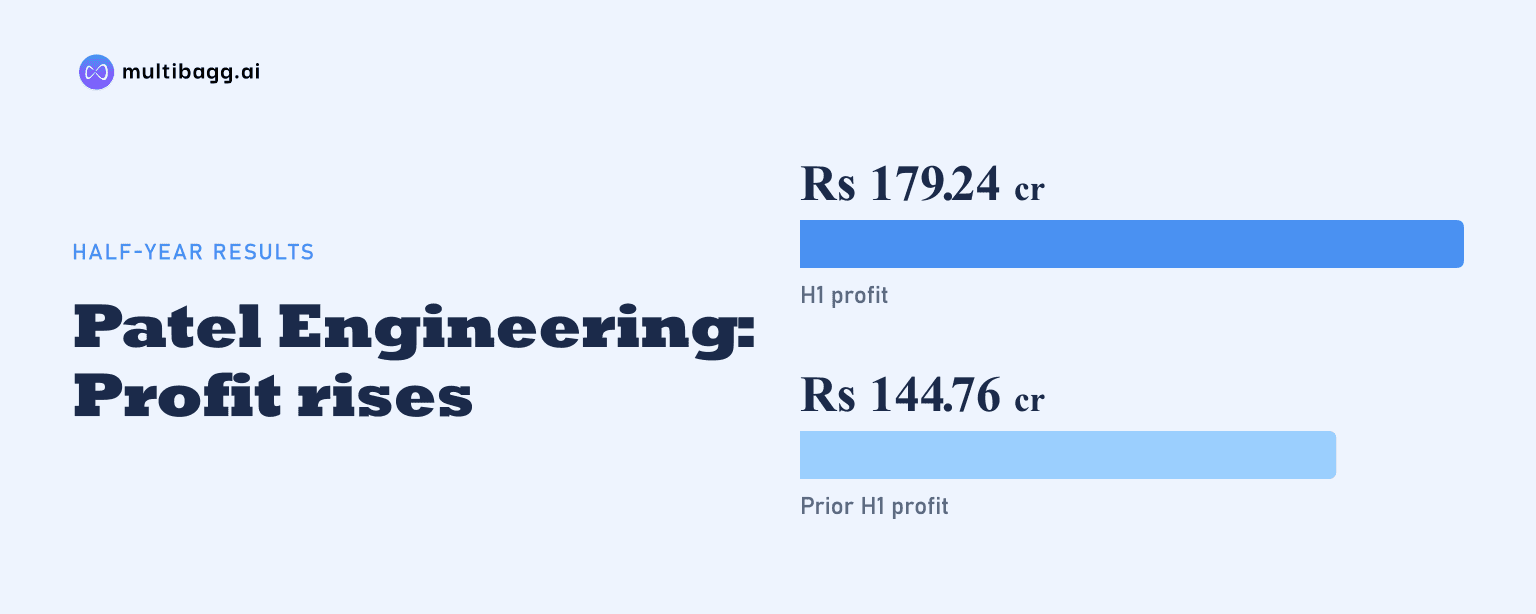
Patel Engineering Limited reported profit for the period of Rs 179.24 crore for the half year ended September 30, 2026, up from Rs 144.76 crore a year earlier, while net cash from operating activities fell to Rs 87.16 crore from Rs 380.12 crore as trade and other receivables used Rs 505.16 crore.
Know Patel Engineering inside out
Results, valuation, peers and who's buying, in one view.
How did Patel Engineering’s first-half profit change?
Patel Engineering’s profit for the period rose 23.8% year on year to Rs 179.24 crore in the half year ended September 30, 2026, from Rs 144.76 crore in the corresponding 2025 half. Profit before tax increased to Rs 224.01 crore from Rs 194.06 crore, while profit before exceptional items and tax was nearly unchanged at Rs 220.13 crore against Rs 220.09 crore.
Revenue from operations increased 2.0% to Rs 249.14 crore from Rs 244.19 crore. Total income was Rs 256.46 crore compared with Rs 254.36 crore, as other income declined to Rs 7.16 crore from Rs 10.17 crore. The increase in reported profit therefore came despite lower other income and modest growth in operating revenue.
Patel Engineering recorded September-quarter profit for the period of Rs 87.25 crore, compared with Rs 64.74 crore in the quarter ended September 30, 2025. It was below the Rs 91.99 crore reported in the June 2026 quarter. Basic earnings per share for the first half were Rs 1.84 against Rs 1.76, while diluted earnings per share were Rs 1.75 against Rs 1.67.
What changed in Patel Engineering’s costs and margins?
Patel Engineering’s finance cost fell to Rs 127.85 crore in the first half from Rs 149.11 crore a year earlier, a reduction of Rs 21.26 crore. Cost of construction declined to Rs 1,071.84 crore from Rs 1,260.06 crore, while material-consumption cost increased to Rs 747.83 crore from Rs 565.48 crore and employee-benefit expense rose to Rs 220.09 crore from Rs 191.56 crore.
Total expenses were Rs 2,306.00 crore, down from Rs 2,318.65 crore in the prior-year half. Other expenses rose to Rs 121.74 crore from Rs 100.81 crore, while depreciation was broadly stable at Rs 51.21 crore compared with Rs 51.64 crore. Lower construction and finance costs offset increases in materials, employee costs and other expenses.
Patel Engineering disclosed an annualised operating margin of 13.24% at September 30, 2026, compared with 13.27% a year earlier. Its annualised net-profit margin was 7.40%, up from 6.31%. The filing identifies Civil Construction, Real Estate and Others as its three reportable business segments.
Revenue within India was Rs 239.22 crore in the first half, up from Rs 229.15 crore a year earlier. Revenue outside India was Rs 9.92 crore, compared with Rs 15.04 crore in the prior-year half. Domestic revenue increased by Rs 10.07 crore, whereas overseas revenue declined by Rs 5.12 crore.
Got a follow-up? Ask IRIS
Why did Patel Engineering’s operating cash flow fall?
Patel Engineering’s net cash from operating activities fell 77.1% to Rs 87.16 crore in the half year ended September 30, 2026 from Rs 380.12 crore in the prior-year half. Operating profit before working-capital changes increased to Rs 379.17 crore from Rs 356.40 crore, indicating that the decline followed working-capital movements rather than this pre-working-capital profit measure.
Trade and other receivables used Rs 505.16 crore of cash in the 2026 first half, compared with a Rs 50.30 crore cash release in the previous corresponding period. Inventories generated Rs 150.71 crore after using Rs 34.89 crore a year earlier, while trade and other payables generated Rs 87.15 crore against Rs 7.70 crore. Those offsets did not cover the receivables cash outflow.
Cash from operations before direct taxes was Rs 111.86 crore, down from Rs 379.52 crore. Direct taxes paid, net of refunds, were Rs 24.70 crore, whereas the previous period recorded a net refund of Rs 0.60 crore. The cash-flow statement therefore shows materially lower conversion of reported profit into operating cash in the six months to September 2026.
What do Patel Engineering’s balance sheet and debt figures show?
Patel Engineering reported total assets of Rs 994.55 crore at September 30, 2026, compared with Rs 952.18 crore at March 31, 2026. Cash and cash equivalents closed at Rs 42.27 crore, up from Rs 37.96 crore at the beginning of the half year, following a net increase of Rs 4.30 crore.
The financing-liabilities reconciliation reported borrowings, including short-term borrowings, long-term borrowings, current maturities and lease liabilities, of Rs 1,356.01 crore at September 30, 2026. This compared with an opening balance of Rs 1,216.09 crore on April 1, 2026, after Rs 115.43 crore of cash-flow additions and Rs 24.49 crore of non-cash changes. The comparable September 30, 2025 balance was Rs 1,560.05 crore.
Patel Engineering disclosed a debt-to-equity ratio of 0.28 at September 30, 2026, compared with 0.39 a year earlier. Total debt to total assets was 0.13 against 0.16, while the current ratio declined to 1.30 from 1.45. The debt-service coverage ratio was 1.90 compared with 1.50, and interest-service coverage was 2.75 compared with 2.50; the filing says these ratios are annualised.
Patel Engineering said it maintained 100% asset cover, based on a valuation report, for its secured non-convertible debentures. It also disclosed a debt credit rating of A with a stable outlook. The results were reviewed by the audit committee and approved by the board on November 5, 2026.
Conclusion
Patel Engineering’s first-half results combine higher profit of Rs 179.24 crore and a Rs 21.26 crore reduction in finance cost with a substantial deterioration in operating cash generation. Revenue rose by Rs 4.95 crore, led by Indian revenue, but a Rs 505.16 crore receivables outflow outweighed cash released from inventories and generated through payables.
The next issue to watch is whether receivables convert into cash after operating cash flow fell to Rs 87.16 crore. The filing also says auditors of Shreeanant Construction Private Limited, Digin Hydro Power Private Limited, Meyong Hydro Power Private Limited and West Kameng Energy Private Limited drew attention to material uncertainty that may cast significant doubt on their ability to continue as going concerns, although those subsidiaries prepared their financial statements on a going-concern basis.