










PEL hydropower accounts for 63.64% of H1-FY27 order book
Key highlights
- PEL’s hydropower order book was Rs 8,620.4 crore, or 63.64% of the Rs 13,546.4 crore total, as of September 30, 2026.
- PEL generated Rs 1,773 crore of hydropower and dam infrastructure revenue in H1-FY27.
- Hydropower covered 18 ongoing projects, while irrigation covered 20 projects with a Rs 1,962 crore order book.
- H1-FY27 order intake was Rs 64.5 crore and was entirely in irrigation.
powered by IRIS
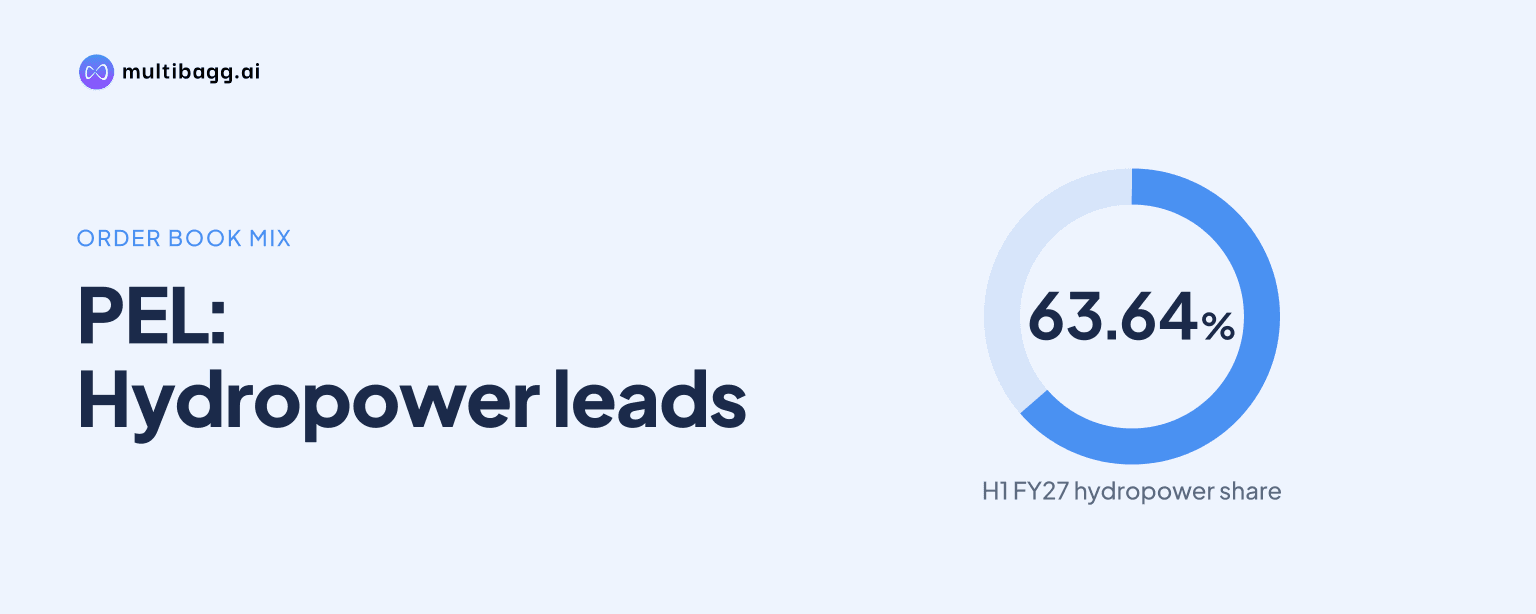
Patel Engineering Limited (PEL) reported a Rs 8,620.4 crore hydropower order book as of September 30, 2026, equal to 63.64% of its Rs 13,546.4 crore H1-FY27 backlog, while hydropower and dam infrastructure generated Rs 1,773 crore in H1-FY27 revenue. The segment was PEL’s largest source of contracted work and reported segment revenue.
Know Patel Engineering inside out
Results, valuation, peers and who's buying, in one view.
What share of PEL’s order book is hydropower?
Hydropower represented 63.64% of PEL’s H1-FY27 order book, with Rs 8,620.4 crore across 18 ongoing projects as of September 30, 2026. PEL’s total order book was Rs 13,546.4 crore across 52 projects, and hydropower was larger than the combined Rs 4,926 crore backlog of its four other reported categories.
Urban Infrastructure & Others was PEL’s next-largest order-book category at Rs 2,262.1 crore, or 16.70% of the total, followed by irrigation at Rs 1,962 crore, or 14.48%. Hydropower exceeded Urban Infrastructure & Others by Rs 6,358.3 crore, showing the extent to which the September 30 backlog was concentrated in hydroelectric work.
How much revenue did PEL’s hydropower business generate?
PEL’s hydropower and dam infrastructure segment generated Rs 1,773 crore in H1-FY27, against consolidated revenue from operations of Rs 2,491.4 crore for the six-month period. The reported segment revenue was higher than the combined Rs 719.4 crore generated by irrigation, tunnelling, and transportation, urban infrastructure and other activities.
Hydropower revenue rose from Rs 2,206.1 crore in FY24 to Rs 2,814.5 crore in FY26, an increase of Rs 608.4 crore. Over the same period, consolidated revenue from operations increased from Rs 4,544.1 crore to Rs 5,102.7 crore, while PEL reported an operating earnings before interest, tax, depreciation and amortisation margin of 13.24% in H1-FY27, compared with 13.27% in H1-FY26.
Which hydropower projects is PEL currently executing?
PEL reported 18 ongoing hydropower projects in its Rs 8,620.4 crore segment backlog, and highlighted Kundah pumped storage, Subansiri hydropower and Kiru hydropower projects in its portfolio. The presentation identifies Kundah as a 500 megawatt pumped storage project, Subansiri as a 2,000 megawatt hydropower project, and Kiru as a 624 megawatt hydropower project.
At Kiru, PEL reported 12 lakh cubic metres of dam concreting against a 12.50 lakh cubic metre target during its Q2-FY27 operational update. It had commenced deck-slab concreting and completed powerhouse slab concreting after the final pour at Unit 4’s service floor, which are execution milestones rather than new order awards.
At Kwar, PEL reported 4 lakh cubic metres of dam concreting against a 7.50 lakh cubic metre target. Excavation was complete for all four powerhouse units; raft concreting for Units 2 and 3 was complete; wall concreting was in progress; and the company reported the start of draft-tube erection work after inauguration of the tailrace tunnel outlet bridge.
Got a follow-up? Ask IRIS
How diversified is PEL beyond hydropower?
PEL had Rs 4,926 crore of non-hydropower work across 34 projects, compared with Rs 8,620.4 crore across 18 hydropower projects. Irrigation had the highest project count outside hydropower at 20 projects, but its Rs 1,962 crore backlog was Rs 6,658.4 crore below the hydroelectric order book.
The transportation, urban infrastructure and other portfolio totalled Rs 2,480.1 crore across 10 projects, comprising Rs 2,262.1 crore of Urban Infrastructure & Others and Rs 218 crore of roads. Tunnelling was separately reported at Rs 483.9 crore across four projects, although PEL also identifies tunnelling-intensive execution as part of its hydropower and transportation capabilities.
PEL’s client split was predominantly government-linked, with central government and public sector undertaking clients accounting for Rs 8,453.1 crore, or 62.40%, of the Rs 13,546.4 crore order book. State government clients accounted for Rs 3,901.4 crore, or 28.80%; international projects in Bhutan and Nepal totalled Rs 393.8 crore across two projects, while 50 domestic projects were valued at Rs 13,152.6 crore.
What do execution stages and strategy indicate about PEL’s hydro exposure?
PEL reported that Rs 5,574.1 crore, or 41.15%, of its total order book was in projects below 10% completion, while Rs 482.1 crore, or 3.56%, was in the 90% to 100% stage. These completion figures cover all 52 projects and do not separately identify the completion stage of the 18 hydropower projects.
Within its hydropower and dam infrastructure portfolio, PEL reported 52.4% as executed and 47.6% as unexecuted. This compared with 65.3% executed for irrigation, 76.6% for tunnelling, and 43.6% for transportation and urban infrastructure, while the presentation does not define the measurement basis for these portfolio percentages.
Management’s stated strategy includes focusing on hydropower, pumped storage and tunnelling, alongside selective expansion into transportation and adjacent infrastructure for portfolio diversification. H1-FY27 order intake was Rs 64.5 crore and was entirely irrigation, compared with Rs 4,400.9 crore of intake in FY26, so the disclosed H1 intake did not materially alter the hydro-heavy closing backlog mix.
Conclusion
PEL’s H1-FY27 disclosures show that hydropower was the principal component of both contracted workload and reported segment execution. The business held Rs 8,620.4 crore of orders, generated Rs 1,773 crore of H1 revenue and covered 18 projects, compared with Rs 4,926 crore of orders across the other four reported backlog categories.
The next items to watch are execution at Kiru and Kwar, and the conversion of the Rs 5,574.1 crore company-wide backlog that was below 10% completion. Management has stated that it will focus on hydropower, pumped storage and tunnelling while selectively expanding transportation and adjacent infrastructure, and future order intake will indicate whether that changes the segment mix.