








PCL starts Maruti, Mahindra; Hyundai award covers 700,000
Max Plan at ₹4,999/yr₹8,999

Find your next multibaggerBe a Pro Investor
Research stocks and track your picks on the go. Download the app.
Key highlights
- PCL began a Maruti Suzuki project in July 2026 with estimated annual revenue of Rs 50 crore.
- PCL began Mahindra programs in September 2026 with about Rs 25 crore of annualised revenue.
- PCL won Hyundai-linked business for 700,000 camshafts annually across India, Korea and the United States.
- PCL reported Q2 FY27 standalone income of Rs 194.96 crore, up 12.5% quarter on quarter.
powered by IRIS
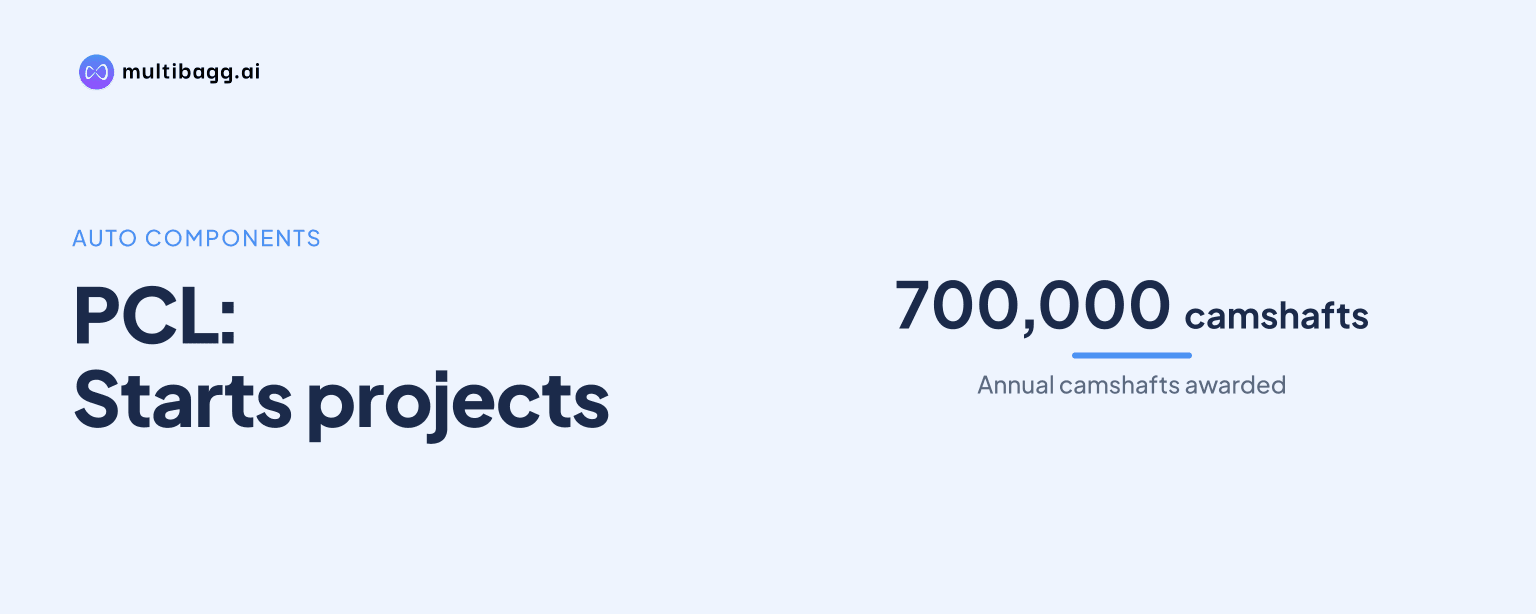
Precision Camshafts Limited began a Maruti Suzuki project in July 2026 and Mahindra programs in September 2026, while winning Hyundai-linked business covering 700,000 camshafts annually. PCL estimates Rs 50 crore of annual revenue from the Maruti Suzuki project and about Rs 25 crore from Mahindra, with some Hyundai production planned from April 2027.
Know Precision Camshafts inside out
Results, valuation, peers and who's buying, in one view.
When did PCL start the Maruti Suzuki and Mahindra programs?
PCL began start of production, or SOP, for a new Maruti Suzuki project in July 2026 and for Mahindra programs in September 2026. Management estimated annual revenue of Rs 50 crore from the Maruti Suzuki project, while the Mahindra programs were expected to generate about Rs 25 crore of annualised revenue.
The Maruti Suzuki launch preceded the Mahindra programs by two months, and the stated annual-revenue potential of the two launched programs totals about Rs 75 crore. The company described both as new camshaft programs moving into production, rather than merely nominations or prospective customer awards.
PCL also received fresh nominations for additional Maruti Suzuki projects, with start-up production planned in 2029 and 2030. Management did not disclose the volumes, revenue potential, investment requirement or individual product scope for these later Maruti Suzuki programs, but the dates extend the disclosed programme pipeline beyond the FY27 launches.
Management said the new nominations show continuing customer commitments to internal-combustion-engine, or ICE, applications. That statement is management’s view of customer activity; the call did not provide an estimate for the size of PCL’s total ICE order book or future revenue from the 2029 and 2030 projects.
What does the Hyundai award add to PCL's camshaft pipeline?
The Hyundai award adds combined annual volume of 700,000 camshafts across India, Korea and the United States. PCL said it will supply Hyundai through a Tier 1 supplier, and that SOP for some projects will begin as soon as April 2027.
Unlike the Maruti Suzuki and Mahindra launches, which management quantified in annual revenue terms at Rs 50 crore and about Rs 25 crore, respectively, the Hyundai award was disclosed only in volume terms. PCL did not provide award revenue, country-level volumes, product mix, programme duration or the proportion of the 700,000 camshafts due to begin production in April 2027.
The different disclosures make a direct revenue comparison unavailable. However, the Hyundai award provides a defined annual production measure alongside the Rs 75 crore combined annual-revenue estimate for the two Indian programs already launched in July and September 2026.
PCL said the Hyundai business is for markets in India, Korea and the United States, broadening the geographic scope of the disclosed program pipeline. The company did not state whether the camshafts would be manufactured at a particular PCL facility, nor did it disclose capacity additions specifically linked to the 700,000-unit annual programme.
How did PCL perform financially in Q2 FY27?
PCL reported standalone total income of Rs 194.96 crore in Q2 FY27, up 12.5% quarter on quarter and about 30% from Q2 of the previous year. Standalone earnings before interest, tax, depreciation and amortisation, or EBITDA, margin was 13.2% during the quarter.
The standalone business recorded a net loss of Rs 58.69 crore in Q2 FY27, primarily because of a Rs 75 crore exceptional item. Management said the charge mainly comprised impairment provisions against PCL’s investments and outstanding loans in subsidiary EMOSS, reflecting its conservative approach to those balances given the business environment and outlook for EMOSS.
Management said profit after tax, or PAT, would have been about Rs 17 crore without the exceptional item. The exceptional charge was partly offset by compensation received from a customer following a rate revision and loss of business, although PCL did not disclose the amount of that compensation or identify the customer.
At the consolidated level, PCL reported total income of Rs 221 crore, about 10% higher quarter on quarter, with an EBITDA margin of 11.6%. Consolidated PAT was Rs 12.9 crore, or 5.83% of income, contrasting with the Rs 58.69 crore standalone loss that included the EMOSS-related exceptional item.
Got a follow-up? Ask IRIS
What are PCL's subsidiaries contributing and what risks remain?
MEMCO, PCL’s Nashik subsidiary, reported total income of Rs 15.8 crore in Q2 FY27, compared with Rs 14.1 crore in Q1 FY27, an increase of 10.9%. Management attributed the growth to higher income from customers including Bosch, Delphi and Endress+Hauser, while saying it was continuing to develop customer relationships in the business.
EMOSS Netherlands reported revenue of Rs 10.8 crore in Q2 FY27, below MEMCO’s Rs 15.8 crore of total income for the same period. Management described the European electric-vehicle market as difficult, citing slower customer decisions and reduced programme visibility, and said PCL would continue to manage EMOSS costs and investment carefully.
In India, PCL’s electric heavy-commercial-vehicle platform delivered its first vehicle to a customer for evaluation and field trials. Management said customer feedback was still awaited, so the call did not disclose a production order, commercial rollout timetable, revenue outlook or further investment amount for that vehicle platform.
PCL said it would assess EMOSS against customer traction, visibility, cash requirements and the potential for substantial returns. It also said it was actively examining acquisition opportunities in India, including areas related to its current operations and outside its existing product range, but identified no target, valuation, financing plan or timetable.
How is PCL preparing for the new production programs?
PCL has invested nearly Rs 24 crore in phased machine-shop automation, with implementation expected by the end of November 2026 or by the end of calendar 2026. Management said the initiative targets significant manpower reduction, improved machine utilisation, more consistent processes and lower manufacturing costs.
The automation investment comes ahead of some Hyundai projects scheduled to begin production from April 2027 and alongside the July and September 2026 program launches. PCL did not quantify expected manpower reduction, cost savings, additional capacity or the payback period on the nearly Rs 24 crore investment.
The company is also optimising foundry bill of materials and manufacturing processes to manage higher raw-material, alloy and consumable costs while maintaining quality standards. In research and development, PCL is re-engineering critical machines with local technology and manufacturing partners to develop localised solutions for assembled camshafts in India.
Management said these capacity, automation and technology measures were intended to support growth while maintaining cost and capital-allocation discipline. The call did not provide a separate capital-expenditure budget for FY27, but it linked the operational work to growing demand for assembled camshafts and the production pipeline that includes 700,000 annual Hyundai camshafts.
Conclusion
PCL has converted two disclosed Indian programs into production, with the July 2026 Maruti Suzuki launch carrying estimated annual revenue of Rs 50 crore and the September 2026 Mahindra programs carrying about Rs 25 crore. The Hyundai award adds annual volume of 700,000 camshafts across three markets, while Q2 FY27 standalone income increased 12.5% quarter on quarter to Rs 194.96 crore despite the Rs 75 crore EMOSS-related exceptional charge.
The next stated milestone is SOP for some Hyundai projects from April 2027. Investors can also watch completion of nearly Rs 24 crore of machine-shop automation by the end of 2026, feedback from the first Indian electric heavy-commercial-vehicle field trials, PCL’s continuing review of EMOSS, and the additional Maruti Suzuki project start-ups planned for 2029 and 2030.

